
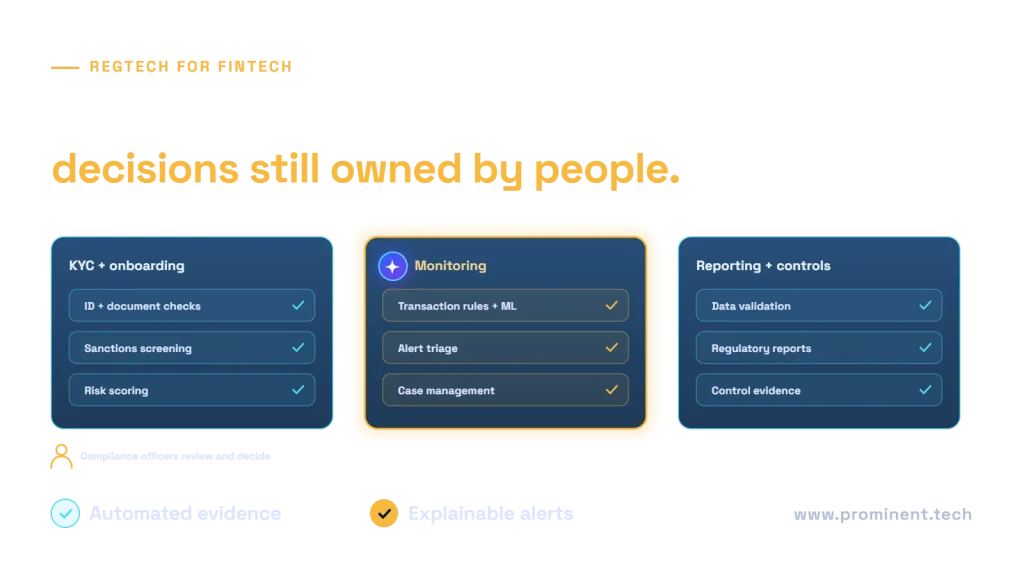
RegTech (regulatory technology) is software that automates compliance work for financial firms: customer onboarding and KYC checks, sanctions and PEP screening, transaction monitoring for money laundering and fraud, regulatory reporting, and the collection of evidence that controls are working. For FinTechs, RegTech makes it possible to scale customer numbers without scaling compliance headcount at the same rate, while giving regulators clearer evidence. It does not transfer responsibility: the firm remains accountable, so RegTech should produce explainable results, keep humans in charge of decisions and leave a complete audit trail.
Key takeaways
- RegTech covers onboarding, monitoring, reporting and control evidence.
- Buy proven components for commodity checks; build where your risks are specific.
- Data quality and integration usually decide whether RegTech works.
- AI helps triage and summarize, but decisions and accountability stay with people.
- Design for explainability and audit from the start.
Where RegTech helps FinTech compliance
| Area | What gets automated | What stays human |
|---|---|---|
| KYC and onboarding | Document and identity verification, business registry checks, risk scoring | Enhanced due diligence decisions |
| Screening | Sanctions, PEP and adverse media screening, ongoing rescreening | Reviewing potential matches |
| Transaction monitoring | Rules and models, alert generation and prioritization | Investigation and reporting decisions |
| Fraud prevention | Real-time scoring and rules | Reviewing held transactions |
| Regulatory reporting | Data collection, validation, report generation | Sign-off and submission |
| Controls and evidence | Automated control tests, evidence capture, dashboards | Interpreting and remediating gaps |
| Regulatory change | Tracking and summarizing new rules | Impact assessment and policy updates |
Deep dives: AI in AML transaction monitoring and AI fraud detection for payments.
A RegTech architecture for FinTechs
A shared customer and transaction data layer feeds onboarding, screening, monitoring and reporting services. Each produces cases for a single case management tool, and every decision is recorded. Integration with providers uses the patterns in FinTech APIs explained, and data governance follows data governance automation practices.
The role of AI in RegTech
- Alert triage: prioritize alerts so investigators see the riskiest first.
- Case summaries: draft narratives from transaction and customer data for review; see LLMs in financial services.
- Document extraction: read onboarding documents and corporate filings; see intelligent document processing.
- Regulatory change: summarize new publications and map them to policies.
- Agents: prepare KYC refreshes and evidence packs under human approval; see agentic AI in finance.
Models used in compliance need validation, monitoring and documentation; see ML governance and model risk management.
Build, buy or integrate?
Most FinTechs buy specialist components for identity verification and screening data, and build the orchestration, data layer, case workflows and any product-specific monitoring logic. This keeps commodity checks reliable while preserving control over risk logic and data.
Implementation roadmap
- Map obligations, risks and current manual effort by process.
- Build the customer and transaction data foundation.
- Automate onboarding and screening with case management.
- Add transaction monitoring with tuned rules, then models.
- Automate reporting and control evidence.
- Introduce AI-assisted triage and summaries with human review.
International standards such as the FATF recommendations shape AML expectations, and regulators such as the UK FCA publish their own work on RegTech. This article is technical guidance, not legal or regulatory advice.
Common questions
What is RegTech?
Regulatory technology: software that automates compliance tasks such as KYC, screening, transaction monitoring, regulatory reporting and control evidence.
How does RegTech help FinTechs?
It lets them onboard and monitor more customers without proportional growth in compliance staff, with more consistent results and better audit evidence.
Does using RegTech make a firm compliant?
No. It supports compliance, but the firm remains responsible for its policies, configuration, decisions and oversight.
Can AI make compliance decisions?
AI can prioritize, extract and summarize, but decisions such as filing a suspicious activity report or rejecting a customer should stay with trained people.
Should a FinTech build or buy RegTech?
Usually both: buy specialist checks and data, and build the orchestration, data layer and product-specific logic.
Scale compliance with RegTech
We build RegTech data platforms, case workflows and AI-assisted triage for financial services and FinTech companies through our software development services.