
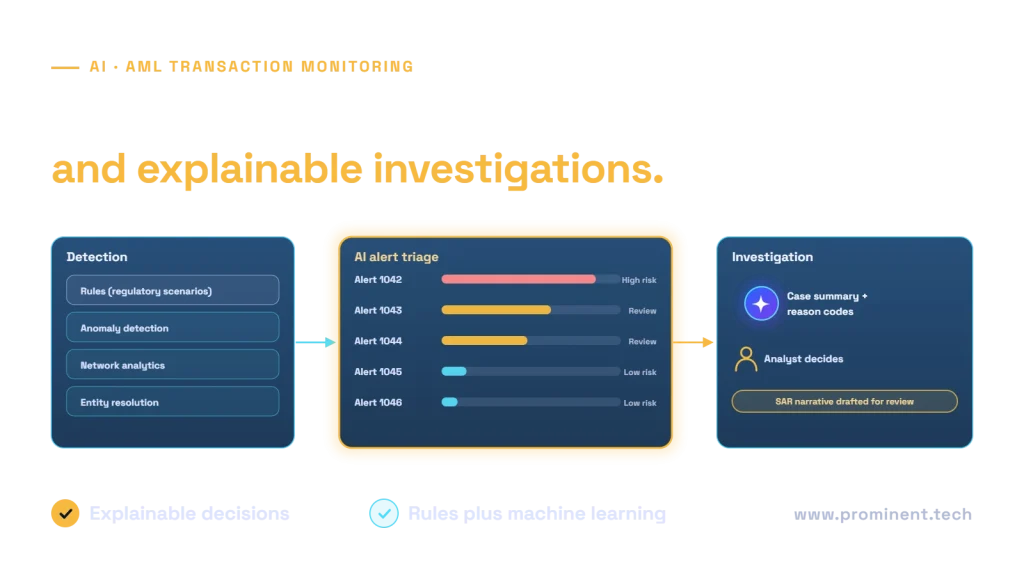
AI improves anti-money laundering (AML) transaction monitoring by adding machine learning, anomaly detection and network analytics to traditional rules, so suspicious activity is found more reliably and the large volume of false-positive alerts is prioritised or reduced. In practice, banks and payment firms keep rules for required scenarios, use models to score and triage alerts, uncover hidden networks through entity resolution and graph analysis, and use language models to summarise cases and draft suspicious activity report narratives for investigators to review. Because regulators expect decisions to be explainable and models to be governed, every AI component needs clear reason codes, validation and human accountability.
Key takeaways
- Combine rules with AI; rules cover mandated scenarios, AI improves detection and prioritisation.
- Alert triage scoring is usually the fastest and safest first use of AI in AML.
- Network analytics finds patterns that transaction-by-transaction rules miss.
- Investigators make decisions; AI prepares evidence and drafts narratives.
- Model risk management and explainability are essential for regulatory acceptance.
Why rules-only AML monitoring struggles
Rules flag transactions that cross thresholds or match known patterns. They are transparent and required for many scenarios, but they generate many false positives, miss behaviour that stays just below thresholds, and cannot see links across customers and accounts. Investigators spend most of their time clearing alerts that turn out to be benign. Unlike real-time payment fraud scoring (see AI fraud detection for payments), AML monitoring looks at patterns over days and weeks and ends in regulatory reporting.
AI techniques for AML transaction monitoring
| Technique | What it adds |
|---|---|
| Alert triage scoring | Ranks rule-generated alerts by likelihood of being suspicious, so investigators start with the riskiest |
| Customer segmentation | Sets expectations per peer group so thresholds fit behaviour |
| Anomaly detection | Flags unusual behaviour that no rule describes |
| Entity resolution | Links records that refer to the same person or company |
| Network analytics | Reveals rings, mule networks and layering across accounts |
| Language models | Summarise cases and draft report narratives for review |
AML monitoring architecture with AI
Transaction, customer and KYC data flow into a governed data platform; see real-time intelligence in Microsoft Fabric. Rules and models run side by side, alerts are scored and enriched, and a case management system tracks investigation and reporting.
AI in investigations
Language models can gather and summarise transaction history, related parties and prior alerts, and draft a narrative. Investigators verify facts against source data and remain responsible for the decision and filing. For secure LLM use in financial institutions, see LLMs in financial services.
Explainability and model governance
- Provide reason codes for every model score that investigators and examiners can understand.
- Validate models independently and monitor them for drift, following principles such as the Federal Reserve’s SR 11-7 model risk guidance.
- Keep rules for scenarios regulators expect, and document how AI complements them.
- Test for unfair outcomes across customer groups.
- Follow local requirements, for example the UK FCA Financial Crime Guide and US FinCEN guidance.
See also ML governance and model risk management.
Metrics that matter
- False-positive rate and alerts per investigator.
- Alert-to-case and case-to-report conversion rates.
- Time to close alerts and cases.
- Detection of known typologies in back-testing.
- Model stability and drift indicators.
Common questions
How does AI help AML transaction monitoring?
It prioritises or reduces false-positive alerts, detects unusual behaviour and hidden networks that rules miss, and helps investigators by summarising cases and drafting narratives.
Can AI replace AML rules?
Not entirely. Rules remain important for required scenarios and transparency; AI complements them for detection and prioritisation.
Will regulators accept AI in AML?
Regulators generally support responsible innovation, but expect explainability, validation, governance and human accountability for decisions.
Can AI write suspicious activity reports?
It can draft narratives from case data, but investigators must verify, edit and approve them before filing.
Where should a bank start with AI in AML?
Usually with alert triage scoring on existing rule alerts, which improves efficiency without changing what is detected.
Bring AI into your AML monitoring responsibly
Share your monitoring setup and alert volumes. Our machine learning and data engineering teams will design explainable triage, analytics and investigation support that fits your compliance framework.