Admissions
Admissions document tracking
Applications and supporting records arrive through separate channels.
- 1Receive application
- 2Check completeness
- 3Admissions review
Practical output
A tracked admissions queue with missing-document flags.
More time for teaching. Clearer insight into every learner.
Build learning platforms, AI study support and academic analytics around your curriculum, systems and educators.
Solutions for organizations and teams working across schools, higher education and learning.
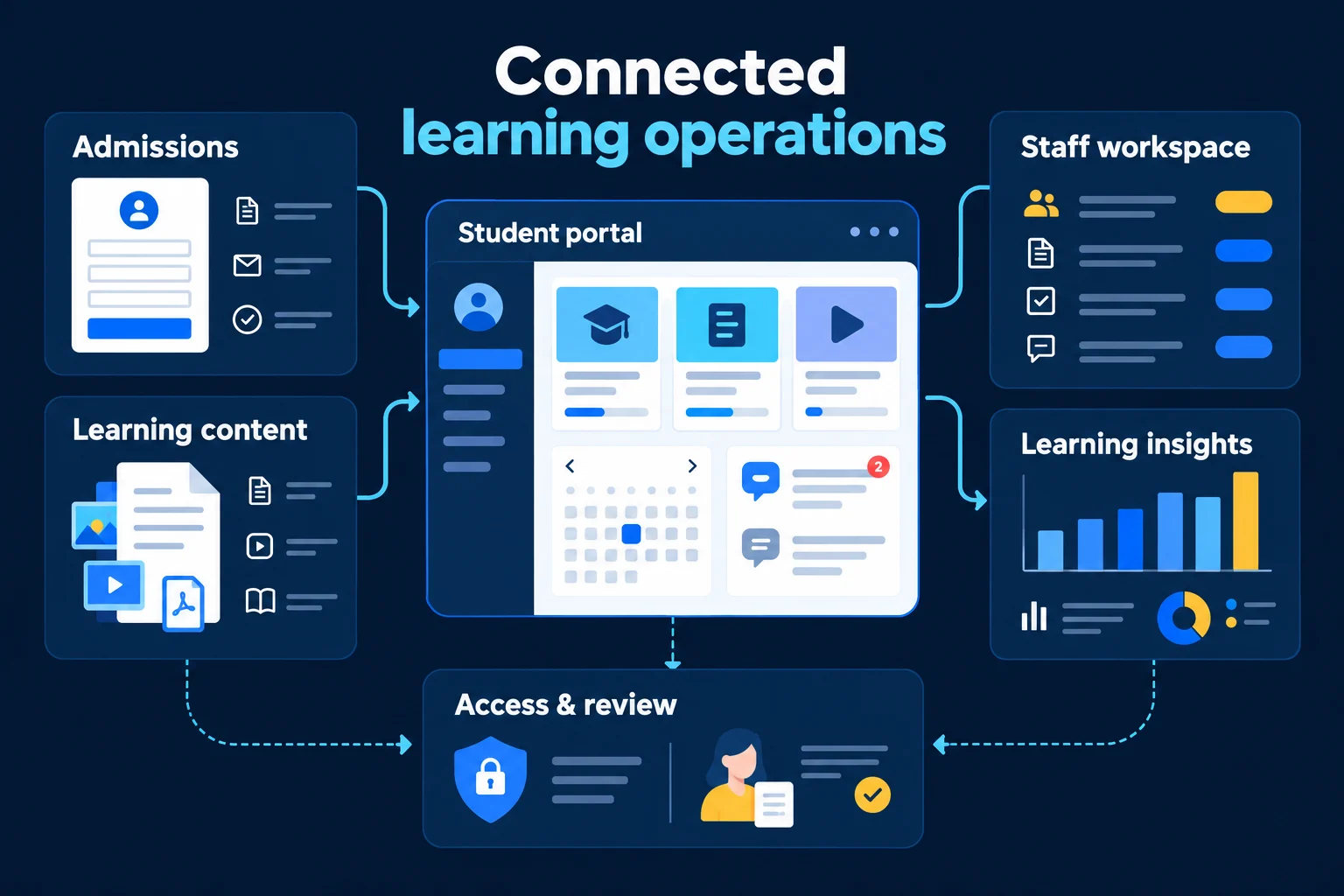
Connect learning, assessment and student-support information for staff and learners.
Explore relevant solutionsBuild scalable learning products with useful AI features and integrations.
Explore relevant solutionsDeliver courses, track progress and report outcomes for learners and clients.
Explore relevant solutionsCreate, tag and update learning content and assessments more efficiently.
Explore relevant solutionsBusiness challenges
Learners progress at different speeds, but educators have limited time for individual support.
Marking, feedback and administration take time away from teaching.
Signs that a learner is struggling are often noticed too late to help.
What we deliver
Illustrative solution areas; scope, applicability and acceptance criteria are validated during discovery.
Recommend practice and content based on each learner’s progress and agreed curriculum rules.
Typical inputs: Course structure, learning objectives and progress data.
WHAT YOU RECEIVE Adaptive learning paths with educator controls.
Assistants that explain concepts and answer questions from approved course material.
Typical inputs: Approved course content, guardrails and escalation rules.
WHAT YOU RECEIVE A course-grounded assistant with source references.
Draft marks and feedback against agreed rubrics for educators to review and approve.
Typical inputs: Rubrics, sample marked work and assessment formats.
WHAT YOU RECEIVE Reviewable feedback drafts and moderation records.
Bring attendance, engagement and attainment into one view to spot learners who need support.
Typical inputs: Learning platform, attendance and assessment records.
WHAT YOU RECEIVE Dashboards with agreed indicators and refresh rules.
Help teams draft quizzes, summaries and course material from approved sources.
Typical inputs: Curriculum documents, style guides and existing content.
WHAT YOU RECEIVE Draft content for author review and publishing.
Scalable web platforms, LMS integrations and student or staff portals.
Typical inputs: Existing LMS, identity and student-information interfaces.
WHAT YOU RECEIVE A connected platform with documented integrations.
Practical applications
Explore department-specific workflows, from the business problem to a practical output your team can review.
Admissions
Applications and supporting records arrive through separate channels.
A tracked admissions queue with missing-document flags.
Student services
Student requests lack clear ownership across campus teams.
A shared service queue with response and escalation history.
Academic administration
Room, instructor and course changes require repeated manual updates.
Reviewed schedules and visible change notifications.
Institutional reporting
Attendance, enrolment and service data sit in disconnected reports.
Traceable operational dashboards without automated student eligibility decisions.
Product engineering
Learning tools do not exchange course and user information consistently.
Documented integrations between approved learning systems.
Learning support
Repeated navigation questions compete with complex learner requests.
Source-linked learning support with human escalation.
Content operations
Draft learning materials move between authors without visible version control.
Versioned course materials and a clear review history.
Platform operations
Product teams lack a shared view of application incidents.
Service dashboards and accountable incident queues.
Programme administration
Enrolments, session dates and facilitator updates are scattered.
A shared cohort workspace with participant communications.
Learning delivery
Completion information is difficult to reconcile across learning tools.
Reviewed completion reports and follow-up task lists.
Assessment operations
Submitted work and assessor feedback are difficult to track.
Assessment queues with feedback history and human grading decisions.
Employer partnerships
Employers request progress updates through spreadsheets and email.
Role-based employer portals and agreed progress reporting.
Editorial
Manuscripts and corrections move between teams without clear status.
Versioned editorial queues and publication-ready packages.
Digital production
Teaching assets are difficult to find because metadata is inconsistent.
A searchable asset catalogue with reviewed metadata.
Rights administration
Usage permissions and expiry dates are scattered across contracts.
A traceable rights register and renewal reminders.
Distribution operations
Publishers cannot easily reconcile deliveries across channels.
Distribution dashboards with accountable exception handling.
Illustrative applications, not completed client projects. Scope, permitted data use and acceptance criteria are agreed during discovery; specialist decisions remain with authorized teams.
Designed for your environment
Controls and deployment choices are scoped to your institution and intended use.
Role-based access for staff, learners and guardians, with agreed handling of learner information.
Source references, educator review and explicit approval of AI-generated marks or content.
Hosting, retention, monitoring and LMS integration requirements agreed with your team.
AI suggestions support educators and learners; assessment decisions and safeguarding remain with qualified staff. Age-appropriate use, accessibility and data-protection requirements are agreed during discovery. No regulatory certification or blanket compliance is implied.
Operational controls: Role-based access · Audit logging · Monitoring · Agreed retention.
Delivery approach
A collaborative delivery approach with concrete outputs.
Understand the workflow, users, systems, constraints and acceptance criteria.
YOU RECEIVE Agreed project scopeDefine interfaces, permissions and a prototype for the key user journey.
YOU RECEIVE Solution prototypeImplement, test and validate the agreed workflow with your team.
YOU RECEIVE Tested working incrementDeploy with handover, monitoring and the agreed improvement plan.
YOU RECEIVE Deployment & handoverExplore further
End-to-end services to support the agreed roadmap.
Common questions
Answers about starting an education or EdTech software, data or AI project.
We begin with your current LMS, student-information system, approved APIs or exports and access rules. Integration scope depends on those interfaces and the permissions available.
No, not by default. AI prepares draft marks and feedback against your rubric; educators review, adjust and approve the final result.
Discovery identifies the information needed, its sensitivity, access roles, hosting and retention. Your team agrees the controls, including any requirements for younger learners, before implementation.
Yes. One course, one assessment workflow or a learning-analytics dashboard can be an initial project with agreed test data and success criteria.
Ownership, licensing, source-code handover and support arrangements are set out in the engagement agreement. Deployment documentation, training and ongoing maintenance can be scoped around your team’s needs.
Let’s plan your next step
Tell us about your learners, systems and priorities.