
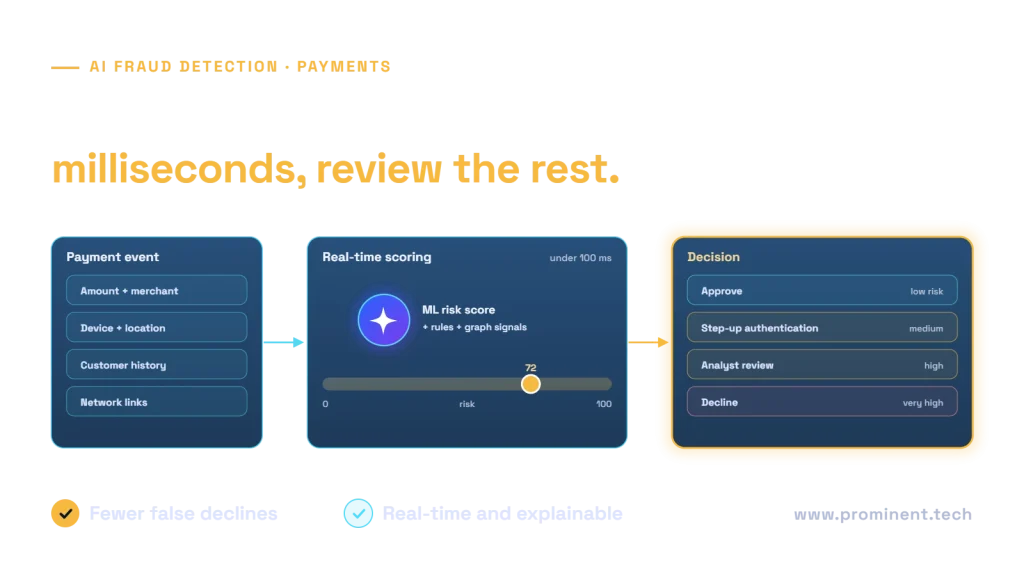
AI fraud detection for payment companies scores every transaction in real time, typically within 100 milliseconds, by combining machine learning risk models with rules, device and behavioural signals and network analysis, then routes each payment to approve, step-up authentication, analyst review or decline. The goal is not just to catch more fraud but to do so with fewer false declines, which cost revenue and customers. A production system also needs a feature store, a case management loop that feeds confirmed outcomes back into training, drift monitoring, explainable decisions and controls that satisfy payment-industry and model risk requirements.
Key takeaways
- Combine machine learning with rules and network signals; each catches fraud the others miss.
- Design for a strict latency budget so scoring never delays good customers.
- Measure false declines and approval rates alongside fraud losses.
- Close the loop: analyst decisions and chargebacks become training labels.
- Fraudsters adapt, so monitor drift and retrain on a regular schedule.
Real-time AI fraud detection architecture for payments
Each payment event is enriched with features, scored by models and rules, and sent to a decision engine that returns an action to the payment flow. Every decision and its reasons are logged. Cases needing review go to an analyst queue, and confirmed outcomes, including chargebacks that arrive weeks later, flow back as labels for retraining. Streaming platforms make the enrichment and feedback possible at scale; see streaming ETL vs batch ETL and real-time intelligence in Microsoft Fabric.
Fraud detection signals and features
| Signal group | Example features |
|---|---|
| Transaction | Amount, currency, merchant category, time of day |
| Velocity | Number and value of payments in the last minute, hour and day per card, account and device |
| Customer behaviour | Deviation from usual merchants, amounts, locations and times |
| Device and session | Device fingerprint, IP risk, typing and navigation patterns, new device |
| Network | Shared devices, cards, addresses or accounts linking to known fraud |
| Merchant | Merchant risk history, refund and chargeback rates |
A feature store keeps these values consistent between training and real-time scoring and precomputes velocity aggregates so lookups stay fast.
Models and techniques
- Gradient-boosted trees are the workhorse for tabular transaction data: accurate, fast and explainable with feature attribution.
- Anomaly detection flags unusual behaviour for new customers or new fraud patterns without labels.
- Graph analytics uncovers fraud rings by linking cards, devices, accounts and addresses.
- Sequence models capture patterns across a customer’s recent transactions.
- Rules encode known patterns, regulatory requirements and immediate responses to new attacks while models retrain.
Fraud is rare, so training must handle class imbalance and labels that arrive late. Evaluate on time-based splits to mimic real deployment. For broader ML budgeting, see machine learning development cost.
Decision strategy and analyst review
Thresholds turn scores into actions. Set them by comparing the cost of fraud losses with the cost of false declines and step-up friction for each segment, and revisit them as fraud patterns change. In the EU, strong customer authentication rules under PSD2 make risk-based step-up a natural part of this strategy. Analysts need a case view that shows the score, the main reasons and linked entities, so decisions are fast and consistent.
Metrics that matter for payment fraud detection
| Metric | Why it matters |
|---|---|
| Fraud loss rate | Value of fraud as a share of payment volume |
| False decline rate | Good customers turned away; often costs more than fraud |
| Approval rate | Revenue and customer experience |
| Precision and recall at the chosen threshold | Model quality where decisions are actually made |
| Review rate and analyst time per case | Operational cost of the system |
| Scoring latency (p99) | Impact on checkout and authorisation times |
| Drift indicators | Early warning that fraud patterns have changed |
Compliance and model governance
- Payment data security. Cardholder data in the pipeline must meet PCI DSS; tokenise card numbers before they reach analytics.
- Model risk management. Banks and many payment firms follow principles such as the US Federal Reserve’s SR 11-7 guidance: documented development, independent validation and ongoing monitoring.
- Explainability. Keep the reasons for each decision so analysts and customers can be given clear explanations.
- Fairness. Test for unintended bias across customer groups.
- Data protection. Use personal data lawfully and minimise retention, for example under GDPR in Europe.
Unlike insurance claims fraud, which can be investigated over days (see AI in insurance claims processing), payment fraud decisions must be made in milliseconds, which shapes every part of this design.
Common questions
How does AI detect payment fraud?
It scores each transaction in real time using machine learning models trained on past fraud, combined with rules, device and behavioural signals and network analysis, then decides whether to approve, challenge, review or decline.
How fast must payment fraud detection be?
Typically within tens of milliseconds to around 100 milliseconds, so the authorisation flow and checkout are not delayed.
Does AI replace fraud rules?
No. Models and rules work together: models find complex patterns, while rules enforce known patterns, regulatory requirements and quick responses to new attacks.
How do we reduce false declines?
Use richer behavioural and device signals, segment-specific thresholds, step-up authentication instead of declines for medium risk, and measure false declines as a core metric.
How often should fraud models be retrained?
Regularly, often monthly or faster, and whenever drift monitoring shows fraud patterns have changed. Confirmed analyst decisions and chargebacks provide the new labels.
Build real-time fraud detection for your payments
Share your payment flows, data sources and current fraud and decline rates. Our custom machine learning and data engineering teams will design the scoring architecture, features and review loop for your risk appetite.