
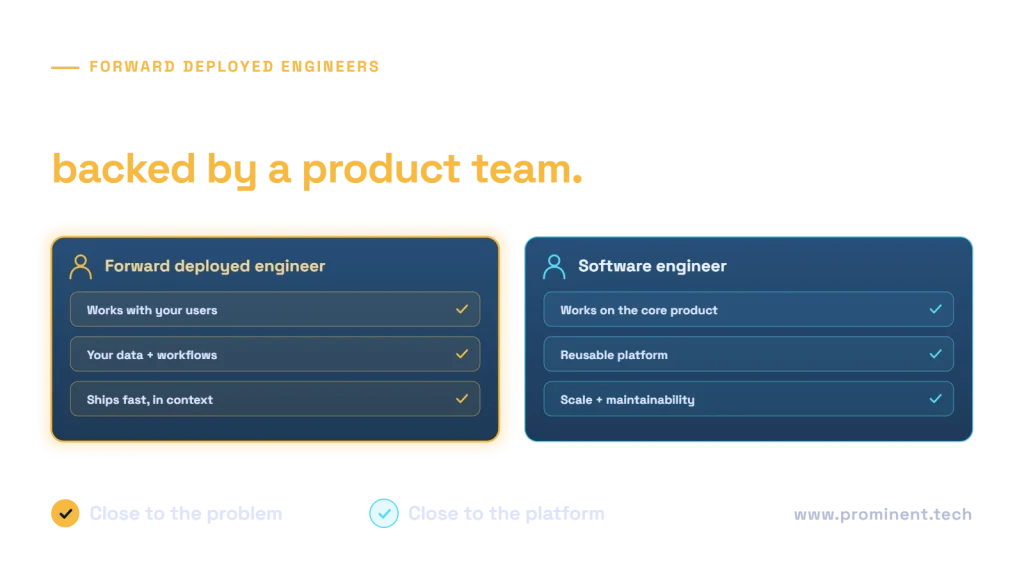
A forward deployed engineer (FDE) is a software engineer who works embedded with a customer or business unit, close to its users, data and workflows, to configure, extend and build solutions that deliver an outcome in that specific setting. A traditional software engineer works within a product or platform team, building reusable capabilities for many users. For AI projects the forward deployed model has become popular because most of the difficulty lies in the customer’s own data, processes and adoption, not in the model. The two roles are complementary: forward deployed engineers find what works in the field, and product engineers turn the repeatable parts into a maintainable platform.
Key takeaways
- FDEs optimize for a specific customer outcome; product engineers optimize for reuse.
- AI projects benefit from FDEs because data and workflow context decide success.
- Without a path back to a shared platform, forward deployed work becomes one-off code.
- The model costs more per engineer but can shorten time to value.
- You can get the benefits through your own embedded team or a delivery partner.
Forward deployed engineer vs software engineer
| Aspect | Forward deployed engineer | Software engineer (product team) |
|---|---|---|
| Works with | Customer users, operations and data owners | Product managers, designers, other engineers |
| Goal | A working outcome for this customer or unit | Features and platforms for many users |
| Typical work | Integration, data pipelines, configuration, custom workflows, prototypes to production | Core services, APIs, reliability, scalability |
| Skills emphasis | Breadth, problem discovery, communication, speed | Depth, design for reuse, long-term quality |
| Feedback loop | Days, directly from users | Release cycles and product metrics |
| Main risk | One-off solutions that are hard to maintain | Distance from real user problems |
The role is related to, but different from, solutions engineers, who focus on pre-sales, and consultants, who typically advise rather than write production code.
Why the forward deployed model suits AI projects
- Context is the hard part: useful AI depends on the organization’s data, permissions, exceptions and unwritten rules.
- Evaluation needs users: only domain experts can say whether outputs are right; see how to test LLM applications.
- Integration dominates: connecting agents and models to real systems is most of the work; see the AI agent readiness checklist.
- Adoption is iterative: workflows change as people learn what the AI can do.
- AI coding tools amplify small teams: an embedded engineer with good specifications can deliver more; see spec-driven development with AI coding agents.
How the operating model works
Forward deployed engineers build on a shared platform, solve the customer-specific problem, and report what was hard or repeated. Product engineers generalize those patterns into the platform, which makes the next deployment faster. The loop matters more than either role alone.
When to use which
- Use forward deployed engineers for a first AI use case in a complex process, where requirements are unclear and close work with users is essential.
- Use a product engineering team for well-understood features that many users need in the same way.
- Use both when rolling AI out across several business units: embedded engineers per unit, with a platform team behind them.
The engagement choice overlaps with staff augmentation vs managed services: forward deployed engineers are embedded like augmented staff but are accountable for an outcome.
Risks and safeguards
| Risk | Safeguard |
|---|---|
| One-off code nobody maintains | Shared platform, code review, a path to generalize |
| Dependence on individuals | Documentation, pairing, handover to your team |
| Security shortcuts in the field | Standard access, secrets and review controls from day one |
| Scope creep | Agreed outcome, metric and time box |
| Higher cost per engineer | Measure time to value and reuse, not hourly rate |
Start with a short discovery so the outcome and metric are clear; see the software product discovery guide and the AI development timeline.
Common questions
What is a forward deployed engineer?
A software engineer embedded with a customer or business unit who builds and adapts solutions in that specific context to deliver an outcome.
How is an FDE different from a software engineer?
An FDE focuses on one customer’s outcome and works directly with its users and data; a product software engineer builds reusable capabilities for many users.
Why are forward deployed engineers used for AI?
Because AI success depends on the customer’s own data, workflows and user feedback, which embedded engineers can work with directly.
Is a forward deployed engineer a consultant?
Not exactly. FDEs write and ship production code and stay accountable for the result, rather than only advising.
Do we need to hire FDEs ourselves?
Not necessarily. A delivery partner can provide embedded engineers backed by its own platform and practices, with handover to your team.
Embed AI engineers in your team
You can hire AI developers who work embedded with your teams and are backed by our AI and ML development practice.