Disconnected systems
Teams re-enter information across applications and spreadsheets. Connect agreed records with clear ownership and exception handling.
Connected operational data
Built around your workflows. Connected to your systems.
Explore practical software, data and AI applications across 16 industries—from healthcare and finance to manufacturing, logistics and technology.
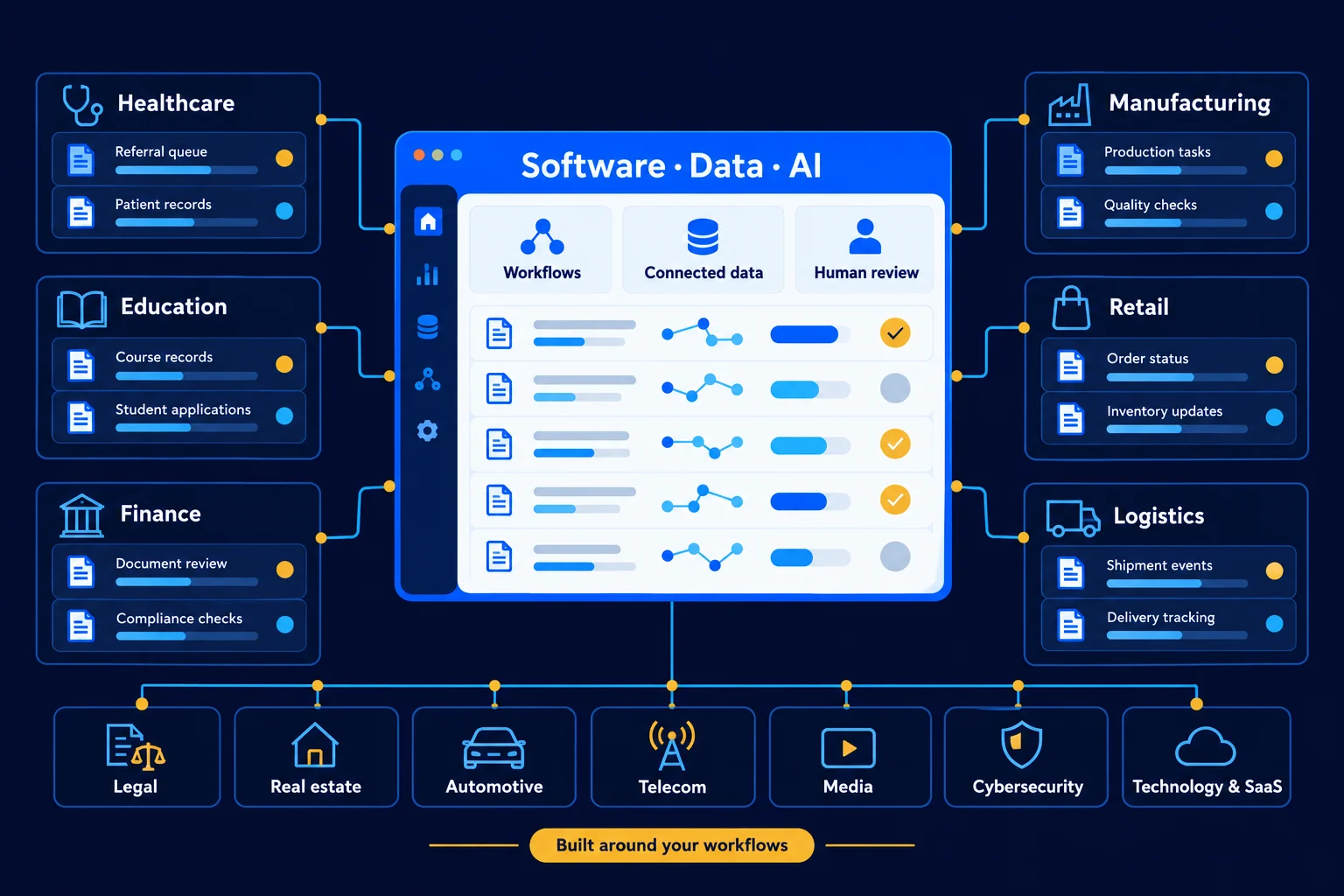
Industries we serve
Find relevant applications for your teams, business systems and operating environment.
Connect patient access, referrals and research information across approved systems.
Referral queues, staff portals and healthcare reporting.
Support admissions, learner services and educational content workflows.
Student portals, learning analytics and reviewed content assistance.
Bring research records, quality evidence and operational information into connected workspaces.
Research metadata, quality evidence and study operations.
Connect engineering, quality, product and service records across the device lifecycle.
Device context, quality review and field-service workspaces.
Bring customer documents, servicing tasks and operational reporting into connected workflows.
Onboarding, document review and reporting tools.
Organize matter information, contract review and permission-aware legal knowledge.
Matter workspaces and source-linked document search.
Connect property listings, tenant requests and portfolio information.
Property portals, request tracking and portfolio dashboards.
Build recruitment portals, onboarding workflows and HR reporting around your existing systems.
Recruitment coordination, onboarding and reviewed HR knowledge.
Connect orders, inventory and customer information across sales channels.
Commerce integrations, stock visibility and customer-service tools.
Bring production, maintenance and quality information into usable operational views.
Production dashboards and reviewed inspection workflows.
Support dealership, vehicle-service and fleet information workflows.
Service portals, fleet reporting and inspection review queues.
Connect shipment events, warehouse records and transport planning information.
Tracking portals, warehouse dashboards and exception queues.
Add useful AI, analytics and integrations to existing products and tenant models.
Product features, knowledge assistants and tenant-aware reporting.
Bring security events and investigation context together for analyst review.
Alert triage queues and traceable investigation workspaces.
Connect network, service and customer information across operating teams.
Service dashboards, network reporting and support workflows.
Coordinate content operations, media assets and audience reporting.
Editorial workspaces, asset search and audience dashboards.
Healthcare and education industries shown.
Illustrative applications, not completed client projects. Each industry page includes examples by organization type and department.
Business challenges
Industry context shapes the solution. Your users, data and acceptance criteria define the scope.
Teams re-enter information across applications and spreadsheets. Connect agreed records with clear ownership and exception handling.
Connected operational dataRequests and documents wait in inboxes. Route them through shared queues with an accountable reviewer.
Visible work and review queuesReports use inconsistent definitions. Build dashboards around agreed sources, measures and refresh rules.
Decision-ready reportingA promising model needs usable inputs, evaluation and a defined place in the workflow. Start with a bounded task.
An evaluated, reviewable use caseDelivery approach
Review concrete decisions and outputs at each stage.
Map the current workflow, responsible teams and source systems.
Workflow and requirements summary
Compare candidate applications by usefulness, data readiness and delivery dependencies.
A bounded first use case
Prototype the key journey and agree how your team will assess the result.
Prototype and acceptance criteria
Build, test and integrate the agreed solution, then review its use after handover.
Working solution and support plan
Explore further
Combine the capabilities your use case needs.
Build portals and applications around your teams and users.
Connect permitted applications and business records.
Prepare reliable data for reporting and AI applications.
Evaluate models and AI features for a defined business task.
Plan deployment, monitoring and repeatable releases.
Improve existing applications in manageable phases.
Maintain agreed applications and deliver useful improvements.
Add specialist engineering capacity to your delivery team.
Common questions
Practical answers about choosing a use case, integrating systems and planning delivery.
They are applications, integrations, analytics or AI features designed around a sector’s workflows and the people who use them. The starting point is a defined business task, such as referral coordination, inventory visibility or document review—not a technology chosen in isolation.
Explore the 16 industry pages above for illustrative applications across healthcare, education and EdTech, pharmaceuticals and biotechnology, medical devices and MedTech, financial services, HR and recruitment, legal, property, retail, manufacturing, automotive, logistics, SaaS, cybersecurity, telecom and media. For another sector, share your workflow so we can assess the fit and any domain expertise needed.
Integration starts with a review of the available APIs, data exports, permissions and ownership. We agree the records to exchange, mapping rules and exception handling before building the connection.
Choose a recurring task with a clear owner, accessible inputs and an outcome your team can assess. Discovery compares the value of improving that task with data readiness, delivery effort and integration dependencies.
Where AI is appropriate, we define who reviews its outputs, what information the reviewer sees and when work should be escalated. Specialist, clinical, legal or other consequential decisions remain with authorized people and require appropriate validation.
An estimate depends on the workflow, data readiness, integrations and acceptance criteria. A defined first phase can resolve uncertainties before a wider build. Handover, monitoring and support responsibilities are agreed in the engagement scope.
Let’s plan your next step
Tell us about your goals, current systems and priorities. We’ll help you define a practical scope and the next step.