
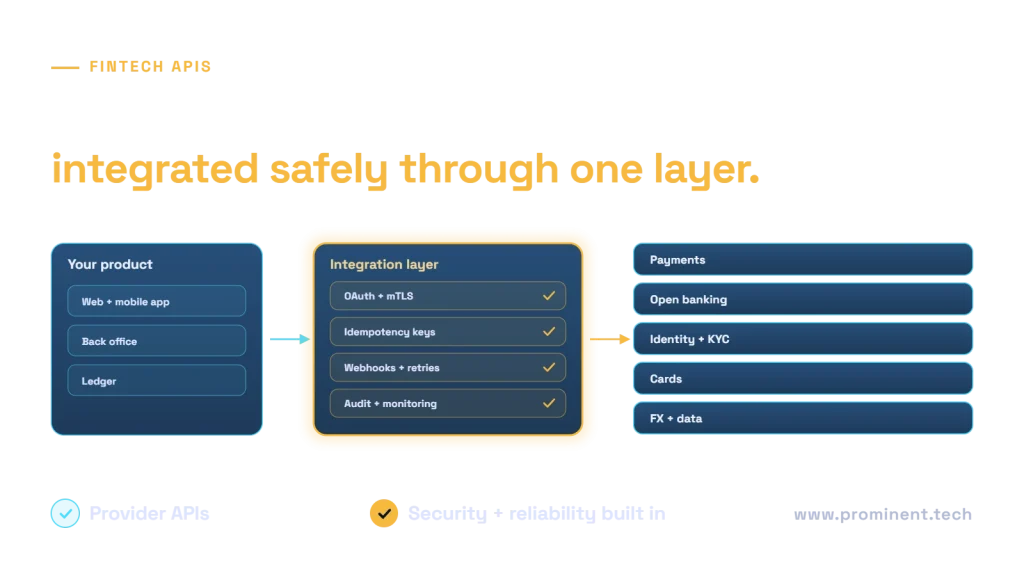
FinTech APIs are the interfaces financial products use to move money and data: payment APIs to accept and send payments, open banking APIs to access account data and initiate payments with customer consent, identity and KYC APIs to verify customers, card issuing and processing APIs, and financial data APIs for FX rates, market data and credit information. Integrating them well requires strong authentication (OAuth 2.0, often with mutual TLS), idempotent requests so payments are never duplicated, reliable webhook handling, reconciliation against your ledger, and monitoring. Most teams build a dedicated integration layer so providers can be added or replaced without changing the product.
Key takeaways
- There are five main families of FinTech APIs, each with its own regulation and risk.
- Idempotency, webhooks and reconciliation matter as much as the API calls.
- Open banking APIs follow regional standards and require customer consent.
- An integration layer reduces lock-in and simplifies adding providers.
- Security reviews, sandbox testing and failure handling come before launch.
Types of FinTech APIs
| API type | What it does | Typical use cases | Key considerations |
|---|---|---|---|
| Payments | Accept cards and local payment methods, payouts, refunds | Checkout, subscriptions, marketplaces | PCI DSS scope, idempotency, webhooks |
| Open banking | Account information and payment initiation with consent | Account aggregation, affordability checks, pay by bank | Regional standards, consent lifecycle |
| Identity and KYC | Document checks, biometrics, sanctions and PEP screening | Onboarding, periodic review | Data protection, audit evidence |
| Cards | Issue virtual and physical cards, controls, authorizations | Expense cards, embedded finance | Real-time authorization latency |
| Financial data | FX rates, market data, credit and business data | Pricing, risk, reporting | Licensing, freshness, rate limits |
Payment messages increasingly use the ISO 20022 standard, which carries richer structured data.
Integration architecture
An integration layer wraps each provider behind your own internal API, handles authentication, retries, idempotency and webhooks, and records every request and response for audit. Your product talks to that layer, not directly to providers. This makes it possible to route between providers, add a backup provider or switch without rewriting the product. See API integration architecture patterns and REST vs GraphQL vs gRPC.
Security essentials
- Authentication: OAuth 2.0 client credentials or authorization code flows, often with mutual TLS and signed requests; see OAuth 2.0 vs OpenID Connect vs SAML. Open banking ecosystems often use the FAPI security profile.
- Secrets: keys and certificates in a managed vault with rotation.
- Webhook verification: verify signatures and timestamps on every incoming event.
- Data minimization: request and store only the data you need; tokenize card data to reduce PCI DSS scope.
- Least privilege: separate credentials per environment and service.
Reliability: idempotency, webhooks and reconciliation
- Idempotency keys on every money-moving request, so retries never create duplicate payments; see idempotency in distributed systems.
- Webhooks processed asynchronously, deduplicated and retried; see webhook vs polling vs event streaming.
- Rate limits and backoff respected; see API rate limiting and backoff.
- Daily reconciliation of provider reports against your ledger, with breaks investigated.
- Versioning: track provider API versions and deprecations; see API versioning best practices.
Selecting API providers
- Coverage of your markets, currencies and payment methods.
- Regulatory status and the licences you can rely on.
- Documentation quality, sandbox realism and SDKs.
- Reliability record, status reporting and support.
- Pricing model, contract terms and exit options.
In the UK, the Open Banking Standards define the API specifications banks provide; in the EU, open banking is based on the Payment Services Directive (PSD2). This article is technical guidance, not legal or regulatory advice. For infrastructure choices, see choosing a cloud provider for FinTech.
Common questions
What are FinTech APIs?
Interfaces that let financial products process payments, access bank account data with consent, verify identity, issue cards and obtain financial data.
What is the difference between payment APIs and open banking APIs?
Payment APIs come from payment providers to accept and send payments; open banking APIs come from banks, under regulation, to share account data or initiate payments with the customer’s consent.
How do you prevent duplicate payments through APIs?
Send an idempotency key with every payment request, store results, and reconcile against the provider’s records daily.
Should we integrate providers directly or build an integration layer?
For more than one provider or a growing product, an integration layer reduces lock-in and centralizes security, retries and audit.
How long does a FinTech API integration take?
A single, well-documented provider can take a few weeks; multiple providers with reconciliation, compliance reviews and failover take longer.
Integrate FinTech APIs reliably
Our API and system integration team builds secure, idempotent integration layers for financial services products.