
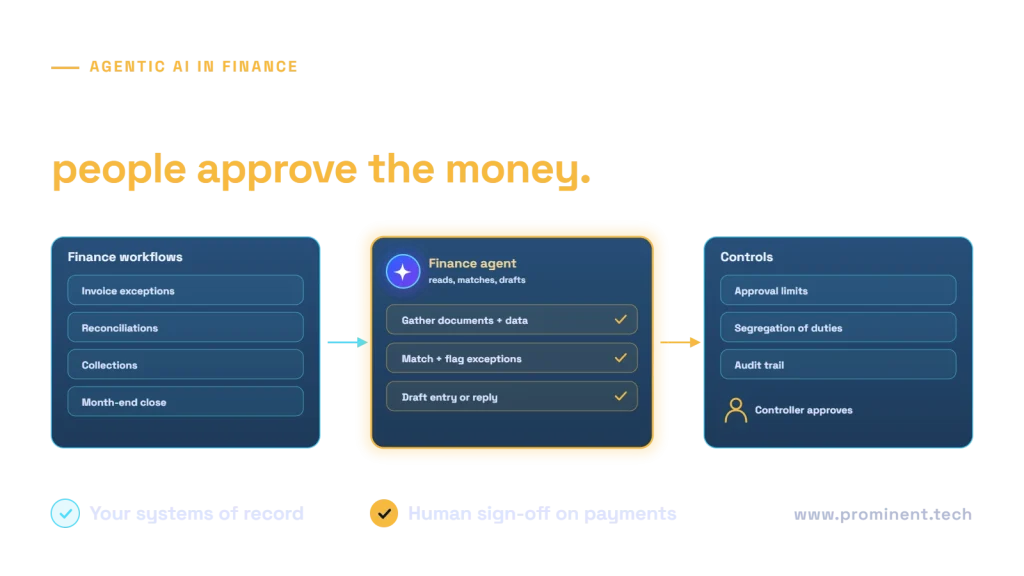
Agentic AI in finance means AI agents that carry out multi-step finance and banking workflows, such as gathering documents, matching transactions, investigating exceptions and drafting entries or replies, by using your systems’ tools under defined permissions. The strongest use cases today are invoice and payment exceptions, reconciliations, collections, month-end close support, KYC refresh, AML alert preparation, credit memo drafting, regulatory reporting preparation, customer servicing and treasury monitoring. In every case, the agent prepares and recommends while people approve anything that moves money, changes a customer’s position or goes to a regulator.
Key takeaways
- Agents are best at the investigation and preparation work around finance decisions.
- Payments, credit decisions and regulatory submissions should keep human approval.
- Approval limits, segregation of duties and audit trails apply to agents as to staff.
- Start with read-only, high-volume exception work where outcomes are easy to check.
- Measure cycle time, exception backlog and rework, not just automation rate.
How a finance agent works
A finance agent receives a task, such as an unmatched payment, and uses tools to read the ERP, bank feed, documents and email. It reasons about what it finds, proposes an action with its evidence, and routes it to the right approver. Everything it reads and does is logged. For the general design, see human-in-the-loop agents.
10 agentic AI use cases in finance
| # | Use case | What the agent does | Who approves |
|---|---|---|---|
| 1 | Invoice and payment exceptions | Investigates price, quantity or PO mismatches and drafts a resolution | AP clerk or buyer |
| 2 | Bank and intercompany reconciliation | Matches items, explains breaks, proposes adjusting entries | Accountant |
| 3 | Collections | Prioritizes accounts, drafts reminders, logs promises to pay | Collections lead |
| 4 | Month-end close support | Runs checklists, prepares accrual and variance commentary | Controller |
| 5 | KYC refresh | Collects updated documents, checks registries, flags changes | KYC analyst |
| 6 | AML alert preparation | Gathers transaction history and context into a case summary | AML investigator |
| 7 | Credit memo drafting | Extracts financials and drafts the memo with sources | Credit officer |
| 8 | Regulatory reporting preparation | Collects data, runs validations, explains anomalies | Reporting manager |
| 9 | Customer servicing | Answers account queries, prepares disputes and changes for review | Service agent for exceptions |
| 10 | Treasury and cash monitoring | Watches balances and forecasts, flags shortfalls, drafts transfers | Treasurer |
Related deep dives: AI in AML transaction monitoring, AI fraud detection for payments and intelligent document processing.
Choosing the level of autonomy
Autonomy should match the risk and reversibility of each action. Reading and summarizing can be automatic; drafting a journal entry can be prepared for approval; releasing a payment should stay with an authorized person. Many teams allow automatic action only for low-value, reversible steps within strict limits, and expand slowly as accuracy is proven.
Controls finance teams expect
- Least privilege: agents use service identities with only the permissions each task needs; see AI agent security threats.
- Approval limits and segregation of duties: an agent never both prepares and approves the same transaction.
- Evidence: every recommendation cites the documents and records it used.
- Audit trail: inputs, tool calls, outputs and approvals are logged and retained.
- Prompt injection defences: treat invoices and emails as untrusted data; see the OWASP Top 10 for LLM applications.
- Model risk management: validate and monitor the agent like other models; see ML governance and model risk management.
The NIST AI Risk Management Framework provides a common vocabulary for these risks. This article is technical guidance, not legal or regulatory advice.
Where to start
- Pick one high-volume exception queue with clear rules and measurable backlog.
- Run the agent read-only, comparing its recommendations with what staff decide.
- Move to prepare-and-approve once agreement is consistently high.
- Track cycle time, backlog, rework and approver overrides.
- Extend to the next process using the same controls and tooling.
Check readiness with our AI agent readiness checklist, and see AI agent development cost for budgets.
Common questions
What is agentic AI in finance?
AI agents that perform multi-step finance tasks, such as investigating exceptions or preparing reconciliations, using system tools under defined permissions and human approvals.
Can AI agents approve payments?
They technically can, but most organizations should keep payment release with authorized people and limit agents to preparation and low-risk, reversible steps.
Which finance process is best to start with?
A high-volume exception queue, such as invoice mismatches or bank reconciliation breaks, where outcomes are easy to check.
How is agentic AI different from RPA in finance?
RPA follows fixed scripts; agents can read unstructured documents, reason about exceptions and choose tools, which is why they need stronger controls.
How do auditors view AI agents?
They expect the same evidence as for people: clear permissions, segregation of duties, logged actions and approvals. Discuss your design with your auditors early.
Build finance agents with controls built in
We design and build financial services agents and AI process automation integrated with your ERP and banking systems, with approvals and audit trails from day one.