
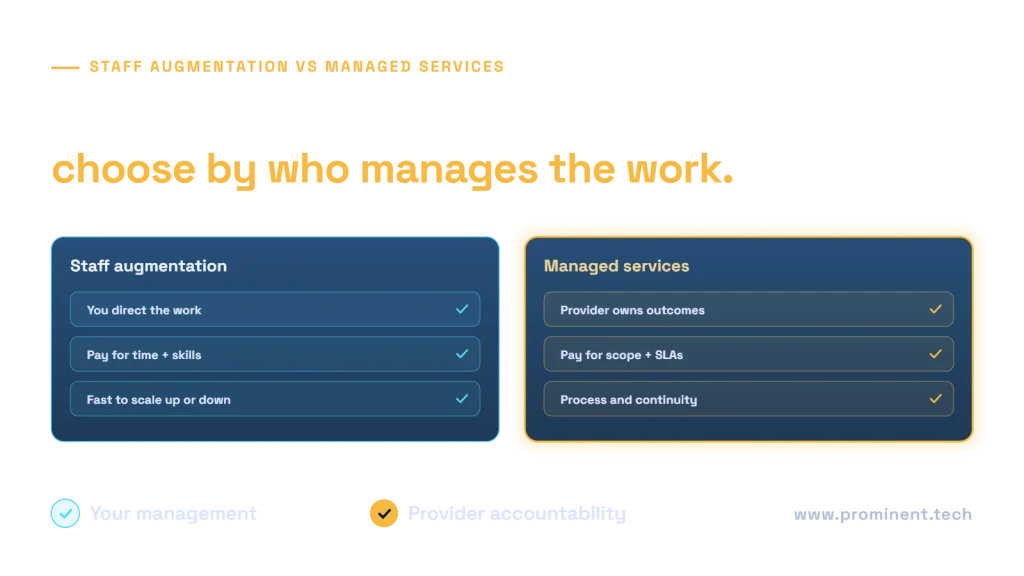
Staff augmentation adds external engineers to your team: you direct their daily work, they follow your processes, and you pay for their time. Managed services hand a defined scope, such as application support, a cloud platform or a delivery stream, to a provider who manages the people and process and is accountable for agreed outcomes and service levels. Choose staff augmentation when you have strong technical leadership and need skills or capacity quickly. Choose managed services when you want predictable outcomes, continuity and less management overhead for work that is well defined. Many companies use both: augmented engineers for product development and managed services for support and operations.
Key takeaways
- The core difference is who manages the work and who is accountable for results.
- Staff augmentation gives flexibility and control; it needs your management time.
- Managed services give predictability and continuity; they need clear scope and SLAs.
- Knowledge retention and documentation should be contractual in either model.
- Hybrid models are common and often the best fit.
Staff augmentation vs managed services compared
| Aspect | Staff augmentation | Managed services |
|---|---|---|
| What you buy | Skilled people and capacity | An outcome or service |
| Who manages daily work | You | The provider |
| Accountability for results | You | The provider, against SLAs |
| Pricing | Time and materials, monthly rates | Fixed monthly fee, per ticket or outcome-based |
| Flexibility | High: scale people up or down | Lower: change through scope changes |
| Speed to start | Fast | Needs transition and onboarding |
| Management overhead for you | Higher | Lower |
| Best for | Product development, skill gaps, peaks | Support, operations, stable defined work |
When each model fits
- Staff augmentation fits when requirements change often, you have product and technical leads to direct the work, and you need specific skills such as data engineering or AI quickly.
- Managed services fit when the work is repeatable and measurable, such as application maintenance, cloud operations or monitoring, and you want it to run without your daily involvement.
- A project or dedicated team fits when you want a provider to deliver a defined product with its own delivery management; see the software product discovery guide for how to scope one.
Cost and commercial models
Staff augmentation usually looks cheaper per hour, but you carry the cost of management, onboarding, tooling and the risk of low productivity. Managed services include management, process, cover for absence and service levels in the price. Compare total cost for the outcome you need, not rates alone. For managed services, define service levels carefully: response and resolution times, availability and quality measures. The Google SRE book’s chapter on service level objectives is a helpful reference for defining measurable targets.
Risks and how to manage them
| Model | Risk | Mitigation |
|---|---|---|
| Staff augmentation | Knowledge leaves with people | Documentation standards, pairing, handover periods |
| Staff augmentation | Management load on your leads | Limit ratio of external to internal staff, add a delivery lead |
| Staff augmentation | Uneven quality | Technical interviews, trial periods, code review |
| Managed services | Vague scope and disputes | Clear service catalogue, SLAs and change process |
| Managed services | Loss of internal knowledge | Shared documentation, runbooks, regular reviews |
| Managed services | Lock-in | Exit plan, your ownership of code, accounts and data |
Hybrid and dedicated team models
A common pattern is augmented engineers inside product teams, a managed service for support and cloud operations, and occasional fixed-scope projects. For AI work, embedded delivery models are also emerging; see how to choose a machine learning development company for evaluation criteria that apply to any partner.
Decision checklist
- Is the work well defined and repeatable, or changing week to week?
- Do you have leads with time to direct external engineers?
- Do you need outcomes guaranteed by service levels?
- How long will you need the capability?
- What knowledge must stay in-house?
- What is the exit plan in each model?
Common questions
What is the difference between staff augmentation and managed services?
With staff augmentation you manage external people as part of your team. With managed services the provider manages the work and is accountable for agreed outcomes and service levels.
Which is cheaper?
Staff augmentation often has lower rates, but managed services include management and continuity. Compare total cost for the outcome.
Is staff augmentation good for long-term work?
It can be, but for long-running, stable work a managed service or dedicated team usually gives better continuity and less management effort.
Can we switch from staff augmentation to managed services?
Yes. It is common to start with augmented engineers and move stable work into a managed service once scope and service levels are clear.
Who owns the code and IP?
In both models the contract should assign ownership of code, documentation and data to you. Confirm this before starting.
Find the right engagement model
We offer both: hire dedicated developers to extend your team, or use our software maintenance and support services for managed outcomes.