
Sales operations
Property enquiry coordination
Project enquiries and follow-up ownership are spread across spreadsheets.
- 1Capture enquiry
- 2Match project context
- 3Sales follow-up
Shared enquiry queues and traceable customer interactions.
Connected property information. Better service workflows.
Build property platforms, document tools and operational reporting for real-estate and PropTech teams.

Solutions for organizations and teams working across real estate & proptech.
Organize project information, documents and customer-service workflows.
Explore relevant solutionsConnect lease, maintenance and tenant-service information.
Explore relevant solutionsImprove property discovery and enquiry follow-up.
Explore relevant solutionsDevelop usable applications and integrations for property operations.
Explore relevant solutionsBusiness challenges
Property and lease information is distributed across separate records.
Tenant and maintenance requests need clear ownership and status.
Search and portfolio reporting depend on consistent data definitions.
What we deliver
Illustrative solution areas; scope, applicability and acceptance criteria are validated during discovery.
Build listing, enquiry and administrative experiences around approved property data.
Typical inputs: Property records, media and publication rules.
WHAT YOU RECEIVE A manageable property portal with role-based workflows.
Extract defined fields from permitted property documents for reviewer confirmation.
Typical inputs: Approved lease or property documents and field definitions.
WHAT YOU RECEIVE Source-linked structured records and exceptions.
Track document review, renewal tasks and agreed operational milestones.
Typical inputs: Lease metadata, owners and reminder rules.
WHAT YOU RECEIVE A reviewable task workflow with status history.
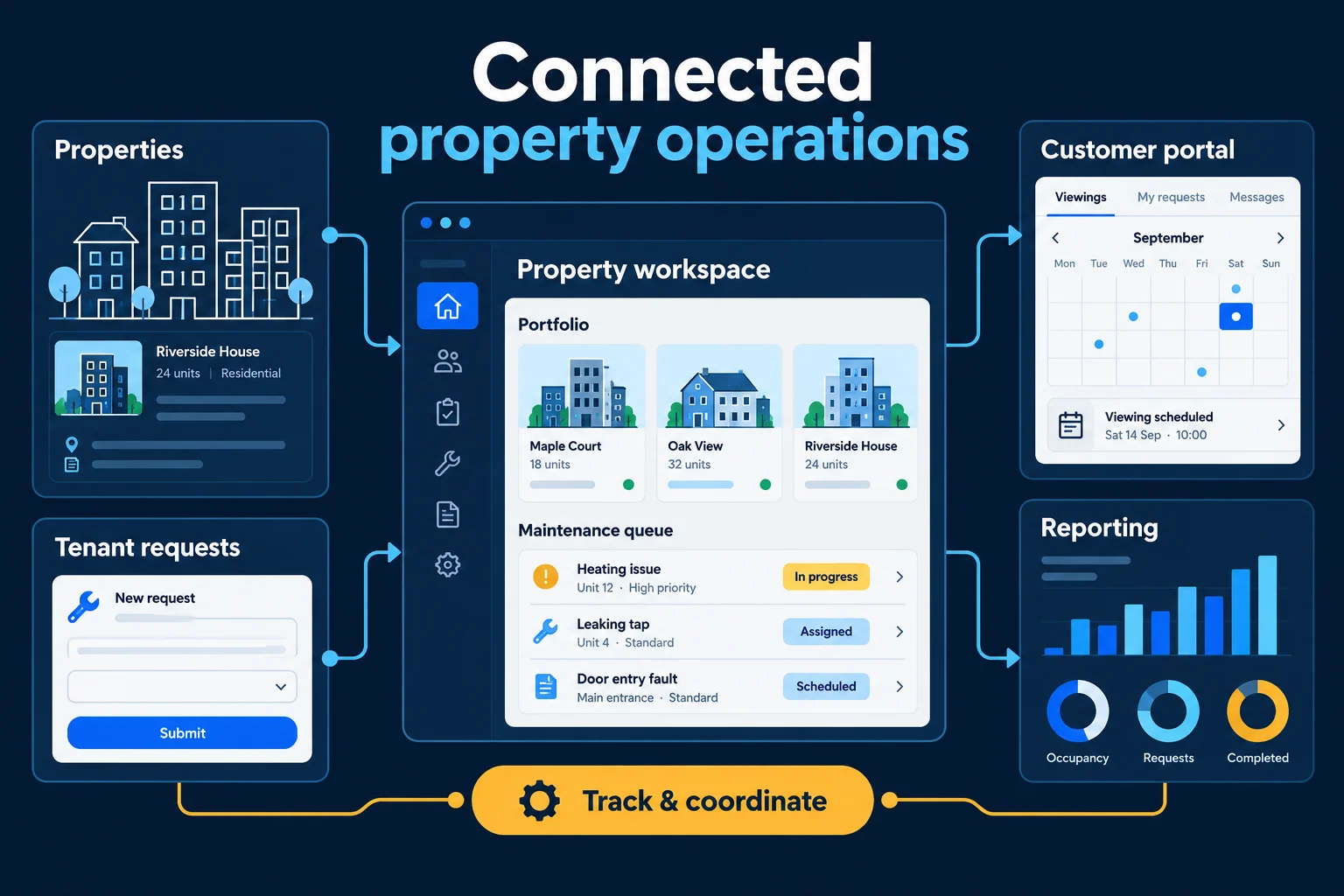
Organize service requests and retrieve approved property information.
Typical inputs: Permitted tenant records, policies and service workflows.
WHAT YOU RECEIVE A service queue or assistant with escalation.
Improve search and filtering around property attributes and user needs.
Typical inputs: Approved listings, attribute definitions and relevance criteria.
WHAT YOU RECEIVE Tested search with controllable filters.
Combine agreed property and operational measures into a clear reporting model.
Typical inputs: Permitted property records and reconciled definitions.
WHAT YOU RECEIVE Dashboards with source traceability and refresh rules.
Practical applications
Explore department-specific workflows, from the business problem to a practical output your team can review.
Sales operations
Project enquiries and follow-up ownership are spread across spreadsheets.
Shared enquiry queues and traceable customer interactions.
Project operations
Milestones and contractor updates use inconsistent reporting.
Reviewed milestone dashboards and accountable actions.
Customer handover
Handover files and outstanding tasks are difficult to reconcile.
Tracked handover checklists and document status.
Procurement
Contractor requirements and submitted evidence lack a shared history.
Role-based contractor portals and visible review status.
Tenant services
Maintenance and service requests arrive through disconnected channels.
Shared tenant service queues with communication history.
Facilities operations
Inspection findings and contractor tasks are recorded separately.
Tracked maintenance work orders and site evidence.
Lease administration
Agreed dates and obligations are buried in lease documents.
A reviewed lease register and renewal reminders.
Property finance
Rent and service-payment records require repeated manual matching.
Traceable payment exceptions and reviewed statements.
Agency operations
Property attributes and availability differ between listing channels.
Reviewed listing records and controlled publication updates.
Client services
Viewing requests and agent availability require repeated calls.
Shared viewing schedules and customer notifications.
Transaction administration
Required documents and reviewer requests are hard to track.
Tracked transaction workspaces without automated legal or lending decisions.
Market research
Teams combine listing and enquiry data with inconsistent definitions.
Source-linked market and agency operations dashboards.
Product engineering
Property and service systems use different identifiers and interfaces.
Documented property data flows and recovery tasks.
Customer onboarding
Customer property setup and data import are hard to coordinate.
Structured onboarding workspaces and reviewed property inventories.
Knowledge operations
Users struggle to find approved building and service information.
Permission-aware document search with source-linked responses.
Platform operations
Issues are difficult to trace across customer property workspaces.
Tenant-scoped monitoring and accountable incident queues.
Illustrative applications, not completed client projects. Scope, permitted data use and acceptance criteria are agreed during discovery; specialist decisions remain with authorized teams.
Designed for your environment
Controls and deployment choices are scoped to your environment and intended use.
Permissions and data minimization for tenant and property information.
Human confirmation of extracted terms and source-linked knowledge responses.
Agreed publication rules, retention, integration and operational ownership.
These examples do not make automated housing eligibility decisions, provide legal advice or guarantee property valuations or investment outcomes.
Operational controls: Access controls · Audit logging · Monitoring · Agreed retention.
Delivery approach
A collaborative delivery approach with concrete outputs.
Understand the workflow, users, systems, constraints and acceptance criteria.
YOU RECEIVE Agreed project scopeDefine interfaces, permissions and a prototype for the key user journey.
YOU RECEIVE Solution prototypeImplement, test and validate the agreed workflow with your team.
YOU RECEIVE Tested working incrementDeploy with handover, monitoring and the agreed improvement plan.
YOU RECEIVE Deployment & handoverExplore further
End-to-end services to support the agreed roadmap.
Common questions
Answers about starting a real estate software, data or AI project.
No. Extracted fields and summaries assist administration and must be checked against source documents. Qualified specialists remain responsible for legal interpretation and advice.
We assess available APIs or exports, permissions and vendor constraints. The plan defines which records can be read or updated and how exceptions will be handled.
A guided tool can retrieve approved information and collect or route service requests. It needs permission controls, clear limitations and a way to reach a responsible person. It does not make housing eligibility decisions.
Yes. A focused listing search, document intake or service-request project can establish the data and operational approach before expansion.
The agreement defines ownership, handover, maintenance and monitoring. Support can include integration changes and iterative improvements within an agreed scope.
Let’s plan your next step
Tell us about your users, systems and priorities.