
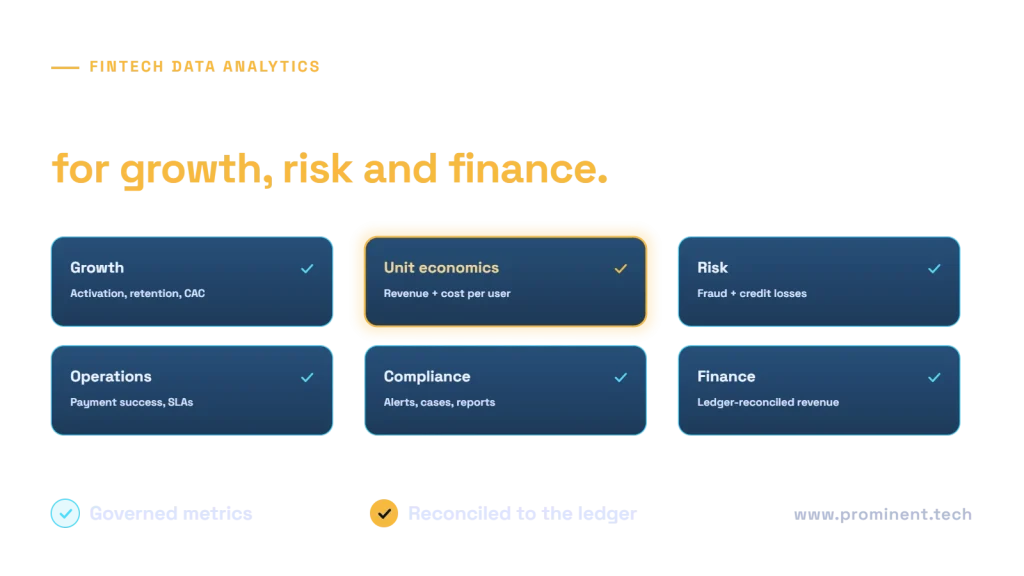
FinTech data analytics turns transaction, customer, risk and operational data into metrics that run the business: growth and retention, unit economics per customer and product, fraud and credit losses, payment success rates, compliance workload and ledger-reconciled revenue. The architecture that works for most FinTechs combines change data capture from production databases, event streams from the product, provider and banking data, a lakehouse or warehouse with a governed semantic model, and BI with row-level security. What separates good FinTech analytics from generic dashboards is that financial numbers reconcile to the ledger and every metric has one agreed definition.
Key takeaways
- Define each metric once, with an owner, and reuse it everywhere.
- Reconcile financial metrics to the ledger before anyone uses them for decisions.
- Protect sensitive data with masking, role-based access and row-level security.
- Near-real-time data matters for fraud and operations, not for every report.
- Start with a few decision-critical metrics rather than a large dashboard estate.
FinTech metrics that matter
| Area | Example metrics | Main users |
|---|---|---|
| Growth | Sign-up to activation rate, retention cohorts, customer acquisition cost | Product, marketing |
| Unit economics | Revenue and cost per active customer, contribution margin by product | Leadership, finance |
| Payments | Authorization and success rates, failure reasons, processing cost | Operations, product |
| Risk | Fraud rate and losses, chargebacks, credit delinquency and losses | Risk |
| Compliance | Onboarding pass rates, alert volumes, case ageing | Compliance |
| Finance | Revenue reconciled to ledger, balances, liquidity | Finance |
FinTech analytics architecture
Production databases are replicated with change data capture so analytics never slows the product. Product events, payment provider reports and bank statements land alongside them. A lakehouse or warehouse cleans and models the data; see data warehouse vs data lake vs lakehouse. Fraud and operational monitoring use streaming paths where minutes matter. Provider data arrives through the integrations described in FinTech APIs explained.
Data modelling and the semantic layer
Model core facts such as transactions, balances and fees with shared dimensions for customer, product, date and channel; see dimensional modelling vs data vault vs one big table. A semantic model holds metric definitions so every report calculates them the same way. In Power BI, design for performance and refresh limits; see Power BI performance optimization.
Governance and security
- Access: role-based access and row-level security by team, entity or region; see Power BI dynamic row-level security.
- Sensitive data: mask or tokenize personal and card data; analysts rarely need raw identifiers. Card data in analytics must respect PCI DSS scope.
- Quality and reconciliation: automated checks and daily reconciliation to the ledger; see data governance automation.
- Lineage: know which sources feed regulatory and board reports; see RegTech for FinTech compliance.
Roadmap
- Agree the ten metrics leadership uses for decisions, with definitions and owners.
- Replicate core data with change data capture and land provider reports.
- Build the transaction and customer models and reconcile them to the ledger.
- Publish a governed semantic model and the first dashboards.
- Add streaming views for fraud and payment operations where needed.
- Extend to forecasting and machine learning on the same trusted data.
Common questions
What is FinTech data analytics?
The use of transaction, customer, risk and operational data to measure and improve growth, unit economics, risk, operations, compliance and finance in a financial technology company.
Which metrics should a FinTech track?
Activation and retention, unit economics per customer, payment success rates, fraud and credit losses, compliance workload and ledger-reconciled revenue.
Do FinTechs need real-time analytics?
For fraud, payment operations and some customer features, yes. Most management and finance reporting works well with hourly or daily data.
How do you keep analytics numbers consistent?
Define metrics once in a governed semantic model and reconcile financial figures to the ledger.
How do you protect customer data in analytics?
Mask or tokenize sensitive fields, apply role-based and row-level security, and log access.
Build trusted FinTech analytics
Our advanced analytics and Power BI teams build governed, reconciled analytics for financial services companies.