Network operations
Network incident coordination
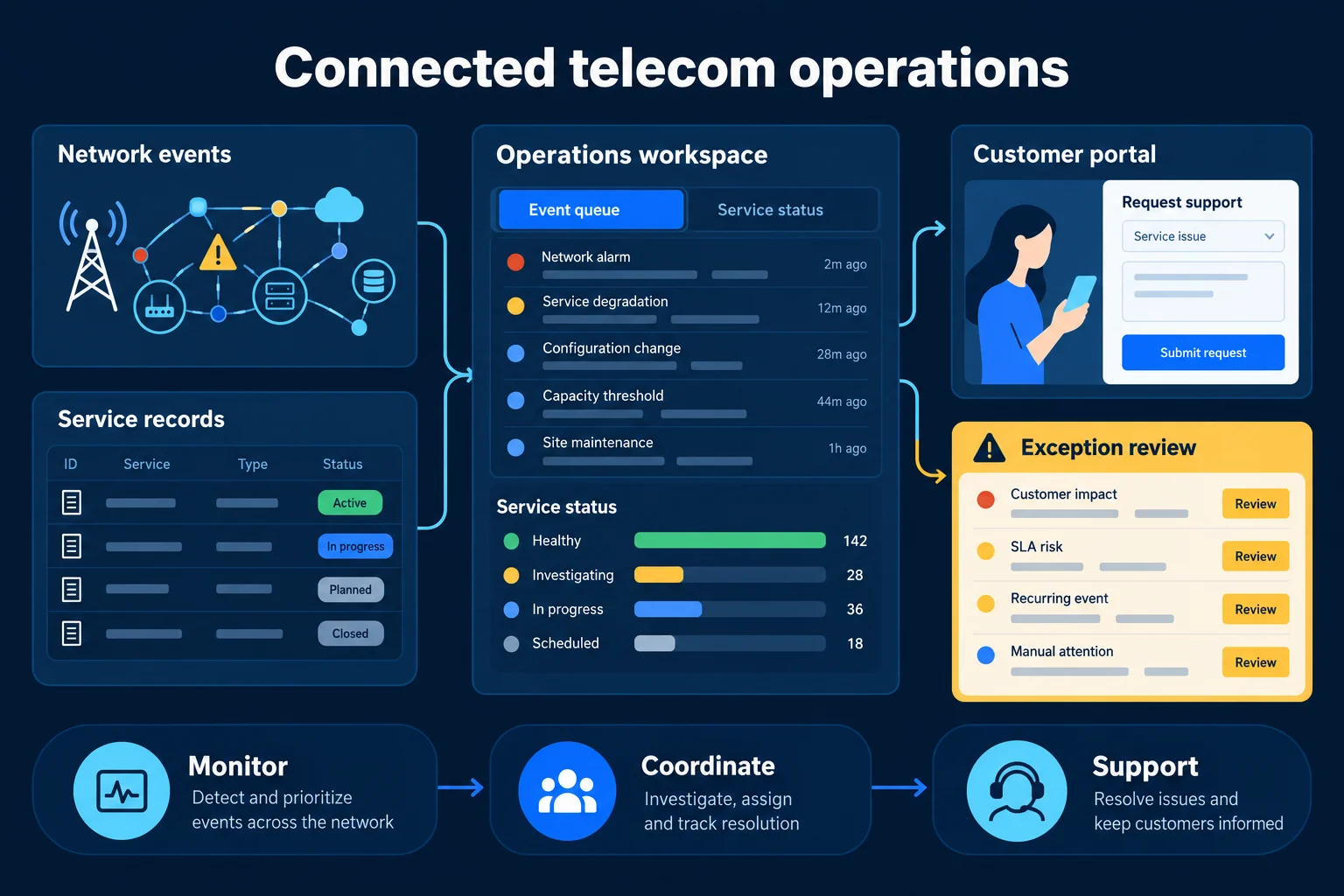
Network events and customer-impact reports are separated.
- 1Collect events
- 2Link affected services
- 3Engineer review
Practical output
A shared incident view with ownership and escalation tracking.

Fewer customers lost. Fewer surprises on the network.
Build churn, network and customer-service solutions around your operational systems, data and teams.
Solutions for organizations and teams delivering connectivity and communication services.
Reduce churn, support customers and understand network performance.
Explore relevant solutionsTrack service quality, faults and customer experience in one place.
Explore relevant solutionsOrganise field operations, assets and maintenance data.
Explore relevant solutionsAdd analytics, automation and AI features to communication products.
Explore relevant solutionsBusiness challenges
Competitive pricing makes switching easy, and losing customers is expensive.
Huge volumes of network data make it hard to spot issues before customers notice.
Billing, plan and fault queries keep contact centres busy.
What we deliver
Illustrative solution areas; scope, applicability and acceptance criteria are validated during discovery.
Identify customers likely to leave and suggest the right retention action.
Typical inputs: Usage, billing, service and contact history.
WHAT YOU RECEIVE Risk scores with reasons and a retention workflow.
Detect unusual network patterns and predict issues before customers notice.
Typical inputs: Network performance metrics and fault history.
WHAT YOU RECEIVE Alerts and dashboards for network operations teams.
Chat and voice assistants for billing, plan and troubleshooting questions.
Typical inputs: Knowledge articles, plan details and escalation rules.
WHAT YOU RECEIVE An assistant with hand-off to human agents.
Understand usage, pricing and upsell opportunities by segment.
Typical inputs: Usage, billing and product data.
WHAT YOU RECEIVE Dashboards with agreed metrics and refresh rules.
Flag SIM, subscription and usage patterns that may indicate fraud.
Typical inputs: Usage records, known fraud cases and rules.
WHAT YOU RECEIVE Scored alerts in a review queue.
Scalable cloud data platforms for high-volume telecom data.
Typical inputs: Existing data sources, volumes and reporting needs.
WHAT YOU RECEIVE A documented, monitored data platform.
Practical applications
Explore department-specific workflows, from the business problem to a practical output your team can review.
Network operations
Network events and customer-impact reports are separated.
A shared incident view with ownership and escalation tracking.
Service fulfilment
Provisioning tasks stall between commercial and technical teams.
Visible service orders and accountable handovers.
Customer care
Agents repeatedly search billing and service tools for context.
Context-rich service queues and approved support guidance.
Billing operations
Usage and billing records contain differences that need manual investigation.
Traceable billing exceptions and resolution history.
Customer onboarding
Installation requests and technician availability are difficult to coordinate.
Shared installation schedules and customer notifications.
Service assurance
Support teams struggle to connect customer faults to network status.
A fault queue linked to permitted service diagnostics.
Field operations
Technicians record job evidence outside the service workflow.
Mobile work orders and traceable completion records.
Partner operations
Wholesale partners rely on email for order and fault updates.
Role-based partner portals with service request history.
Asset operations
Site and equipment records are inconsistent across contractors.
A traceable site inventory and data exception queue.
Field maintenance
Inspection findings and follow-up work lose context between teams.
Tracked maintenance tasks with site evidence.
Project delivery
Permits, dependencies and contractor updates are hard to track.
Shared rollout dashboards and accountable actions.
Commercial operations
Required contractor records are scattered across messages.
Versioned contractor files and renewal reminders.
Developer services
Developers need clear access setup and integration guidance.
Developer workspaces and tracked integration tasks.
Platform operations
Failed requests and delivery events need consistent operational visibility.
Service dashboards and traceable recovery queues.
Trust operations
Reported messages lack consistent evidence for specialist assessment.
Auditable abuse cases with authorized escalation decisions.
Customer success
Customers need an agreed view of usage and delivery status.
Tenant-scoped usage dashboards and reporting exports.
Illustrative applications, not completed client projects. Scope, permitted data use and acceptance criteria are agreed during discovery; specialist decisions remain with authorized teams.
Designed for your environment
Controls and deployment choices are scoped to your environment and intended use.
Role-based access and agreed handling of subscriber and usage information.
Explanations for scores and explicit approval before customer-facing or network actions.
Hosting, data volumes, monitoring and integration requirements agreed with your team.
These solutions support commercial, service and network teams; operational decisions remain with your staff. Network and regulatory requirements are assessed during discovery; no certification or blanket compliance is implied.
Operational controls: Access controls · Audit logging · Monitoring · Agreed retention.
Delivery approach
A collaborative delivery approach with concrete outputs.
Understand the workflow, users, systems, constraints and acceptance criteria.
YOU RECEIVE Agreed project scopeDefine interfaces, permissions and a prototype for the key user journey.
YOU RECEIVE Solution prototypeImplement, test and validate the agreed workflow with your team.
YOU RECEIVE Tested working incrementDeploy with handover, monitoring and the agreed improvement plan.
YOU RECEIVE Deployment & handoverExplore further
End-to-end services to support the agreed roadmap.
Common questions
Answers about starting a telecom software, data or AI project.
We begin with your current systems, their approved APIs or exports, data definitions and access rules. Integration scope depends on those interfaces and permissions.
Only where you agree. By default, models score and alert; customer offers and network changes follow your approval rules.
Discovery identifies the data needed, sensitivity, access roles, hosting and retention. Your team agrees the controls before implementation.
Yes. A churn model for one segment, a network dashboard or one service-assistant journey can be an initial project with agreed success measures.
Ownership, licensing, source-code handover and support arrangements are set out in the engagement agreement. Deployment documentation, training and ongoing maintenance can be scoped around your team’s needs.
Let’s plan your next step
Tell us about your customers, network and priorities.