
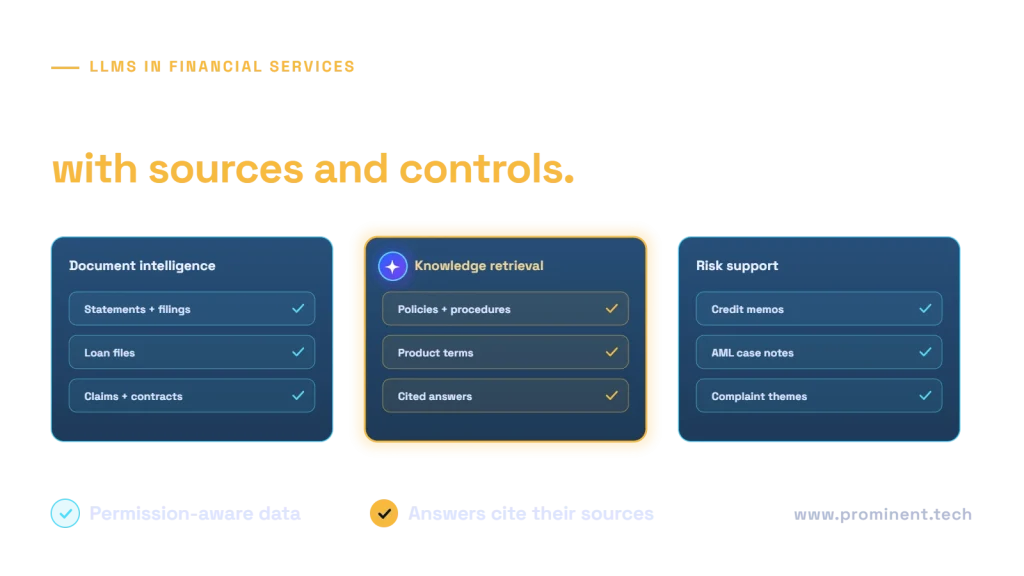
Large language models (LLMs) in financial services are used mainly for three things: document intelligence (reading and extracting data from statements, loan files, filings and contracts), knowledge retrieval (answering staff and customer questions from approved policies and product terms, with citations), and risk support (drafting credit memos, AML case notes and complaint analysis for human review). They work best when connected to the institution’s own data through retrieval, restricted by user permissions, tested against real cases and kept under human review for decisions. They should not make credit, compliance or investment decisions on their own.
Key takeaways
- The value of LLMs in finance is reading, summarizing and explaining at scale.
- Retrieval-augmented generation with citations is the default architecture.
- Permissions, data residency and logging matter as much as model choice.
- Hallucinations are managed with grounding, evaluation and human review.
- LLM use cases fall under model risk management like other models.
LLM use cases in financial services
| Area | Use case | Human role |
|---|---|---|
| Document intelligence | Extract fields from bank statements, payslips and financial statements | Review low-confidence fields |
| Document intelligence | Summarize loan files, covenants and contracts | Credit officer checks summary |
| Knowledge retrieval | Staff assistant over policies, procedures and product terms | Escalate unclear answers |
| Knowledge retrieval | Customer service answers with cited sources | Agent reviews sensitive replies |
| Risk support | Draft credit memos from financials and notes | Credit officer decides |
| Risk support | AML case narratives from alert data | Investigator decides |
| Operations | Classify and route complaints, emails and requests | Sample review |
| Engineering | Explain and modernize legacy code and reports | Engineer reviews changes |
For agents that take actions across these workflows, see agentic AI in finance.
A secure LLM architecture for finance
- Retrieval with permissions: users only get answers from documents they may see; see enterprise RAG security.
- Document processing: OCR, layout and table extraction before the LLM; see multimodal RAG for PDFs and tables.
- Guardrails: input checks, PII handling and output policies; see LLM guardrails.
- Logging and evaluation: prompts, sources and answers kept for audit and testing.
Risks and how to control them
| Risk | Control |
|---|---|
| Hallucinated facts or figures | Grounding, citations, numeric checks against source data, human review |
| Data leakage | Permission-aware retrieval, private hosting options, no training on your data by contract |
| Prompt injection from documents | Treat documents as untrusted, restrict tools, filter outputs |
| Bias in drafted assessments | Testing across segments, decision stays with people |
| Unexplained changes after model updates | Version pinning, regression test suites |
See the real cost of LLM hallucinations and how to test LLM applications. The OWASP Top 10 for LLM applications and the NIST AI Risk Management Framework are good references. This is technical guidance, not legal or regulatory advice.
Choosing models and hosting
Most institutions use a mix: hosted frontier models through enterprise cloud agreements for complex reasoning, and smaller models for classification and extraction. Key questions are data residency, contractual data use, latency, cost and how updates are controlled. See choosing between OpenAI, Claude and open-source LLMs and small vs large language models.
A practical roadmap
Common questions
How are LLMs used in financial services?
Mainly to read and extract data from documents, answer questions from approved knowledge with citations, and draft risk and compliance narratives for human review.
Are LLMs safe for banking data?
They can be, with permission-aware retrieval, suitable hosting and contracts, guardrails, logging and human review. Safety comes from the architecture, not the model alone.
Can an LLM make credit decisions?
It should not decide alone. It can summarize information and draft memos, while credit decisions stay with people and validated models.
How do you stop LLMs hallucinating in finance?
Ground answers in retrieved sources, require citations, check figures against source data, test with golden datasets and keep people in the loop for material outputs.
Where should a bank start with LLMs?
With an internal knowledge assistant or document extraction use case, where value is clear and risk is contained.
Bring LLMs into your financial workflows safely
We build generative AI integrations for financial services teams, with permission-aware retrieval, guardrails and evaluation built in.