Client intake
Legal client intake workflows
Enquiries and supporting documents lack a consistent intake process.
- 1Capture enquiry
- 2Check required information
- 3Lawyer review
Practical output
Structured intake files and routed follow-up tasks.

Faster review. Better-organised knowledge. Lawyers stay in control.
Build contract review, legal research and matter workflows around your documents, systems and confidentiality requirements.
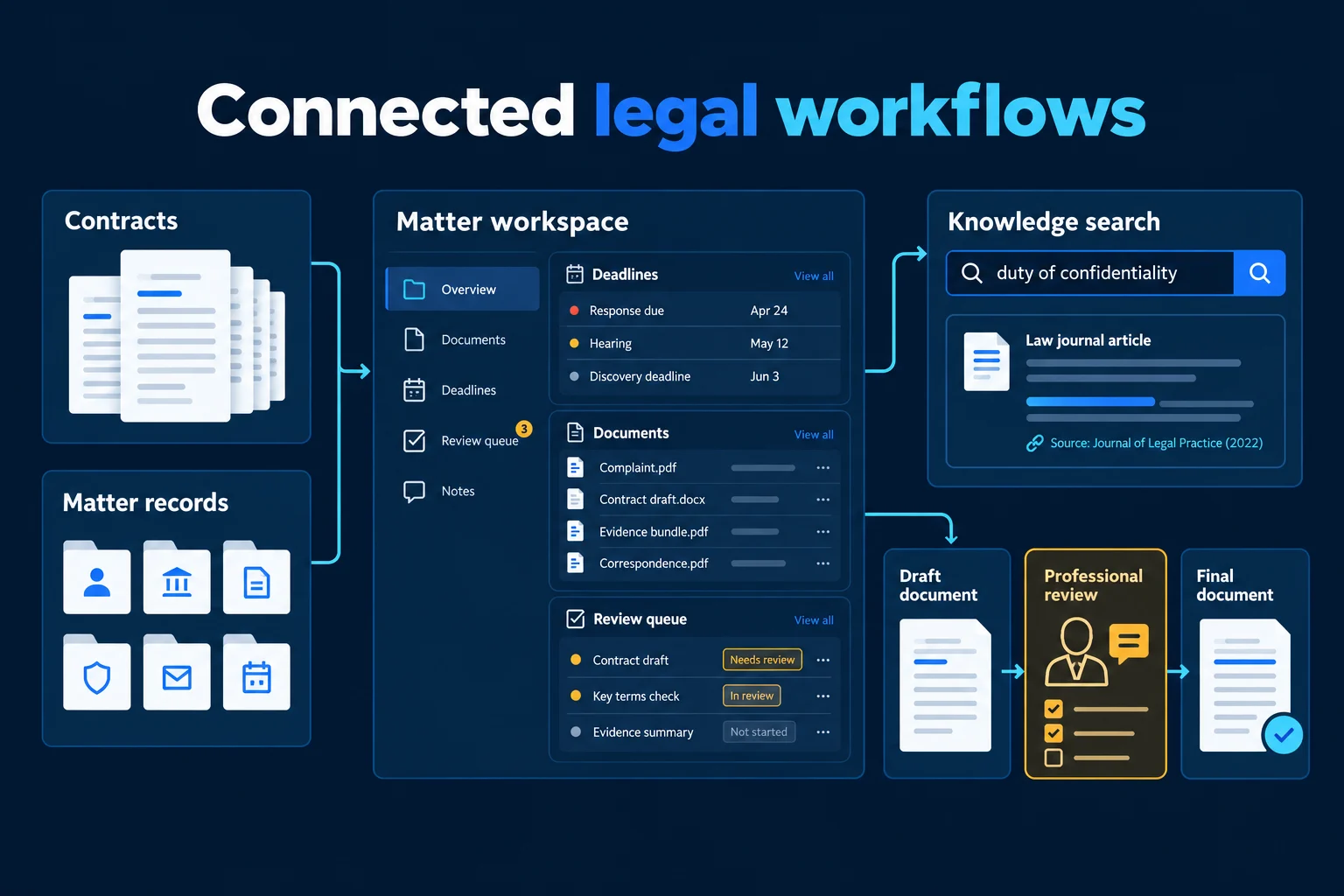
Solutions for organizations and teams handling legal documents, research and matters.
Speed up review, research and drafting while keeping client information secure.
Explore relevant solutionsManage contracts, requests and approvals across the business.
Explore relevant solutionsAdd document AI, search and integrations to legal products.
Explore relevant solutionsTrack obligations, policies and review evidence in one place.
Explore relevant solutionsBusiness challenges
Contracts, case files and disclosure sets run to thousands of pages.
Finding relevant precedents, clauses and internal knowledge across sources takes hours.
Client information must stay confidential, and AI tools must not expose privileged material.
What we deliver
Illustrative solution areas; scope, applicability and acceptance criteria are validated during discovery.
Extract key clauses, dates and obligations, and flag unusual or missing terms for lawyer review.
Typical inputs: Contracts, clause library and agreed review checklist.
WHAT YOU RECEIVE Structured clause summaries and a review queue.
Search approved knowledge, precedents and internal guidance with source references.
Typical inputs: Curated documents, knowledge base and permissions.
WHAT YOU RECEIVE Permission-aware search and cited draft answers.
Prepare first drafts of standard agreements and correspondence from approved templates.
Typical inputs: Templates, clause library and drafting rules.
WHAT YOU RECEIVE Draft documents for lawyer review.
Classify and prioritise large document sets for e-discovery and due diligence.
Typical inputs: Document sets, categories and reviewer decisions.
WHAT YOU RECEIVE Tagged documents with review history.
Bring matter status, workload and billing information into one view.
Typical inputs: Matter, time and billing records.
WHAT YOU RECEIVE Dashboards with source traceability and refresh rules.
Private, access-controlled AI over your firm’s or team’s documents.
Typical inputs: Document repositories, ethical walls and access rules.
WHAT YOU RECEIVE A secure knowledge tool with audit logging.
Practical applications
Explore department-specific workflows, from the business problem to a practical output your team can review.
Client intake
Enquiries and supporting documents lack a consistent intake process.
Structured intake files and routed follow-up tasks.
Matter operations
Deadlines, documents and task ownership are spread across systems.
A permission-aware matter workspace with tracked handovers.
Knowledge management
Teams spend time finding approved precedents and internal guidance.
Source-linked draft answers requiring professional verification.
Document services
Drafts and reviewer comments are difficult to reconcile.
Versioned review queues and a documented approval history.
Commercial legal
Business teams submit incomplete contract requests through email.
Structured contract intake and clear responsibility tracking.
Legal operations
Renewal dates and agreed obligations are buried in documents.
A reviewed obligation register and accountable reminders.
Corporate governance
Meeting records and approvals are stored in disconnected locations.
Versioned governance records and traceable approvals.
Internal advisory
Internal questions reach legal teams without enough business context.
A service queue with referenced guidance and lawyer-reviewed responses.
Product engineering
Case and document systems do not exchange information consistently.
Documented integrations with agreed access boundaries.
Document intelligence
Structured fields need to be checked against original documents.
Source-linked extraction results with reviewer corrections.
Customer success
Users repeat product questions while complex issues wait.
Tracked support requests and permission-aware product guidance.
Platform operations
Service issues lack consistent visibility across client workspaces.
Application monitoring and traceable incident resolution.
Policy operations
Teams struggle to track approved versions and assigned reviewers.
Controlled policy versions and a review history.
Third-party risk
Supplier evidence arrives late or without clear ownership.
Structured due-diligence files and accountable follow-up.
Audit coordination
Repeated evidence requests create scattered copies and unclear status.
A traceable evidence workspace and request tracker.
Regulatory operations
Teams need to connect new publications to an internal review owner.
A source-linked change register; interpretations remain with qualified staff.
Illustrative applications, not completed client projects. Scope, permitted data use and acceptance criteria are agreed during discovery; specialist decisions remain with authorized teams.
Designed for your environment
Controls and deployment choices are scoped to your environment and intended use.
Role-based access, ethical walls and agreed handling of privileged and client information.
Source references, lawyer review and explicit approval of AI-generated summaries or drafts.
Hosting, retention, monitoring and document-system integration agreed with your team.
These solutions support legal professionals; they do not provide legal advice. Legal judgement and sign-off remain with qualified lawyers. No regulatory certification or blanket compliance is implied.
Operational controls: Ethical walls · Access controls · Audit logging · Agreed retention.
Delivery approach
A collaborative delivery approach with concrete outputs.
Understand the workflow, users, systems, constraints and acceptance criteria.
YOU RECEIVE Agreed project scopeDefine interfaces, permissions and a prototype for the key user journey.
YOU RECEIVE Solution prototypeImplement, test and validate the agreed workflow with your team.
YOU RECEIVE Tested working incrementDeploy with handover, monitoring and the agreed improvement plan.
YOU RECEIVE Deployment & handoverExplore further
End-to-end services to support the agreed roadmap.
Common questions
Answers about starting a legal software, data or AI project.
We begin with your current document, matter and knowledge systems, their approved APIs or exports and access rules. Integration scope depends on those interfaces and permissions.
No. AI extracts, summarises and drafts; lawyers review, correct and approve every output that is relied on. Each output keeps source references for checking.
Discovery identifies the documents involved, sensitivity, access roles, ethical walls, hosting and retention. Data stays in the environment you approve and is not used to train public models.
Yes. One contract type, one research collection or one matter dashboard can be an initial project with agreed test documents and acceptance criteria.
Ownership, licensing, source-code handover and support arrangements are set out in the engagement agreement. Deployment documentation, training and ongoing maintenance can be scoped around your team’s needs.
Let’s plan your next step
Tell us about your documents, systems and priorities.