
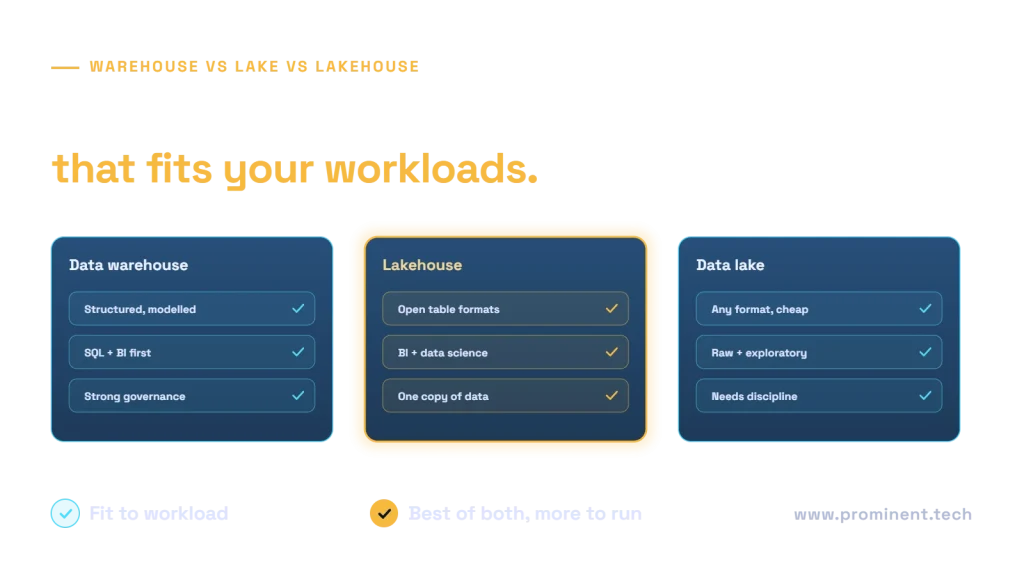
A data warehouse stores structured, modelled data optimized for SQL analytics and BI, with strong governance and predictable performance. A data lake stores any data, structured or not, cheaply in object storage, suiting raw data, data science and exploration but needing discipline to avoid becoming a “data swamp”. A lakehouse adds open table formats such as Delta Lake or Apache Iceberg on top of lake storage, giving warehouse-like transactions, schema enforcement and SQL performance over one copy of data for BI, data science and AI. Choose a warehouse for mainly structured reporting, a lake for cheap raw storage and exploration, and a lakehouse when you need both on one platform, accepting more engineering responsibility.
Key takeaways
- The choice is driven by workloads, data types and team skills, not by trends.
- Lakehouses reduce data copies but need stronger data engineering practices.
- Warehouses remain the simplest option for structured BI with SQL-skilled teams.
- Cost depends on compute patterns, data volumes and operations, not storage alone.
- Many organizations combine patterns: a lake for raw data, curated tables for BI.
Data warehouse vs data lake vs lakehouse compared
| Aspect | Data warehouse | Data lake | Lakehouse |
|---|---|---|---|
| Data types | Structured | Any | Any, with tables for structured data |
| Schema | On write | On read | Enforced on tables, flexible for raw |
| Storage | Proprietary or managed | Object storage, open files | Object storage, open table formats |
| Transactions | Yes | Limited | Yes, via the table format |
| Best for | BI, reporting, finance data | Raw data, data science, archives | BI plus data science and AI on one copy |
| Main users | Analysts, BI developers | Data engineers, scientists | All of these |
| Governance effort | Lower, built in | High, easy to lose control | Moderate, needs a catalog |
| Engineering effort | Lower | Moderate | Higher |
Cost drivers
Storage is rarely the main cost: object storage is inexpensive in every pattern. The larger costs are compute for loading and querying, how efficiently queries use it, the number of data copies, and the people needed to build and operate the platform. A warehouse may cost more per query but less in engineering time; a lakehouse may reduce copies and licence costs but need more skilled engineers. Model your actual workloads before deciding. For Microsoft Fabric capacity sizing, see Fabric capacity planning.
Decision guide
- Choose a data warehouse if your data is mostly structured, your main need is BI and reporting, and your team is SQL-focused.
- Choose a data lake for cheap retention of raw and semi-structured data, data science exploration and archives, usually alongside something else for BI.
- Choose a lakehouse if you need BI, data science and AI on the same data, want open formats to avoid lock-in, and have or can build data engineering skills.
A typical lakehouse architecture
Most lakehouses follow a layered (often called medallion) design: raw data lands in a bronze layer, is cleaned and conformed in silver, and is modelled into business-ready gold tables for BI and AI. Open table formats such as Delta Lake and Apache Iceberg provide transactions, schema enforcement and time travel. The original lakehouse paper (CIDR 2021) explains the reasoning. Quality checks between layers are essential; see data quality frameworks compared.
Platform options
Cloud warehouses, lakehouse platforms and integrated analytics suites increasingly overlap: many warehouses can query open table formats, and lakehouse platforms offer SQL warehouses. Evaluate on your workloads, ecosystem and skills. Related guides: Fabric lakehouse vs warehouse, Snowflake to Databricks migration and data warehouse to data lake migration.
Common questions
What is the difference between a data warehouse, data lake and lakehouse?
A warehouse stores structured, modelled data for SQL analytics; a lake stores any raw data cheaply; a lakehouse adds open table formats to lake storage to give warehouse-like features on one copy of data.
Is a lakehouse cheaper than a data warehouse?
Not automatically. It can reduce copies and licences, but compute usage and engineering effort often decide the total cost.
Can a lakehouse replace a data warehouse?
For many workloads, yes. Some organizations keep a warehouse for specific BI or finance needs where its simplicity and performance are valued.
Do I still need a data lake if I have a warehouse?
Often yes, for raw, semi-structured or unstructured data, data science and low-cost retention.
Which is best for AI?
A lakehouse or lake usually suits AI and machine learning better, because it keeps raw and unstructured data alongside curated tables.
Choose the right data architecture
Our data engineering team assesses your workloads and builds the warehouse, lake or lakehouse that fits them, with governance and cost controls.