
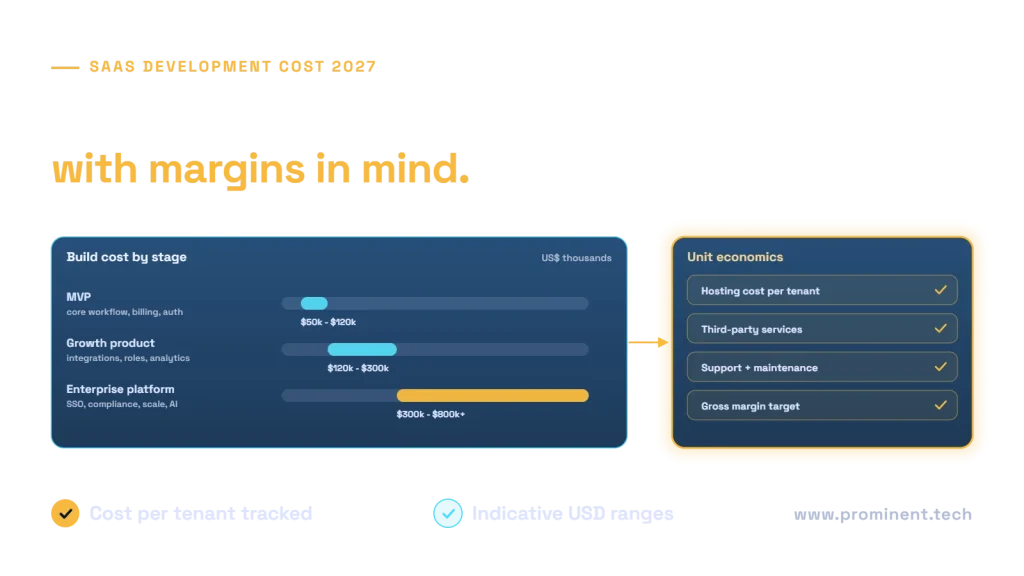
In 2027, SaaS application development typically costs US$50,000 to US$120,000 for a minimum viable product with one core workflow, authentication and subscription billing, US$120,000 to US$300,000 for a growth-stage product with integrations, roles, analytics and a polished experience, and US$300,000 to US$800,000 or more for an enterprise-grade multi-tenant platform with single sign-on, compliance certifications, high availability and AI features. Running costs then scale with customers: hosting, third-party services and 15 to 25 percent of the build per year for maintenance and improvement. Healthy SaaS economics depend on tracking infrastructure cost per tenant from the start. These are indicative planning ranges, not a quote.
Key takeaways
- Fund SaaS development in stages: MVP to validate, growth to expand, enterprise to scale.
- Multi-tenancy, billing, security and integrations are the main cost drivers beyond core features.
- Enterprise customers bring requirements such as SSO, audit logs and SOC 2 or ISO 27001.
- Track cost per tenant so pricing protects gross margin as you grow.
- Discovery before the MVP keeps the first release small and focused.
SaaS development cost by stage
| Stage | Typical scope | Indicative build cost (USD) | Typical timeline |
|---|---|---|---|
| MVP | One core workflow, sign-up and authentication, subscription billing, admin basics | $50,000 – $120,000 | 3 – 5 months |
| Growth product | More workflows, integrations, roles and permissions, analytics, onboarding | $120,000 – $300,000 | 6 – 12 months |
| Enterprise platform | SSO, audit logs, data residency, compliance, high availability, AI features | $300,000 – $800,000+ | 12+ months, in releases |
SaaS cost drivers
- Multi-tenancy: tenant isolation, configuration and data model. See multi-tenant SaaS architecture.
- Billing and subscriptions: plans, trials, usage metering and invoices, often using a platform such as Stripe Billing.
- Identity: sign-up, roles and enterprise SSO. See multi-tenant authentication.
- Integrations: connectors customers expect, plus a public API.
- AI features: see AI features SaaS customers will pay for.
- Design quality: onboarding and UX that reduce churn.
Running costs and unit economics
| Cost line | Indicative monthly range (USD) |
|---|---|
| Cloud hosting | $300 at launch to $20,000+ at scale |
| Third-party services (auth, email, billing fees, monitoring) | $100 – $3,000 |
| AI model usage (if applicable) | Scales with usage |
| Maintenance and improvement | 15 – 25% of build per year |
Calculate hosting and service cost per tenant and compare with revenue per tenant to keep gross margin healthy. Our Azure cost optimization guide covers the levers.
Enterprise readiness costs
- Single sign-on and SCIM user provisioning.
- Audit logs, data export and admin controls.
- Security certifications such as SOC 2 or ISO/IEC 27001, with ongoing audit costs.
- Data residency options; see GDPR-compliant cloud architecture.
- Service level commitments and support processes.
A worked SaaS MVP estimate
Illustrative, fictional example: a B2B SaaS MVP for scheduling field service jobs.
| Line | Assumption | Amount (USD) |
|---|---|---|
| Discovery | Users, MVP scope, prototype, architecture | $12,000 |
| MVP build | Scheduling workflow, mobile web, tenancy, billing, admin | $85,000 |
| Running cost | $700 a month hosting and services in year one | $8,400 |
| Improvement | 20% of build after launch | $17,000 |
| First-year total | $122,400 |
For UK budgets in pounds, see cloud application development cost in the UK.
Reducing SaaS development cost
- Run discovery first to keep the MVP small; see software product discovery.
- Buy commodity services for authentication, billing, email and analytics.
- Use a modular monolith at the start; split services only when scale requires it. See microservices vs monolith.
- Automate testing and deployment early to keep releases cheap.
- Plan version 2 deliberately rather than rewriting under pressure; see building version 2.
Common questions
How much does it cost to build a SaaS application in 2027?
Indicatively, US$50,000 to US$120,000 for an MVP, US$120,000 to US$300,000 for a growth-stage product and US$300,000 to US$800,000 or more for an enterprise-grade platform, plus running and maintenance costs.
How long does it take to build a SaaS MVP?
Typically three to five months including discovery, build, testing and launch.
What are the ongoing costs of a SaaS product?
Hosting and third-party services that grow with customers, plus 15 to 25 percent of the build per year for maintenance and improvement.
Do we need SOC 2 from the start?
Not usually for an MVP, but design security controls early. Enterprise customers often ask for SOC 2 or ISO 27001 as you grow.
Should a SaaS MVP use microservices?
Rarely. A well-structured modular monolith is faster and cheaper to build and can be split later.
Plan your SaaS build with a realistic budget
Share your product idea, target customers and growth plans. Our software development team will run discovery and give you a staged budget from MVP to scale.