
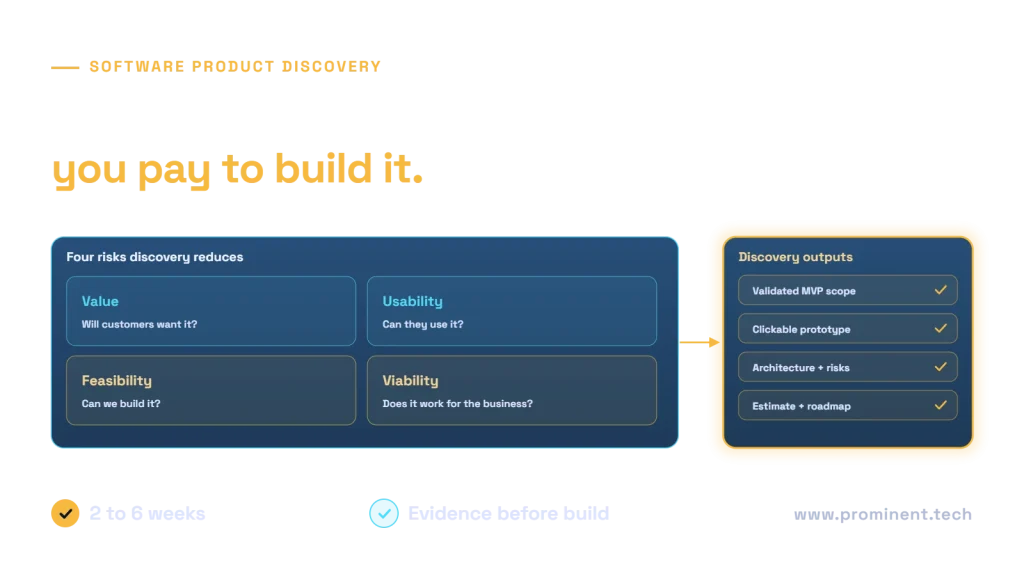
Software product discovery is a short, structured phase before development, typically two to six weeks, that tests whether a product idea is valuable, usable, technically feasible and viable for the business, and turns the answers into a validated MVP scope, a clickable prototype, an architecture with known risks, and an estimate and roadmap. It replaces assumptions with evidence from users, stakeholders and technical spikes, so the build budget goes into the right features. Discovery is the cheapest insurance in software: it costs a small fraction of the build and prevents the most expensive mistake, building the wrong thing well.
Key takeaways
- Discovery reduces four risks: value, usability, feasibility and business viability.
- Talk to real users and test prototypes before writing production code.
- Run technical spikes on the riskiest integrations or AI capabilities early.
- End discovery with a decision: build, change direction or stop.
- Keep discovery going in smaller loops after development starts.
Why software product discovery matters
Most failed software products work technically; they fail because people do not need them, cannot use them easily, or they do not make business sense. Product leader Marty Cagan describes these as the four big risks: value, usability, feasibility and viability. Discovery addresses all four before the expensive part begins. It also produces a far more reliable estimate; see our guide to realistic development timelines.
The software product discovery process
1. Align on goals
Interview sponsors and stakeholders to agree the business goal, target users, success measures and constraints.
2. Understand users
Interview and observe target users, map their current journey and identify the biggest pains and opportunities.
3. Shape the solution
Prioritise the problems to solve first, sketch options and define user stories for a minimum viable product.
4. Prototype and test
Build a clickable prototype and test it with users. Even five users reveal most usability issues, as Nielsen Norman Group explains.
5. Prove feasibility
Run technical spikes on risky integrations, data or AI features, and outline the architecture.
6. Plan and decide
Estimate the MVP, sequence releases and present a go, change or stop decision.
Software product discovery deliverables
| Deliverable | What it contains |
|---|---|
| Product brief | Goals, users, success measures, constraints |
| User research findings | Personas, journeys, pains, opportunities |
| MVP scope | Prioritised user stories and what is out of scope |
| Clickable prototype | Key screens tested with users |
| Architecture outline | Components, integrations, hosting, security, risks |
| Estimate and roadmap | Effort ranges, release plan, team and budget |
| Decision record | Recommendation and the evidence behind it |
Discovery for AI products
AI products add a fifth question: is the data good enough? Discovery should check data availability and quality, test the AI capability on real examples, define how quality will be measured and decide what humans must review. Our AI agent readiness checklist and AI-ready data playbook help structure this.
Who should be involved
- A business sponsor who can make decisions.
- A product owner who will own the product after launch.
- Representative users.
- A business analyst and a UX designer.
- A solution architect and a senior engineer for feasibility.
Our business analysis and project management teams typically run discovery with your stakeholders.
Common product discovery mistakes
- Skipping user research and relying on stakeholder opinions.
- Treating the prototype as a commitment to every feature shown.
- Ignoring technical risks until development.
- Making the MVP too large.
- Ending without a clear decision.
Planning a new version of an existing product? See building version 2 of your product.
Common questions
What is software product discovery?
A short phase before development that validates whether a product is valuable, usable, feasible and viable, and produces an MVP scope, prototype, architecture and estimate.
How long does product discovery take?
Typically two to six weeks, depending on the product’s size, the number of stakeholders and how much user research is needed.
Is discovery worth the cost?
Usually yes. It costs a small fraction of the build and reduces the risk of building features nobody needs or underestimating effort.
What is the output of product discovery?
A validated MVP scope, a tested prototype, an architecture outline with risks, an estimate and roadmap, and a recommendation on whether to proceed.
Can discovery continue during development?
Yes. Continuous discovery keeps testing new ideas with users in small loops while the team builds.
Start your product with evidence
Share your product idea and goals. Our software development team will run a focused discovery and give you a validated scope, prototype and estimate before you commit to the build.