
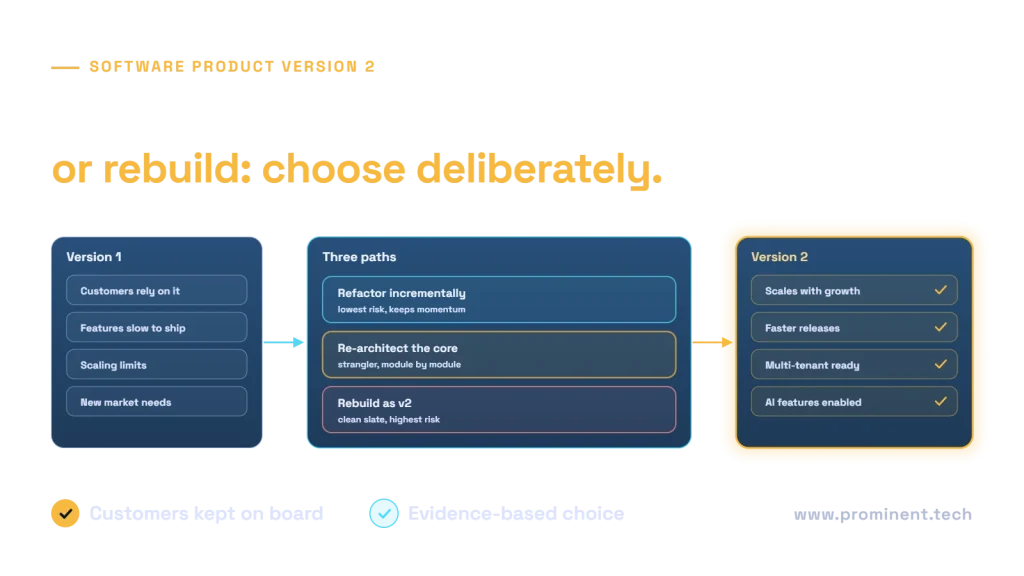
Building version 2 of a software product usually means choosing between three paths: refactoring the existing product incrementally, re-architecting its core module by module while it keeps running, or rebuilding it as a new product. The right choice depends on how much of version 1’s architecture still fits your goals, how fast you must ship new capabilities, how much risk existing customers can tolerate and whether the domain itself has changed. Most successful version 2 projects re-architect incrementally behind stable interfaces, migrate customers in waves and avoid the trap of an all-at-once rewrite that stalls feature delivery for a year or more.
Key takeaways
- Define what version 2 must achieve in business terms before choosing an approach.
- Incremental refactoring or re-architecture is lower risk than a full rebuild in most cases.
- Rebuild only when the architecture, technology or domain no longer fits and cannot be evolved.
- Protect existing customers with stable APIs, data migration plans and phased rollout.
- Keep shipping customer value during version 2, or competitors will.
Signs your product needs a version 2
- New features take far longer than they used to because of tangled code and side effects.
- Performance or cost limits appear as customers and data grow.
- You need capabilities the architecture resists, such as multi-tenancy, mobile, integrations or AI.
- You are entering a new market or segment with different requirements.
- The technology stack is approaching end of support or hiring for it is hard.
Refactor, re-architect or rebuild
| Approach | What it means | Best when | Risk |
|---|---|---|---|
| Incremental refactor | Improve code and structure while shipping features | Architecture mostly fits; problems are code quality | Low |
| Re-architect the core | Replace modules or layers behind stable interfaces, step by step | Key parts no longer fit, such as data model or tenancy | Medium |
| Rebuild as version 2 | New product built alongside, customers migrated later | Domain or technology has fundamentally changed | High |
Architecture choices for the target, such as microservices vs a modular monolith or clean vs vertical slice architecture, should follow from the goals, not fashion.
How to decide
Martin Fowler’s idea of sacrificial architecture is a helpful framing: version 1 did its job by getting you to product-market fit, and parts of it can now be replaced deliberately. Start with a short discovery to define goals and constraints; see our software product discovery guide.
Protecting existing customers
- Stable interfaces. Keep public APIs stable or versioned; see API versioning best practices.
- Data migration. Plan, rehearse and reconcile customer data moves.
- Waves. Migrate customers in groups, starting with friendly early adopters.
- Feature parity decisions. Decide explicitly which v1 features will not move, and communicate early.
- Rollback. Keep a way back for each wave.
A version 2 delivery plan
If version 2 introduces multi-tenancy, design it carefully; see multi-tenant SaaS architecture. If it adds AI, see AI features SaaS customers will pay for.
Version 2 pitfalls
- The second-system effect: loading version 2 with every deferred idea until it never ships.
- Feature freeze: stopping v1 improvements for a year while v2 is built.
- Underestimated migration: customer data and integrations take longer than the new code.
- Lost knowledge: v1 behaviours customers rely on that nobody documented.
- No measurable goals: success defined as “done” rather than outcomes.
Common questions
Should we rebuild our product from scratch for version 2?
Only when the architecture, technology or domain no longer fits and cannot be evolved. In most cases, incremental re-architecture delivers the benefits with less risk.
How long does a version 2 take?
Incremental re-architecture typically shows results in three to six months and continues in phases; a full rebuild often takes a year or more before customers migrate.
How do we keep customers happy during version 2?
Keep shipping improvements, keep APIs stable, migrate in waves with support and communicate changes early.
What is the second-system effect?
The tendency to over-design a second version with every feature postponed from the first, which delays delivery and adds complexity.
Can AI help build version 2?
AI coding assistants can speed up refactoring, tests and documentation under engineering review, but architecture decisions and migration planning still need experienced people.
Plan version 2 of your product with confidence
Share your product, goals and pain points. Our software development and modernization teams will assess version 1 and recommend the safest path to version 2.