
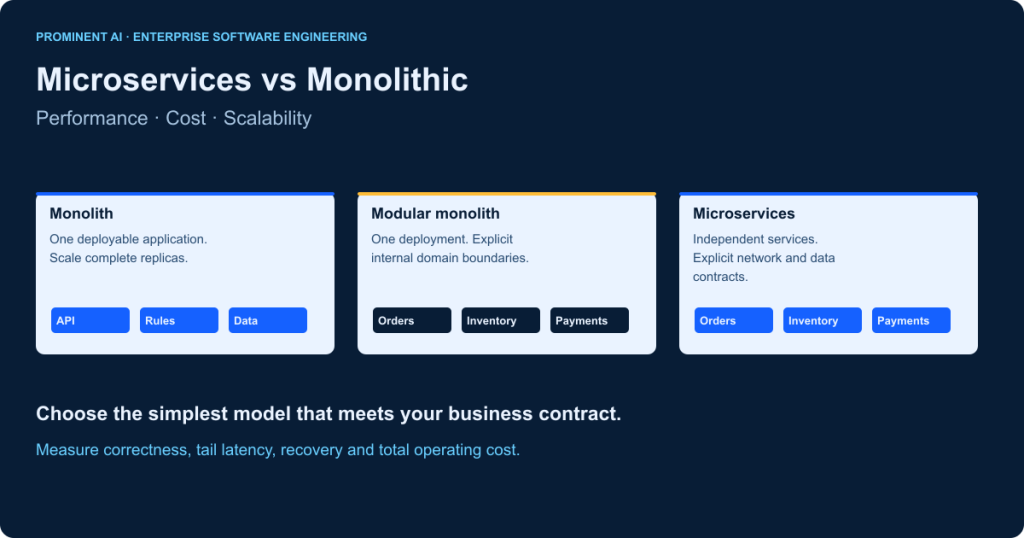
Microservices vs monolithic architecture is a decision about deployment and operational boundaries. A monolith ships an application as one deployable unit; microservices separate business capabilities into independently deployable services. A modular monolith keeps one deployment while enforcing internal domain boundaries. Monoliths can scale horizontally, and microservices do not automatically improve performance or reduce cost. Choose around the independence your teams and workloads actually need, then validate latency, data consistency, recovery and total operating cost. For a small team with evolving requirements, a well-structured modular monolith is often a practical starting point.
Key takeaways
- Deployment independence is the useful distinction; repository count and API count are poor substitutes.
- Measure a complete business transaction, including failed attempts and recovery.
- Keep data ownership explicit, even when modules share physical infrastructure.
- Consider a modular monolith before paying the ongoing cost of distribution.
- Extract services incrementally when a measurable business requirement justifies the boundary.
What is monolithic architecture?
A monolithic application is released as a single application unit. It can contain UI endpoints, business rules and data-access layers within one process. A request enters the API, invokes business logic and accesses persistence without a network call between every internal layer. That says little about code quality: a carefully structured application and a tightly coupled legacy system can both be monoliths.
A common deployment uses multiple application replicas behind a load balancer and a separately managed database. Externalise session state where necessary and account for scheduled jobs, caches and database contention. The application can therefore scale out, although each replica carries the complete deployed unit. A single process also creates a shared runtime failure boundary. AWS’s architecture comparison is a useful introduction; scaling and reliability still require workload-specific design.

What is microservices architecture?
Microservices organise software around business capabilities with independently deployable implementations and explicit communication contracts. Orders, inventory and payments might be separate services when their responsibilities and owners are stable. They communicate through APIs or asynchronous messages, rather than relying on unrestricted access to one another’s internals.
Distribution brings identity propagation, discovery, network failure, compatible contracts and operational ownership into ordinary application work. Centralised logs, distributed traces and deployment automation become necessary capabilities. A collection of small HTTP endpoints that must always release together is closer to a distributed monolith than independent services. Microsoft’s architecture guidance describes these responsibilities.

What is a modular monolith?
A modular monolith has one deployment but deliberately separates domains inside it. Orders exposes an application contract; Inventory owns its rules and persistence conventions; Payments hides provider integration. Internal calls usually remain in-process. Other modules cannot simply query private tables or import implementation classes because doing so is convenient.
Enforce boundaries through project references, visibility rules, architecture tests and code review. Give module data an owner, avoid circular dependencies, and version externally consumed contracts. Shared infrastructure does not require shared business ownership. A local transaction can remain useful where modules genuinely share a transactional boundary, but coupling through that transaction should be an explicit decision.
This approach is attractive when the domain is changing, releases can be coordinated and independent operations offer little immediate value. It is not a promise that later extraction will be effortless. Module contracts, data dependencies and external integrations still need migration work. Fowler’s Monolith First describes the difficulty of discovering stable boundaries at the beginning of a product.

Microservices vs monolithic architecture: key differences
The matrix distinguishes a conventional monolith from an intentionally modular one. These are design tendencies, not guaranteed outcomes or numerical rankings. The implementation must demonstrate the claimed independence.
| Dimension | Monolith | Modular monolith | Microservices |
|---|---|---|---|
| Deployment | One application | One application | Independent service releases |
| Structure | Layers or domains | Explicit domain modules | Business capabilities |
| Modularity | Must be enforced | Tested internal contracts | Network and data contracts |
| Development complexity | Fewer runtime boundaries | Boundary discipline | Distributed-system concerns |
| Initial speed | Simple shared setup | Some modular design investment | Platform setup and contracts |
| Latency | In-process internal calls | In-process module calls | Network/serialization overhead |
| Throughput | Workload dependent | Workload dependent | Workload dependent |
| Scaling | Full-unit replicas or scale-up | Full-unit replicas or scale-up | Per-service where supported |
| Compute use | Whole application footprint | Whole application footprint | Per-service sizing; idle overhead |
| Networking | External dependencies | External dependencies | Also inter-service paths |
| Database | Often shared schema | Owned module data conventions | Private logical stores/contracts |
| Transactions | Local transaction where possible | Local transaction if intentionally shared | Local transactions plus coordination |
| Consistency | Database and external boundaries | Explicit module invariants | Explicit cross-service convergence |
| Fault isolation | Shared process | Shared process | Potential process isolation |
| Availability | Replicas and dependency design | Replicas and dependency design | Dependency-chain design |
| Disaster recovery | Application and data restoration | Application and data restoration | Coordinated multiple-component recovery |
| Tests | Unit, integration, end-to-end | Also module-boundary tests | Also API/event contract tests |
| Monitoring | Application and dependencies | Also module signals | Per-service plus end-to-end |
| Debugging | Single-process path | Module-aware local path | Correlated distributed diagnosis |
| DevOps | One main application pipeline | One main pipeline; module checks | Many owned delivery paths |
| CI/CD | Coordinated deployable | Coordinated deployable | Compatible independent deployments |
| Security | Process and application access | Module policies in shared process | Also workload identities and channels |
| Infrastructure cost | Typically fewer components | Typically fewer components | More separately operated components |
| Operating cost | Shared runtime operations | Also modularity maintenance | Also contracts, messaging and platform |
| Team autonomy | Needs coordination | Domain ownership; shared release | Independent ownership if boundaries fit |
| Release independence | Whole deployed unit | Whole deployed unit | Service-level, when verified |
| Maintenance | Coupling determines difficulty | Boundary discipline matters | Contract/runtime estate matters |
| Vendor dependency | Hosting/framework/data choices | Hosting/framework/data choices | Also broker/orchestration choices |
| Migration | Current dependencies matter | Extraction still needs data work | Boundary changes cross network/data |
| Business fit | Simple application scope | Growing cohesive domains | Justified autonomy/isolation |
One repository can contain many independently deployed services. Multiple repositories can still enforce tightly coupled releases. Containers package software; Kubernetes orchestrates workloads. Neither determines the architecture by itself. Fowler’s Microservice Trade-Offs explains why autonomy has a distribution and operations cost.
Microservices vs monolithic performance: which is faster?
There is no universal winner. An in-process call avoids the serialization, network transfer and remote scheduling of a service call. A remote boundary can nevertheless help isolate a heavy workload or let it use a different resource configuration. Database queries, connection pools, caching and contention can dominate either design.
The 2022 IEEE Access performance and scalability evaluation compared a reference application implemented in Java and C#.NET across local, Azure Spring Cloud and Azure App Service environments. Its findings varied with deployment, computational intensity and scaling configuration. Those historical runtimes and prices do not establish today’s cheapest architecture, and the reference workload is not a substitute for your checkout path.
A reproducible comparison framework
Implement equivalent browsing, cart, checkout, inventory-update and order-creation behaviour. Use the same seeded dataset, correctness checks, authentication requirements and acceptance criteria. Pin code commits, dependencies, runtime versions, database settings, region and test-client location. Record replicas and autoscaling policy; do not call unlike resource allocations equivalent merely because both use three containers.
Run cold-start, steady-state, peak-load and recovery tests separately. Use a fixed arrival schedule as well as concurrency-based tests so a slow server does not silently reduce offered load. A suggested protocol is a documented warm-up followed by five measured trials per configuration, with randomised execution order. This is a proposed test plan; no project benchmark is claimed.
| Operation | Fixed contract | Acceptance evidence |
|---|---|---|
| Browse | Fixed catalogue/query/cache state | Response correctness, latency and scan load |
| Cart | Stable user/cart identity; identical updates | Concurrency correctness and conflicts |
| Checkout | Same inventory/payment simulator contract | Accepted completion, duplicate prevention |
| Inventory update | Same contention and retry policy | Reservation correctness and backlog age |
| Order creation | Same durable acceptance requirement | Persistence, replay and settlement |
Capture requests per second, p50/p95/p99 latency, errors, CPU, memory, database wait/load and bytes transferred. Separate successful checkout completion from an HTTP acknowledgement that only accepted a job. Include timeouts, retries and eventual settlement in the business outcome. Cost per successful request equals attributable test-window cost divided by accepted successful requests, with failed work included in the numerator. Preserve raw results and analyse tail latency instead of comparing only averages.
Monolithic vs microservices scalability
Scale vertically by allocating a larger instance, or horizontally by adding replicas. Both approaches can apply to a monolith. They stop helping when a shared bottleneck, such as database locking or a serial job, dominates. Adding application replicas may increase database connections and make that bottleneck worse.
In an illustrative promotion, checkout processing grows faster than catalogue browsing. A monolith can add full application replicas. With a justified service boundary, checkout can scale separately while catalogue capacity remains stable. That can improve resource allocation, but only if payment providers, inventory reservations, databases and gateway limits can support the additional work.
Use measured queue depth, service time and accepted completion rate to configure scaling. Stateful services need state placement and partitioning plans; a queue needs age and backlog monitoring. Minimum replicas, cold starts, failover headroom and uneven tenant demand affect the economics. Independent scaling is valuable when its measured benefit exceeds additional infrastructure and engineering overhead.
Microservices vs monolithic cost: compare total ownership
A monolith commonly needs application compute, persistence, a load balancer, delivery automation and monitoring. A modular monolith adds deliberate module engineering and boundary tests while retaining one deployment. Microservices can add separately reserved capacity, gateways, broker operations, network transfer, multiple data stores, telemetry pipelines and more deployment/security work.
Do not assume every service needs its own physical database server or Kubernetes cluster. Conversely, hiding shared database or platform-team expenses makes a distributed design look artificially cheap. Count idle capacity, incident response, certificate rotation, dependency upgrades and contract maintenance as well as active requests.
Monthly TCO = compute + data/storage + gateways/load balancing + messaging + billable networking + telemetry + delivery tooling + security/support services + operational labour + amortised implementation or migration. Use incremental costs for an incremental decision, and fully allocated costs for estate planning. State which perspective applies.
| Planning input | A: early SaaS | B: enterprise modules | C: multi-team platform |
|---|---|---|---|
| Team / scope | 4 engineers; 4 modules | 12 engineers; 8 modules | 40 engineers; 15 candidate capabilities |
| Requests / month | 1 million | 20 million | 300 million |
| Peak concurrent requests | 50 | 300 | 2,000 |
| Initial compute test | 2 replicas × 730 h | 3 replicas × 730 h | Per-capability replicas × active hours |
| Service alternative | 4 logical services; measure each minimum | Extract 2 justified workloads first | Measure separate checkout and other pools |
| Database fixture | 20 GB; transactional reads/writes | 500 GB; mixed transactions/reporting | 5 TB; hot partitions and projections |
| Network planning input | 100 GB/month | 1,000 GB/month | 20,000 GB/month |
| Release frequency | Weekly | Several per week | Daily per owning team where useful |
| Telemetry assumption | One app; 14-day diagnostic retention | Module/service traces; 30-day retention | Sampled traces; owned signals; 30 days |
| Ops effort sensitivity | 20 / 40 / 80 h/month | 80 / 160 / 320 h/month | 320 / 640 / 1,280 h/month |
| Region/currency | East US / USD | East US / USD | East US / USD |
| Rate verification | Required; no rates entered | Required; no rates entered | Required; no rates entered |
These are synthetic planning inputs, not sizing recommendations. For each candidate, enter actual instance counts, resource profiles, active hours, database configuration, storage, network meters and retention. The region is East US, USD for comparison only; no vendor rates have been entered. The companion worksheet requires a rate verification date and leaves monetary totals unknown until every applicable line is priced.
For compute, sum instance-hours multiplied by the matching configuration’s rate; include vCPU/memory/request meters when using consumption billing. Model database, broker, gateway and logging tiers according to their actual billing units. Multiply engineering operations hours by an agreed loaded hourly cost, then add one-time work divided by the chosen amortisation period. Avoid counting shared platform labour twice. Rerun for UK, Canadian, Australian, German, Dutch or Irish deployment requirements rather than converting one USD subtotal into a local quote.
Reliability, fault isolation and resilience
A process failure can affect every module in a monolith; replicas and recovery controls can reduce its user impact. A service boundary can isolate a failure, but a synchronous checkout chain still depends on every required participant. A shared database, identity provider or routing layer can remain a common failure point.
Set explicit timeouts and retry only appropriate transient failures. Bound attempts, use backoff and jitter, and make repeated commands safe. A timeout does not prove a payment failed. The Retry pattern and Circuit Breaker pattern address different failure behaviours.
Use bulkheads to limit resource exhaustion. Queue buffering can protect a downstream worker, but backlog age and recovery capacity matter. Define graceful degradation explicitly: catalogue browsing may continue during recommendation failure, while an uncertain payment should enter a recoverable pending state. Exercise backup restoration and dependency failure; more services do not automatically provide disaster recovery.
Database architecture and data consistency
Service-owned data means other services use an approved contract instead of writing private tables. Logical stores can share physical infrastructure when isolation, ownership and resource requirements permit. Direct cross-service joins and shared schema migrations can defeat release independence. Microsoft’s data considerations explain this coupling.
For checkout, create a pending order, reserve inventory, request payment authorisation and confirm or compensate according to business rules. A saga coordinates local transactions. Compensation is a new business operation, not a guaranteed database rollback; a refund, reservation release or manual review may have its own failures. Record correlation, event identity and state transitions.
An outbox persists a state change and publication intent within the applicable local transaction boundary. A relay can redeliver, so consumers need durable deduplication or idempotent effects. This does not make an external payment exactly once. Reconcile ambiguous provider outcomes before issuing another charge.
CQRS separates write and read responsibilities. A reporting projection can avoid chatty cross-service queries but adds synchronisation and freshness obligations; it need not imply event sourcing. A modular monolith can retain a local transaction where justified, while keeping cross-domain coupling visible. Choose the consistency contract from business invariants, not the architecture’s fashionable label.
Security comparison
A monolith has fewer internal network endpoints, but a process compromise can expose more application capability. Microservices can narrow identity and data permissions per service while increasing the number of endpoints, credentials, policies and dependencies that require maintenance. Neither is automatically secure.
Validate user authentication and resource-level authorisation at the responsible service. A gateway’s token validation does not establish that a caller may access a particular tenant’s order. Use appropriate workload identity, encrypted transport, managed secrets, rotation and least privilege. Avoid forwarding arbitrary user tokens or trusting internal traffic merely because it originates inside a network.
Threat-model tenant isolation, message tampering, replay, dependency compromise and administrative access. Audit significant decisions without recording unnecessary personal information in logs or trace attributes. Patch base images and libraries, test denied access and define incident ownership. Product selection alone is not a compliance claim. Our AI security guidance covers additional risks when AI features enter these applications.
Development speed, testing and deployment
A single application can simplify onboarding, local debugging and transaction tests. Maintain module-focused unit and integration tests so every change need not rely on a slow end-to-end suite. One deployable unit still benefits from feature flags, staged releases and automated rollback.
Independent services need contract tests, compatible API/event evolution and repeatable environment setup. Prove that one service can deploy while its consumers remain on the previous version. Database changes need an expand/migrate/contract strategy rather than rollback assumptions that discard newly written data. Coordinate the few changes that genuinely cross boundaries.
Distributed traces connect spans across requests and services; combine them with metrics and structured logs to distinguish a slow dependency from a failed business action. Retain useful context while controlling telemetry volume and sensitive fields. Teams need an owner who can diagnose and operate each deployed service. Architecture cannot manufacture team autonomy when every release still needs the same shared approval bottleneck.
Microservices vs monolithic architecture in .NET
An ASP.NET Core modular monolith can use separate domain projects, dependency injection, EF Core and SQL Server, with public module interfaces and private implementations. Deploy the application to an appropriate App Service or Container Apps configuration. The following structural C# example illustrates an in-process contract; its implementation, persistence, authorisation and tests are deliberately omitted.
public interface IInventoryReservations
{
    Task<bool> TryReserveAsync(Guid orderId, string sku,
        int quantity, CancellationToken cancellationToken);
}

// Orders depends on the contract, not Inventory's DbContext.
// A durable implementation must enforce a unique reservation key
// and define concurrency, release and replay behaviour.
In a microservices version, Orders invokes an Inventory API or publishes a command, with an independent identity, deployment and data contract. The remote version needs timeout handling, compatible messages, correlation and idempotency. Do not silently replace a local interface with HTTP and assume its reliability or transaction semantics remain unchanged.
As checked on 30 October 2026, Microsoft lists .NET 10 as LTS through November 2028. Choose a supported patched runtime and verify hosting compatibility. Illustrative snippets here have not been deployed or load-tested in Azure. The architectural comparison also applies to Node.js/TypeScript: language and repository layout do not determine deployment boundaries.
Microservices on Azure vs AWS
On Azure, App Service can suit straightforward HTTP applications, Container Apps can provide managed container deployment and per-app scaling, and AKS suits requirements for Kubernetes-level control. Microsoft’s compute comparison describes their different operating models. API Management, Service Bus, Azure SQL and Azure Monitor/Application Insights can fulfil relevant gateway, messaging, persistence and telemetry roles.
On AWS, representative choices include ECS with Fargate for managed container compute, EKS for Kubernetes, API Gateway for appropriate API exposure, SQS/SNS for queueing and pub/sub, RDS for relational persistence and CloudWatch for monitoring. These are options to assess, not a mandatory shopping list. Validate current regional features, quotas, security and pricing in the chosen services. A monolith can use managed cloud hosting too; containers and serverless execution are packaging/compute choices, not proof of microservices. References: ECS/Fargate · EKS · SQS · RDS ·
Illustrative enterprise architecture examples
These are hypothetical decision contexts, not client projects. The recommendation is a starting point for assessment, not an outcome claim.
| Industry | Requirement | Candidate approach | Important trade-off |
|---|---|---|---|
| E-commerce | New catalogue/cart/checkout product | Modular monolith; extract hot checkout only if proven | Measure reservation contention; protect customer/payment boundaries |
| Banking/finance | Account workflows with strong invariants | Retain transactional core; assess bounded surrounding services | Reconciliation and authorisation outweigh service count |
| Insurance | Claims and policy teams release differently | Modular domains; services for stable independent capabilities | Protect sensitive claims and version business events |
| Healthcare administration | Scheduling and administrative integrations | Simple modular core plus bounded adapters | Purpose-limited access and reliable external-system reconciliation |
| Manufacturing | Plant operations and delayed telemetry | Hybrid with separately scaled ingestion where justified | Handle offline plants and timestamp ordering |
| Logistics | Shipment events and planning workloads | Separate event processing if peaks justify it | Control duplicates and tenant/supplier visibility |
| SaaS | Small team; changing tenant requirements | Modular monolith with explicit tenant boundaries | Load-test noisy tenants before extracting services |
| CRM/ERP integration | Existing core and multiple external APIs | Adapters and asynchronous workers around retained core | Rate limits, secrets, idempotency and auditability |
Monolith to microservices migration
Start with the business constraint: a release bottleneck, independently varying workload or reliability boundary. Inventory modules, integrations and database dependencies; map domain responsibilities with business specialists. Domain analysis helps identify meaningful boundaries without pretending that every entity needs a service.
Establish baseline correctness, performance, incidents and cost. Strengthen tests, CI/CD and observability before extraction, and consider modularising first. Select a bounded candidate with manageable dependencies. Introduce routing and an anti-corruption layer where legacy concepts need translation. A Strangler Fig route gradually redirects accepted functionality while the remainder stays operational.

Move data ownership deliberately. Backfill a known snapshot, capture permitted changes, reconcile records and define which system is authoritative at each stage. Avoid uncontrolled dual writes. Establish event identity, replay and compensation before cutover. Validate functionality, authorisation, peak load and recovery; use controlled traffic switching and observable rollback criteria. Monitor production and retire the replaced path only after acceptance and retention requirements are satisfied.
Keep an accepted hybrid if further extraction has no business value. Migration is not justified merely because a monolith is old, especially when it meets service targets and the team cannot operate additional boundaries. Updating its runtime, modularity or delivery process may address the actual constraint more economically.
Common microservices architecture mistakes
| Mistake | Impact | Mitigation |
|---|---|---|
| Premature decomposition | Unstable network boundaries | Discover and modularise domains first |
| Tiny services | Chatty calls and overhead | Group cohesive responsibilities |
| Distributed monolith | Coordinated releases plus network risk | Test independent deployment |
| Shared table writes | Schema coupling and unclear ownership | Use owned contracts |
| Long synchronous chains | Tail latency and cascading failures | Reduce hops; use justified async work |
| Missing observability | Slow incident diagnosis | Trace end-to-end business operations |
| Unbounded retries | Amplified load and duplicate effects | Bound attempts and enforce idempotency |
| Weak contracts | Breaking consumer releases | Compatibility and contract tests |
| No service owner | Unmaintained operations | Name delivery and on-call ownership |
| No consistency policy | Unreconciled business state | Define saga, recovery and reconciliation |
| Platform proliferation | Excess operational burden | Standardise justified capabilities |
| Unnecessary Kubernetes | Cluster work without business value | Evaluate simpler managed hosting |
| Insufficient tests | Unsafe extraction/cutover | Correctness, access and failure tests |
| No cost control | Hidden idle/telemetry expense | Workload budgets and cost ownership |
| Weak secrets handling | Expanded compromise paths | Managed secrets, rotation and least privilege |
| Unclear domains | Repeated cross-service changes | Revisit business boundaries |
When should you choose each architecture?
For a small team, an uncertain domain and no demonstrated need for independent deployment, begin by evaluating a modular monolith. This is an engineering recommendation, not a universal rule. Regulatory isolation, existing organisational boundaries or a highly asymmetric workload can justify a different starting point.
| Decision input | Assessment |
|---|---|
| Product maturity | Uncertain → keep boundaries easy to change |
| Domain complexity | Cohesive modules first; split stable capabilities |
| Team size | Count operational capacity, not headcount alone |
| Team independence | Services help only if owners can release/operate |
| Release frequency | Measure actual coordination bottlenecks |
| Traffic volume | High volume alone does not require services |
| Traffic distribution | Asymmetric demand may justify extraction |
| Scaling needs | Prove independent-resource benefit |
| Latency needs | Keep critical hot paths short |
| Availability | Map dependency and failure boundaries |
| Compliance | Derive isolation from actual obligations |
| Infrastructure | Reuse an effective existing platform |
| Operational maturity | Close automation/recovery gaps first |
| Budget | Fund full lifecycle, including people |
| Time to market | Prefer simpler operation for early validation |
| Integration complexity | Use explicit adapters and consistency contracts |
| Future expansion | Record evidence that would trigger reassessment |

Record the decision, rejected alternatives and evidence that would trigger reassessment. Microsoft’s readiness assessment provides an ongoing review structure. An architecture decision should remain revisable as product needs and operating capability change.
Production architecture readiness checklist
| Readiness area | Acceptance criterion |
|---|---|
| Domains and ADRs | Owners approve boundaries, invariants and alternatives |
| SLOs and capacity | Peak workload meets accepted latency/error/freshness targets |
| Security | Allowed/denied tenant and service-identity tests pass |
| Delivery and tests | Repeatable build, deployment and compatibility checks |
| Observability | A transaction can be traced to its durable outcome |
| Resilience | Timeout, duplicate delivery and dependency failure are exercised |
| Backup and recovery | Restore and reconcile within agreed RPO/RTO |
| Cost | Dated rates, complete meters and labour assumptions reviewed |
| Ownership | Named support, rollback triggers and operational runbooks |
How Prominent AI Services LLP can help
Prominent’s published offerings include custom software development, API and system integration, DevOps services and legacy modernization. Agree an architecture review, technical assessment, proof of concept, implementation or engineering-support scope around your actual constraints.
A useful assessment produces a dependency map, decision record, test protocol and operating-cost assumptions before recommending wholesale decomposition. For related lifecycle context, see MLOps and DevOps. AI models add lifecycle responsibilities; they do not by themselves require an application to become microservices.
Frequently asked questions
What is the difference between microservices and monolithic architecture?
Are microservices faster than monolithic applications?
Are microservices more scalable than monoliths?
Are microservices more expensive?
What is a modular monolith?
Is a modular monolith better than microservices?
Can monolithic applications scale horizontally?
When should a startup use microservices?
What are the disadvantages of microservices?
Why do microservices need more monitoring?
Can microservices share one database?
What is a distributed monolith?
What is the Strangler Fig pattern?
How do you migrate a monolith to microservices?
Are microservices suitable for .NET applications?
Do microservices require Kubernetes?
Which architecture is more secure?
Which architecture is easier to maintain?
When should enterprises avoid microservices?
How should performance and cost be evaluated?
Choose an architecture your team can operate
Prefer the simplest deployment model that satisfies the business contract. Preserve clear domains, measure real workloads and introduce distributed boundaries where their benefits justify their cost. Discuss Your Software Architecture to define an assessment or implementation scope.
Technical sources checked 30 October 2026. Workloads and cost scenarios are illustrative; no customer outcomes, cloud benchmark results or savings are claimed.