
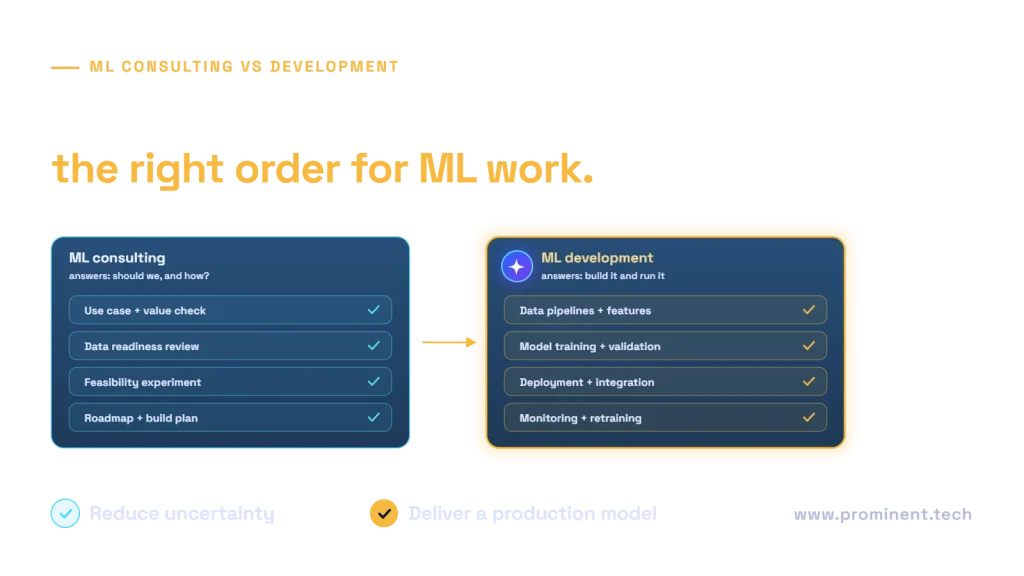
Machine learning consulting helps you decide whether and how to use ML: which problem is worth solving, whether your data supports it, what a model could realistically achieve and what it would take to run. Machine learning development builds and operates the solution: data pipelines, model training and validation, deployment, integration and monitoring. If your use case, data and success measure are still uncertain, start with consulting or a short discovery phase. If they are clear and validated, go straight to development. Many organizations need a little of both, in that order.
Key takeaways
- Consulting reduces uncertainty; development delivers a working, monitored model.
- Most failed ML projects fail on problem framing and data, not on algorithms.
- A time-boxed feasibility experiment is often the best bridge between the two.
- Development without ownership of monitoring and retraining is only half the job.
- Choose a partner that can do both, so the advice is grounded in delivery reality.
ML consulting vs ML development compared
| Aspect | ML consulting | ML development |
|---|---|---|
| Main question | Should we use ML here, and how? | How do we build and run it reliably? |
| Typical outputs | Use-case assessment, data review, feasibility results, roadmap | Pipelines, trained model, APIs, integration, monitoring |
| Typical duration | A few weeks | Several months, then ongoing operation |
| Team | ML architect, data scientist, business analyst | Data engineers, ML engineers, software and DevOps engineers |
| Success measure | A confident go/no-go decision and plan | Model performance and business impact in production |
| Main risk if skipped | Building the wrong thing | A good idea that never reaches production |
Durations are indicative and depend on scope and data. For budgets, see machine learning development cost.
Which do you need first?
Two questions decide it: how clearly defined is the problem and success measure, and how ready is the data? If both are clear, development can start. If either is uncertain, a short consulting or discovery phase pays for itself by avoiding months of work on the wrong target.
- Start with consulting if you have an idea but no baseline, no labelled data, or no agreement on what “good” looks like.
- Start with development if you have a validated use case, accessible data, a clear metric and a place for the model to run.
- Consider whether ML is needed at all. Rules, analytics or an off-the-shelf service may solve it; see custom ML model vs off-the-shelf platform.
What ML consulting should deliver
- Problem framing: the decision the model supports, the users and the cost of errors.
- Value estimate: how much a realistic improvement over the current process is worth.
- Data assessment: sources, volume, quality, labels, access and privacy constraints; see the AI-ready data playbook.
- Baseline and feasibility: a simple model or experiment that shows what is achievable.
- Architecture and operating model: where the model runs, who owns it and how it is monitored.
- Roadmap: phases, team, budget range and decision points.
Good consulting ends with a decision, not just a slide deck. The NIST AI Risk Management Framework is a useful lens for the risk part of that decision.
What ML development should deliver
- Reproducible data pipelines and feature engineering.
- Training, evaluation and validation against the agreed metric and a baseline.
- Deployment as an API, batch job or embedded component, integrated with your systems.
- Monitoring for data drift, performance and cost, with retraining procedures; see MLOps vs DevOps.
- Governance: documentation, approvals and model risk controls; see ML governance and model risk management.
Google’s Rules of Machine Learning remain a sound guide to building ML systems pragmatically.
The bridge: a feasibility sprint
A time-boxed feasibility sprint, often two to six weeks, joins the two. It uses real data to build a baseline model, measures it against the agreed metric and produces a go/no-go recommendation with a build plan. It limits spending until the evidence is in. Our product discovery guide describes the same principle for software in general.
Common mistakes
- Hiring developers before agreeing on the metric and the decision the model supports.
- Paying for strategy work that never touches real data.
- Treating a notebook prototype as a production system.
- Splitting advice and delivery across vendors with no shared accountability.
- Forgetting the people and process changes needed to use the model’s output.
When choosing a partner, the checklist in how to choose a machine learning development company helps.
Common questions
What is the difference between ML consulting and ML development?
Consulting decides whether and how to use machine learning for a problem. Development builds, deploys and operates the model and its data pipelines.
Do I always need ML consulting first?
No. If the use case, data and success metric are already clear and validated, you can start development directly, usually with a short alignment phase.
How long does ML consulting take?
Usually a few weeks for assessment and feasibility, depending on the number of use cases and data access.
Can one company do both?
Yes, and it often helps: advice grounded in delivery experience is more realistic, and the build team understands the reasoning behind the plan.
What should I have ready before talking to an ML partner?
The business problem, current process and its cost, the data you think is relevant and who owns it, and how you would measure success.
Start with the right ML engagement
Our custom machine learning development team runs feasibility sprints and builds production models, and our business analysis team frames the problem first.