
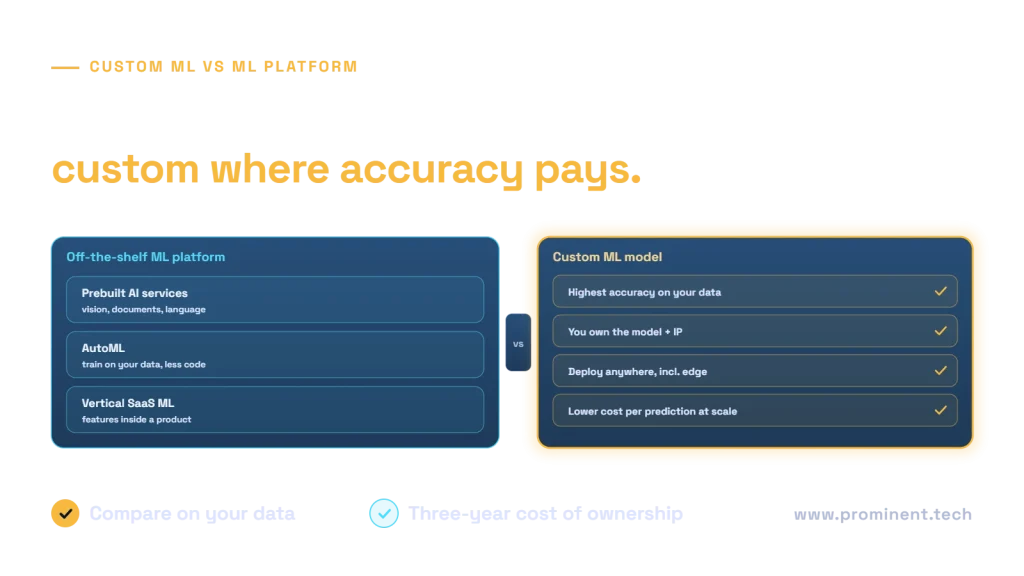
Choose an off-the-shelf ML platform, such as prebuilt AI services, AutoML or ML features inside a SaaS product, when it reaches the accuracy you need on your own data, fits your deployment and data terms, and its per-prediction pricing works at your volume; choose a custom ML model when accuracy on your specific domain is a competitive advantage, you need full ownership of the model, deployment flexibility such as on-premises or edge, explainability for regulated decisions, or lower cost per prediction at high scale. The decision should be tested, not assumed: benchmark the platform on a representative sample of your data, compare three-year total cost, and consider the common middle path of customising a platform model before building from scratch.
Key takeaways
- Benchmark prebuilt services on your own data before deciding; demos rarely reflect your edge cases.
- Custom models win on domain accuracy, ownership, deployment flexibility and cost at very high volume.
- Platforms win on speed, maintenance and breadth for common tasks.
- Customisable platform models, such as custom document or vision models, are a practical middle step.
- Compare three-year cost, including retraining, monitoring and per-prediction fees.
The spectrum of ML options
| Option | Examples | Your effort |
|---|---|---|
| Prebuilt AI service | Document extraction, image tagging, translation, speech; see Azure AI services | Integration only |
| Customisable prebuilt model | Custom document or image models trained on your labelled examples | Labelling and integration |
| AutoML | Platform searches models for your tabular, text or image data; see automated ML | Data preparation and evaluation |
| Custom ML model | Model designed and trained for your problem and data | Full ML lifecycle |
This is narrower than the broader question of buying AI products versus building AI applications, which we cover in build vs buy AI.
Decision criteria
| Criterion | Favours platform | Favours custom |
|---|---|---|
| Accuracy needed | Good enough for the task | Domain-specific accuracy is a competitive edge |
| Data | Little labelled data | Large, proprietary labelled data |
| Volume | Low to moderate predictions | Very high volume where per-call fees add up |
| Deployment | Cloud API acceptable | On-premises, edge or strict latency |
| Explainability | Not critical | Regulated decisions need detailed explanations |
| Ownership | Vendor terms acceptable | Model must be your IP |
| Team | Limited ML skills | ML engineering available in-house or via a partner |
A decision path
When custom is the answer, plan the full lifecycle; see machine learning development cost and MLOps vs DevOps.
Comparing three-year cost
Platform costs scale with usage, while custom models front-load cost and then run cheaply per prediction, but need ongoing monitoring and retraining. Illustrative: at 50,000 document pages a month, a prebuilt extraction service may cost far less than a custom model; at 5 million pages a month with specialised layouts, a custom model can pay back within a year. Run the numbers for your volumes.
Ownership and lock-in
- Check who owns custom models trained in a platform and whether they can be exported.
- Keep labelled data and evaluation sets in your own storage.
- Abstract model calls behind your own interface so you can switch later.
- Read data terms: is your data used to improve the vendor’s models?
For selecting a partner if you build, see how to choose an ML development company.
Common questions
Should we build a custom ML model or use an off-the-shelf platform?
Use a platform if it meets your accuracy target on your data at acceptable cost and terms. Build custom when domain accuracy, ownership, deployment needs or volume economics justify it.
Is AutoML good enough?
Often for tabular and standard problems, and it is a fast way to set a baseline. Complex, domain-specific or high-stakes problems may need custom modelling.
When is a custom model cheaper?
Usually at very high prediction volumes, or when a platform’s per-call pricing and limits do not fit, after accounting for build and maintenance costs.
Can we start with a platform and switch later?
Yes, if you keep your data and evaluation sets and call the model through your own interface.
Who owns a model trained on our data in a platform?
It depends on the vendor’s terms. Check ownership, export rights and data use before you commit.
Make the custom vs platform decision with evidence
Share the task and a sample of your data. Our custom machine learning team will benchmark platform options against a custom approach and compare three-year cost.