
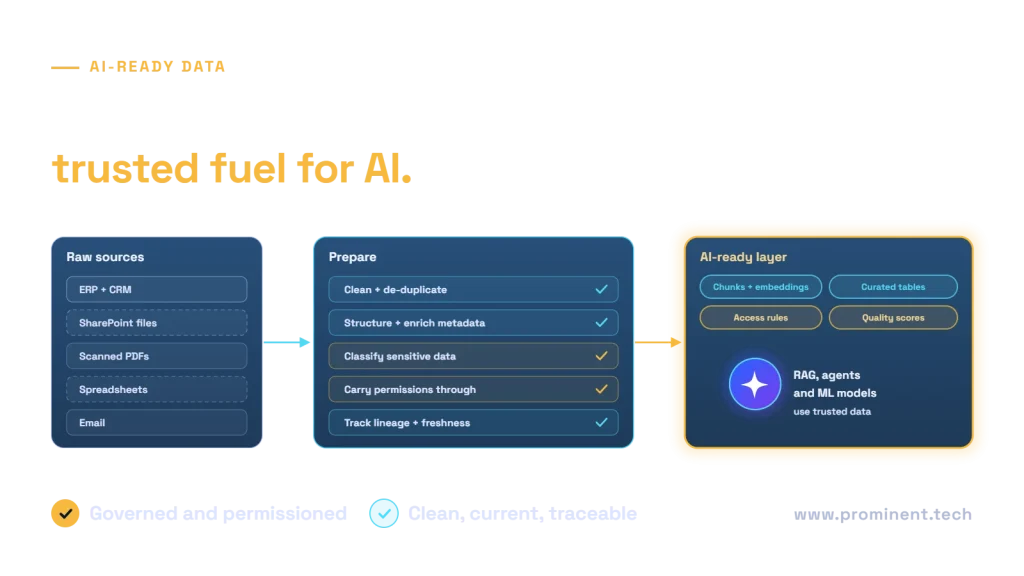
AI-ready data is data that an AI system can find, trust, understand and is allowed to use: it is accurate and current, consistently structured, described with metadata, classified for sensitivity, tagged with access permissions and traceable back to its source. Getting there is less about buying new tools and more about a repeatable preparation process: inventory the sources a use case needs, clean and structure them, enrich them with metadata, carry permissions through, and keep quality and freshness monitored. This playbook walks through each step, with checks you can apply to your own data before an AI project starts.
Key takeaways
- AI-ready data is defined per use case. Prepare the data one AI use case needs, not “all company data”.
- Generative AI needs unstructured content prepared as well as structured tables: documents, policies, emails and manuals.
- Permissions are part of data readiness. An AI system must not reveal content a user could not open themselves.
- Metadata such as owner, date, version and sensitivity is what lets AI choose the right source and cite it.
- Readiness is not a one-off clean-up. Freshness, quality and lineage must be monitored continuously.
What makes data AI-ready?
Traditional data quality focuses on reports: are the numbers correct and complete? AI adds new demands, because a model will read, combine and act on the data without a person checking each record. The table below summarises the dimensions that matter.
| Dimension | What it means for AI | Simple test |
|---|---|---|
| Accurate | Facts are correct, so answers and actions are correct | Spot-check a sample against the system of record |
| Current | Superseded versions are removed or clearly marked | Can the AI tell the latest policy from last year’s? |
| Consistent | The same thing has the same name and format everywhere | Do customer IDs and product codes match across systems? |
| Described | Metadata says what the data is, who owns it and when it changed | Does each document have an owner, date and type? |
| Classified | Sensitive and personal data is labelled | Can you list where personal data sits in scope? |
| Permissioned | Access rights travel with the data into the AI layer | Would a junior user’s AI answer reveal a board paper? |
| Traceable | Every answer can be traced back to its source | Can the AI cite the document and version it used? |
How AI changes data quality requirements
For machine learning models, the focus is training data: representative, labelled and free of leakage between training and test sets. For generative AI and retrieval-augmented generation (RAG), the focus shifts to unstructured content: documents need to be split into meaningful chunks, enriched with metadata and indexed so the right passage is retrieved. Duplicate or outdated documents are especially harmful here, because the model may confidently quote the wrong version. Our RAG architecture guide explains how retrieval works.
For AI agents, data readiness also covers the systems they act on. Records must be reliable enough to base actions on, and the agent’s access must be limited to what its task requires.
The six-step AI-ready data playbook
1. Inventory the sources for one use case
List every source the use case needs: databases, document libraries, file shares, email archives and third-party systems. For each, record the owner, format, volume, update frequency and how it is accessed today. This keeps the scope realistic and exposes gaps early.
2. Profile and clean
Measure completeness, duplicates, conflicting values and outdated content. Remove or archive superseded documents, fix key identifiers and standardise formats such as dates and units. Our data cleaning and preprocessing service covers this step.
3. Structure and enrich
Convert scans to text with document AI, split long documents into sections that keep headings and context, and add metadata: owner, date, version, document type, product, region and audience. Rich metadata lets retrieval filter to the right content and lets answers cite sources.
4. Classify and protect
Label personal, confidential and regulated data. Decide what may be sent to an AI model, what must be masked and what must stay out of scope. Data protection law such as the GDPR applies to AI processing just as it does to any other use.
5. Carry permissions through
Map existing access controls from the source systems into the AI layer, so retrieval only returns content the requesting user may see. This is one of the most important and most often skipped steps. Governance tools such as Microsoft Purview help classify data and track where it flows.
6. Monitor quality, freshness and lineage
Automate checks that run on every refresh: row counts, null rates, schema changes, document age and failed conversions. Track lineage so you know which sources feed which AI features. When a source changes, you can then find and re-test the affected features.
A reference architecture for AI-ready data
A layered approach keeps raw data, cleaned data and AI-ready assets separate, so each can be governed and rebuilt independently. The medallion pattern of bronze, silver and gold layers is a common way to organise this. See medallion architecture explained. On Microsoft platforms, Microsoft Fabric can host the lakehouse and pipelines, with Purview governance for classification and lineage.
AI-ready data checklist
| Check | Ready when |
|---|---|
| Scope | Sources for one named use case are listed with owners |
| Duplicates and versions | Superseded documents are archived or clearly marked |
| Identifiers | Key IDs match across the systems being combined |
| Text extraction | Scanned and image-based documents are converted and checked |
| Metadata | Owner, date, version and type exist for each document |
| Sensitivity | Personal and confidential data is classified and handled by rule |
| Permissions | Access rules are enforced in retrieval, verified with test users |
| Freshness | Refresh schedules exist and failures raise alerts |
| Lineage | You can trace any AI answer back to its source and version |
| Test set | Real questions or cases with known correct answers are collected |
Common AI-ready data mistakes
- Indexing everything. Loading every file share into a vector index brings in outdated, duplicate and sensitive content. Start from the use case.
- Ignoring permissions. A single shared index without access filtering can expose confidential documents to everyone.
- Treating it as a one-off project. Data changes daily; without monitoring, readiness decays within weeks.
- Losing structure. Splitting documents without keeping headings, tables and context makes retrieval less accurate.
- No owner. Every source needs a named owner who can fix problems when quality checks fail.
Preparing data well is also the most reliable way to control AI project cost, as we show in custom AI integration cost.
Common questions
What is AI-ready data?
Data that is accurate, current, consistent, described with metadata, classified for sensitivity, permission-controlled and traceable, so AI systems can use it safely and cite it.
Do we need a data lake or lakehouse to be AI-ready?
Not always. A focused use case can work directly with well-governed sources. A lakehouse helps when several AI use cases share data and need consistent quality, lineage and security.
How long does it take to make data AI-ready?
For one use case with a handful of sources, typically four to eight weeks. Large, messy document estates or many systems take longer.
Is AI-ready data different for RAG and for machine learning?
Yes. Machine learning focuses on representative, labelled training data. RAG focuses on clean, current, well-chunked documents with metadata and permissions.
How do we keep data AI-ready over time?
Automate quality and freshness checks on every refresh, assign source owners, track lineage and re-test AI features when sources change.
Prepare your data for AI with confidence
Tell us the AI use case you have in mind and the sources it depends on. Our data engineering team will assess readiness, fix the gaps and build a governed pipeline that keeps your data AI-ready.