
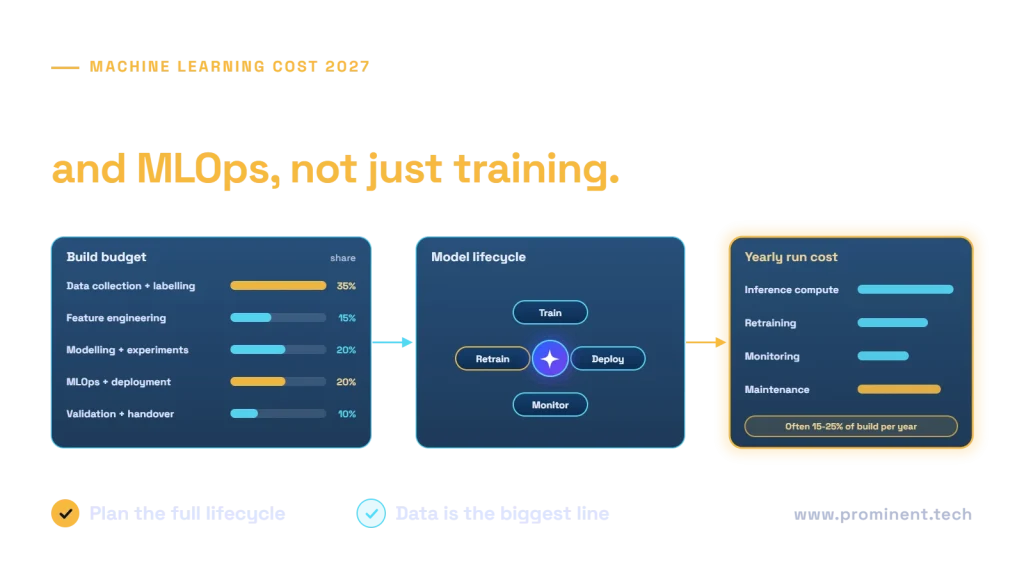
In 2027, machine learning development cost typically ranges from US$30,000 to US$90,000 for a predictive model on structured business data, US$60,000 to US$200,000 for a custom computer vision, NLP or forecasting model that needs new data collection or labelling, and US$150,000 to US$500,000 or more for an ML platform running several models with full MLOps. Running costs for inference, retraining, monitoring and maintenance usually add 15 to 25 percent of the build cost per year. Data preparation is the largest single line, often a third or more of the budget. These are indicative planning ranges; data availability, accuracy targets and deployment requirements decide where a project lands.
Key takeaways
- Machine learning development cost is driven by data first: availability, quality and labelling effort.
- Production ML needs MLOps for deployment, monitoring and retraining. Budget for it from the start.
- Accuracy targets have steep cost curves; agree the business value of each extra point of accuracy.
- Many problems once solved with custom ML can now start with foundation models. Compare before you build.
- Release budget in phases: data assessment, proof of value, production, then scale.
Machine learning development cost by project type
| Project type | Examples | Indicative build cost (USD) | Typical timeline |
|---|---|---|---|
| Predictive model on structured data | Churn prediction, lead scoring, demand forecasting from existing records | $30,000 – $90,000 | 2 – 4 months |
| Custom model with new data | Computer vision inspection, document classification, specialised NLP | $60,000 – $200,000 | 3 – 6 months |
| ML platform or multiple models | Several models sharing features, pipelines, monitoring and governance | $150,000 – $500,000+ | 6 – 12 months |
Ranges assume a blended onshore and offshore team and cloud ML services. Real-time, edge or regulated deployments sit at the top of each band. See examples in AI demand forecasting and predictive maintenance using machine learning.
Where a machine learning budget goes
Building the model itself is a minority of the work. As the well-known paper Hidden Technical Debt in Machine Learning Systems showed, the surrounding data, configuration, serving and monitoring infrastructure is far larger than the model code.
Machine learning development cost drivers
- Data availability. Using existing, clean historical records is far cheaper than collecting new data.
- Labelling. Supervised models need labelled examples. Expert labelling, such as for medical images or legal documents, is costly.
- Accuracy target. Moving from 85 to 95 percent accuracy can cost more than reaching 85 percent did.
- Explainability and fairness. Regulated decisions need explainable models, bias testing and documentation.
- Deployment target. Batch scoring is cheapest; real-time APIs and edge devices add engineering.
- Integration. Feeding predictions into business systems and workflows. See adding AI to existing software.
- MLOps maturity. Automated pipelines, versioning and monitoring cost more up front but reduce long-term cost.
Running and maintenance costs
| Cost line | What drives it | Indicative monthly range (USD) |
|---|---|---|
| Inference compute | Prediction volume, latency needs, model size | $100 – $5,000 |
| Training and retraining | Retraining frequency, data volume, GPU needs | $100 – $3,000 |
| Data pipelines and storage | Feature pipelines, refresh schedules, retention | $100 – $2,000 |
| Monitoring | Drift detection, performance tracking, alerting | $50 – $800 |
| Maintenance and improvement | Investigating drift, new features, upgrades | Usually 15 – 25% of build per year |
Model the compute side with the provider’s calculator, for example Azure Machine Learning pricing. Models degrade as the world changes, so plan for monitoring and retraining from day one. See MLOps vs DevOps and the Google Cloud MLOps maturity guide.
Custom machine learning or foundation models?
Since 2023, many text and image tasks that once required custom models, such as classification, extraction and summarisation, can be prototyped quickly with foundation models and prompts. Custom ML still wins when you have large volumes of structured data, need very low cost per prediction at scale, require tight latency, or must explain each decision. A practical approach is to prototype with a foundation model, measure accuracy and cost per prediction, and train a custom model only where it clearly beats that baseline. See RAG vs fine-tuning vs prompt engineering and fine-tuning with LoRA and QLoRA.
A worked machine learning cost estimate
Illustrative, fictional example: a distributor wants to forecast weekly demand for 5,000 products using three years of sales history.
| Line | Assumption | Amount (USD) |
|---|---|---|
| Data assessment and preparation | Clean sales history, add promotions and seasonality features | $22,000 |
| Modelling and validation | Compare baseline and ML models, back-test accuracy | $18,000 |
| MLOps and integration | Weekly pipeline, ERP write-back, monitoring | $20,000 |
| Running cost | $600 a month compute, storage and monitoring | $7,200 |
| Maintenance | 20% of build for retraining reviews and improvements | $12,000 |
| First-year total | $79,200 |
Weigh this against measured benefits such as lower stock-outs and reduced excess inventory during a pilot on a subset of products.
How to reduce machine learning development cost
- Assess data first. A short data assessment avoids building on data that cannot support the target accuracy.
- Start with a simple baseline. Rules or simple models often deliver most of the value and set the bar for complex ones.
- Use managed ML services for training, deployment and monitoring instead of building infrastructure.
- Label smartly. Active learning and model-assisted labelling reduce expert time.
- Agree accuracy against value. Stop when extra accuracy no longer pays for itself.
Common questions
How much does machine learning development cost in 2027?
Indicatively, US$30,000 to US$90,000 for a predictive model on existing structured data, US$60,000 to US$200,000 for a custom model needing new data, and US$150,000 to US$500,000 or more for an ML platform, plus 15 to 25 percent of build per year to run and maintain.
What is the most expensive part of an ML project?
Usually data collection, preparation and labelling, followed by MLOps for deployment, monitoring and retraining.
How long does it take to build a machine learning model?
Two to four months for a predictive model on existing data, three to six months for custom models needing new data, and six to twelve months for a platform.
Is it cheaper to use generative AI instead of custom ML?
Often for prototypes and text tasks. Custom ML can be cheaper and more accurate at high volumes, for structured data and where decisions must be explained.
Why do ML models need ongoing budget?
Data and behaviour change over time, so models drift. Monitoring, retraining and maintenance keep accuracy at the level the business relies on.
Get a machine learning estimate grounded in your data
Share the prediction you need, the data you hold and how results will be used. Our custom machine learning model development team will assess your data and give you a phased estimate with clear accuracy and value targets. For broader AI budgets, see custom AI integration cost.