
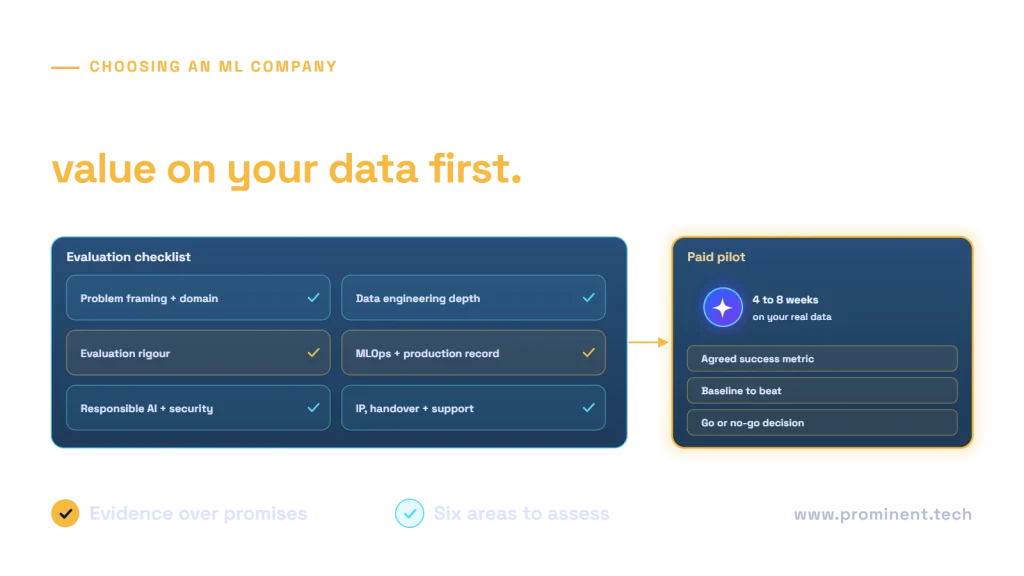
Choose a machine learning development company that frames your business problem before proposing models, shows real data engineering and MLOps capability, evaluates models rigorously against a baseline, has production systems to reference, takes responsible AI and security seriously, and gives you ownership of models, code and data pipelines. The most reliable way to compare candidates is a short paid pilot on your own data with an agreed success metric and a go or no-go decision at the end. This guide gives first-time AI buyers a checklist of questions, red flags and engagement models.
Key takeaways
- Good ML partners start with the business problem and data, not with algorithms.
- Ask to see production systems and how they are monitored, not just demos.
- Insist on a measurable baseline and a held-out evaluation.
- Make sure you own the models, code, pipelines and documentation.
- Run a paid pilot on your data before committing to a large engagement.
Six areas to evaluate in a machine learning development company
| Area | What good looks like |
|---|---|
| Problem framing and domain | Asks about decisions, users and value before suggesting models |
| Data engineering | Assesses data quality, builds reliable pipelines and features |
| Evaluation rigour | Defines baselines, held-out tests and business-relevant metrics |
| MLOps and production | Deploys, monitors and retrains models in production |
| Responsible AI and security | Tests for bias, explains models where needed, protects data |
| Ownership and handover | You own the IP; documentation and knowledge transfer are planned |
Questions to ask a machine learning development company
- How would you frame our problem, and what decision will the model improve?
- What data would you need, and how will you check it is sufficient?
- What simple baseline will the model have to beat?
- How will you evaluate the model, and on which metric we care about?
- Can you show a model you put into production and how it is monitored?
- How do you handle drift and retraining? See MLOps vs DevOps.
- Would a foundation model or a simpler approach work instead of custom ML?
- How do you test for bias and explain predictions?
- How is our data secured and where is it processed?
- Who owns the models, code and pipelines, and what do we receive at the end?
The NIST AI Risk Management Framework and Google’s People + AI Guidebook are useful references for judging how seriously a partner treats risk and user experience.
Run a paid pilot on your own data
A four to eight week paid pilot, sometimes called a proof of value, is the best evidence you can get. It shows how the partner works with your data and people, and whether the approach beats the baseline. Check your data first with our AI-ready data playbook, and see typical budgets in machine learning development cost.
Engagement models
| Model | Best for |
|---|---|
| Paid pilot or proof of value | Testing feasibility and the partner on a defined problem |
| Fixed-scope project | A well-defined model and integration with clear acceptance criteria |
| Dedicated team | Ongoing ML roadmap with several models; see hire ML developers |
| Advisory plus your team | Building internal capability with expert guidance |
Red flags when choosing an ML partner
- Promising accuracy figures before seeing your data.
- No baseline or evaluation plan.
- Only demos and research projects, no production references.
- Vague answers on monitoring, retraining and support.
- Retaining ownership of models trained on your data.
- Recommending complex deep learning where simpler methods would do.
For a structured scoring approach you can adapt, see our partner evaluation scorecard, and for deciding whether to build at all, see build vs buy AI.
Common questions
How do I choose a machine learning development company?
Assess problem framing, data engineering, evaluation rigour, MLOps, responsible AI and ownership terms, check production references and run a paid pilot on your own data.
What should an ML proposal include?
Problem framing, data assessment, baseline, evaluation metric and method, delivery plan, deployment and monitoring approach, team, costs and ownership terms.
How long should an ML pilot take?
Typically four to eight weeks, ending with an evaluation against the baseline and a clear go or no-go decision.
Should we own the trained model?
Yes. Models trained on your data, plus code, pipelines and documentation, should belong to you, subject to licences of any third-party components.
Do we need custom ML or can we use generative AI?
It depends on the task. A good partner will compare foundation-model approaches with custom ML on your data and recommend the cheaper option that meets the target.
Evaluate us on your data
Share the prediction or decision you want to improve. Our custom machine learning team will propose a focused paid pilot with an agreed baseline, metric and decision point.