
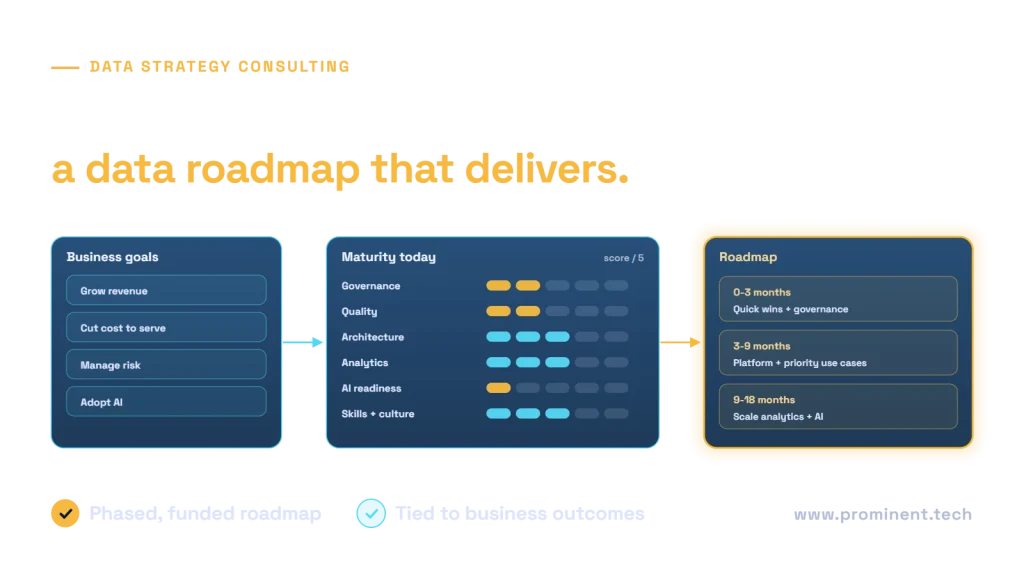
Data strategy consulting helps an organisation decide what data it needs to achieve its business goals and how to collect, govern, store and use that data, then turns those decisions into a funded, phased roadmap. A modern data strategy engagement typically runs 6 to 12 weeks and delivers a current-state maturity assessment, prioritised use cases tied to measurable outcomes, a target data architecture, a governance and operating model, and an 18-month roadmap with a business case. It now also has to make the organisation ready for AI, because analytics and AI share the same foundations: trusted, well-governed and accessible data.
Key takeaways
- Start from business outcomes, not technology. Every element of the strategy should trace back to a goal.
- Assess maturity across governance, quality, architecture, analytics, AI readiness, and skills and culture.
- Prioritise a small number of high-value use cases and fund them in phases.
- Governance and ownership matter as much as platform choice.
- A good engagement ends with quick wins in the first 90 days, not just a document.
Signs you need a data strategy
- Different reports give different answers to the same question.
- Teams spend more time finding and fixing data than analysing it.
- Data sits in disconnected systems, spreadsheets and departmental tools.
- Nobody is clearly accountable for key data such as customers, products or finances.
- AI pilots stall because the data they need is inaccessible, inconsistent or sensitive.
- Platform decisions are made project by project, leading to duplicated tools and cost.
How a data strategy consulting engagement works
1. Discover
Interview leaders and data users, review systems, reports and existing initiatives, and map how data flows today. Understand the pain points and what has been tried before.
2. Define outcomes and use cases
Translate business goals into measurable outcomes, then list the analytics and AI use cases that would move them. Score each use case on value, feasibility and data readiness. Our business analysis team often leads this step.
3. Assess maturity
Rate current capability across governance, quality, architecture, analytics, AI readiness, and skills and culture, using a recognised reference such as the DAMA Data Management Body of Knowledge.
4. Design the target state
Define the target architecture, such as a lakehouse with layered data, along with the governance model, data ownership, security and the skills required.
5. Build the roadmap and business case
Sequence the work into phases, estimate cost and benefit, and agree the first 90 days, including quick wins that build momentum.
Deliverables to expect from a data strategy engagement
| Deliverable | What it contains | Who uses it |
|---|---|---|
| Current-state assessment | Systems, data flows, pain points, maturity scores | Leadership, IT, data teams |
| Prioritised use case portfolio | Use cases scored on value, feasibility and data readiness | Business sponsors |
| Target data architecture | Platform, layers, integration, security and AI enablement | Architects, engineering |
| Governance and operating model | Data owners and stewards, policies, quality standards, decision rights | Data office, business units |
| Roadmap | Phased plan over 12 to 18 months, with dependencies and milestones | Programme management |
| Business case | Costs, benefits, risks and funding phases | Finance, executive sponsors |
| First 90-day plan | Quick wins, team setup, first platform and governance steps | Delivery teams |
Assessing data maturity
Maturity scores are most useful as a way to find the weakest links that block priority use cases, not as a grade. For example, a strong analytics team cannot deliver trusted dashboards if data quality and ownership score low. Typical early investments include data quality checks and observability; see data quality frameworks compared and data pipeline observability.
Making the data strategy AI-ready
A modern data strategy has to support AI as well as reporting. That means planning for unstructured content such as documents and emails, metadata and lineage, permission-aware access and data classification. Our AI-ready data playbook explains the preparation steps, and the AI agent readiness checklist helps prioritise agent use cases.
On Microsoft platforms, the target architecture often centres on Microsoft Fabric, with governance through Purview. See our guides to Microsoft Fabric architecture, Fabric governance and Power BI vs Microsoft Fabric.
Choosing a data strategy consulting partner
- Business first. They should start with your goals and use cases, not a preferred product.
- Delivery experience. A strategy written by people who build data platforms is more realistic about effort and risk.
- Vendor neutrality where it matters. Platform recommendations should be justified against your needs.
- Practical outputs. Expect a roadmap you can fund and start, not only a maturity report.
- Knowledge transfer. Your team should own the strategy and be able to update it.
Common questions
What does data strategy consulting include?
Typically a current-state assessment, prioritised use cases, a target data architecture, a governance and operating model, a phased roadmap and a business case, plus a plan for the first 90 days.
How long does a data strategy engagement take?
Usually 6 to 12 weeks, depending on the size of the organisation, the number of business units and how much existing documentation is available.
Do we need a data strategy before starting AI projects?
Not before every project, but AI at scale depends on governed, accessible data. A data strategy prevents each AI project from rebuilding the same foundations.
What is the difference between data strategy and data governance?
Data strategy sets the goals, priorities and roadmap for data. Data governance is one part of it: the roles, policies and controls that keep data trusted and secure.
Who should own the data strategy?
A senior business sponsor, often supported by a chief data officer or head of data, with data owners named in each business domain.
Build a data strategy you can act on
Share your business goals and the data challenges you face. Our data engineering and business analysis teams will assess your maturity, prioritise use cases and deliver a phased roadmap with quick wins in the first 90 days.