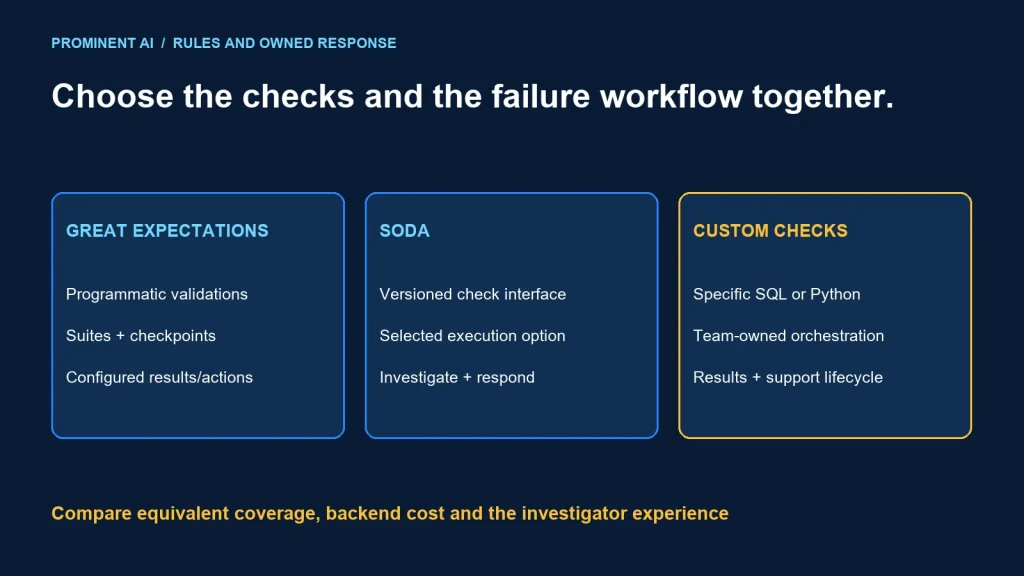
Choose a data quality framework by the checks you must express, the systems where they run and the people who must respond when they fail. Great Expectations, Soda and custom checks can all support validation, but their configuration, integration and ownership costs differ. A tool is useful only when its results lead to an appropriate pipeline or business decision.
Key takeaways
- Compare specific versions and product editions, not an open-source library against an entire commercial platform.
- Separate rule execution from incident ownership and release gating.
- Measure query and scan costs as well as subscription and engineering effort.
- Test both known failures and valid edge cases before production rollout.
Compare like-for-like deployment options
Great Expectations
The GX Core overview describes a Python validation workflow: data and batches are connected to Expectation Suites through Validation Definitions, with Checkpoints and Actions supporting execution and result handling. Data Docs provides human-readable definitions and validation results. Check API compatibility for the installed version; older examples can use a different configuration model.
Evaluate GX when a programmatic Python workflow and reusable assertions fit the engineering team. Prototype the actual data backend and operational result path instead of judging only an interactive notebook demonstration.
Soda
Soda documentation covers contract-based checks, developer tools, integrations and product experiences for investigating and responding to issues. Distinguish the selected library, agent and cloud offering. Soda’s older SodaCL documentation and newer contract interfaces should not be mixed into one unversioned implementation recipe.
Evaluate the exact deployment option with the people who author rules and triage failures. Confirm backend support, data handling, result storage and licensing. Do not assume every feature described for a hosted product is included in every local component.
Custom SQL or Python checks
Custom checks can be appropriate for a small, specific validation surface or a business rule that does not map cleanly to an existing framework. The team then owns execution, rule versioning, result schemas, alert routing, documentation and upgrades. A short query can be easy to write while the surrounding operating system remains substantial work.
Great Expectations vs Soda vs custom checks
| Decision area | GX Core candidate | Soda candidate | Custom checks |
|---|---|---|---|
| Rule authoring | Python-based Expectations and suites | Selected version’s contract/check interface | Team-defined SQL, Python or configuration |
| Data execution | Verify supported backend and batch design | Verify selected connector and execution option | Implement connections and query execution |
| Results | Validation results and configured documentation/actions | Selected local or product result workflow | Define storage, retention and presentation |
| CI integration | Wrap validations in explicit build policy | Wrap supported checks in explicit build policy | Build exit-status and artifact handling |
| Ownership | Configure response and support process | Verify available collaboration workflow | Implement response and support process |
This matrix is a selection worksheet rather than a complete product inventory. Validate the exact edition, versions and connectors before treating an entry as an implementation commitment.
Design the checks before selecting the framework
Start with the data contract. Write down what a consumer is entitled to rely on: key uniqueness, acceptable missing values, valid business states, reference integrity and freshness. Agree on the consequence of each failure with the data owner.
| Check family | Illustrative rule | Interpretation caution |
|---|---|---|
| Completeness | Required order identifier is present | Not every optional field needs zero nulls |
| Uniqueness | One accepted row per declared business key | History tables may legitimately repeat an entity |
| Validity | Status belongs to the approved state set | New legitimate states need a controlled rule update |
| Reconciliation | Accepted target totals match the source contract | Counts alone do not prove correct transformations |
| Freshness | Expected partition arrives by the agreed deadline | No new business activity differs from a failed load |
Use fixtures for valid data, known defects and ambiguous edge cases. Test a deliberately broken dataset to prove the gate can fail. A report showing all green checks is weak evidence if no one has verified that the checks detect their intended defects.
CI validation and production monitoring have different jobs
CI can verify rule syntax, configuration and behavior on controlled fixtures before a change is merged. Production validation examines real data and needs safe handling of failures. A failed production rule may require stopping publication, quarantining a partition or alerting an owner; define that response explicitly.
Versioned contract + fixtures
  → CI rule tests
  → approved validation release
  → production data checks
  → structured results and evidence
  → block, quarantine or alert by severity
  → owned investigation and accepted resolution
Distinguish “data failed a rule” from “the validation service could not run.” A connection failure should not be recorded as passing data quality. Store run identifiers, dataset versions, rule versions and execution errors so incident review can reconstruct what happened.
Keep sensitive failed-row samples under the appropriate access policy. Broadly accessible notifications should contain enough context to route the incident without exposing unnecessary personal or confidential records.
Total-cost assumptions
Compare the same dataset scope and rule coverage over the same period. Use current quotes and actual backend measurements rather than assuming open-source means cost-free or hosted means less engineering in every environment.
| Cost line | Assumption to record | Evidence |
|---|---|---|
| Software or subscription | Selected edition and required features | Current licensing and quote |
| Backend compute | Datasets scanned, frequency and query shape | Measured warehouse or cluster consumption |
| Implementation | Connections, rules, result storage and orchestration | Pilot engineering effort |
| Operations | Alert triage, rule changes and upgrades | Observed support workload |
| Governance | Evidence retention and sample-data controls | Approved operating requirements |
A large number of cheap checks can still create expensive scans or alert fatigue. Group work where supported, avoid unnecessary full-table validation and measure important rules at a frequency justified by the business contract.
A practical selection process
- Select one important dataset and its accountable owner.
- Define a small set of rules covering distinct failure modes.
- Implement equivalent checks in shortlisted options.
- Run valid, invalid and execution-failure cases.
- Inspect backend cost and the investigator’s workflow.
- Agree on rollout, upgrade and evidence ownership.
Choose the option that expresses the rules correctly and supports a sustainable response process. A framework with a long feature list can still be a poor fit if the team cannot maintain its rules or interpret its failures.
For replay-sensitive ingestion, use the CDC architecture guide. For execution bottlenecks, use the PySpark tuning tutorial. Quality validation and performance testing should support the same data contract.
Common questions
Which data quality framework fits modern ETL pipelines?
The best fit depends on rule coverage, backend support, integration and ownership. Compare equivalent checks and failure workflows in a bounded pilot.
Are custom SQL checks enough?
They can be for a specific scope, provided the team also owns execution, results, alerting, versioning and maintenance.
Should every failed check stop the pipeline?
No universal policy applies. Define severity and response with the data owner; critical contract failures and informational anomalies can require different actions.
Does a passing suite prove all data is correct?
No. It establishes only that the executed checks passed for the tested data and configuration. Review coverage and untested assumptions.
Can old framework examples be reused unchanged?
Check version and edition compatibility first. Interfaces and operating models evolve, especially across major releases.
Choose checks that lead to owned decisions
Bring dataset contracts, representative defects and operational requirements to a review. Request a data engineering pipeline assessment to select and integrate an appropriate validation approach.