
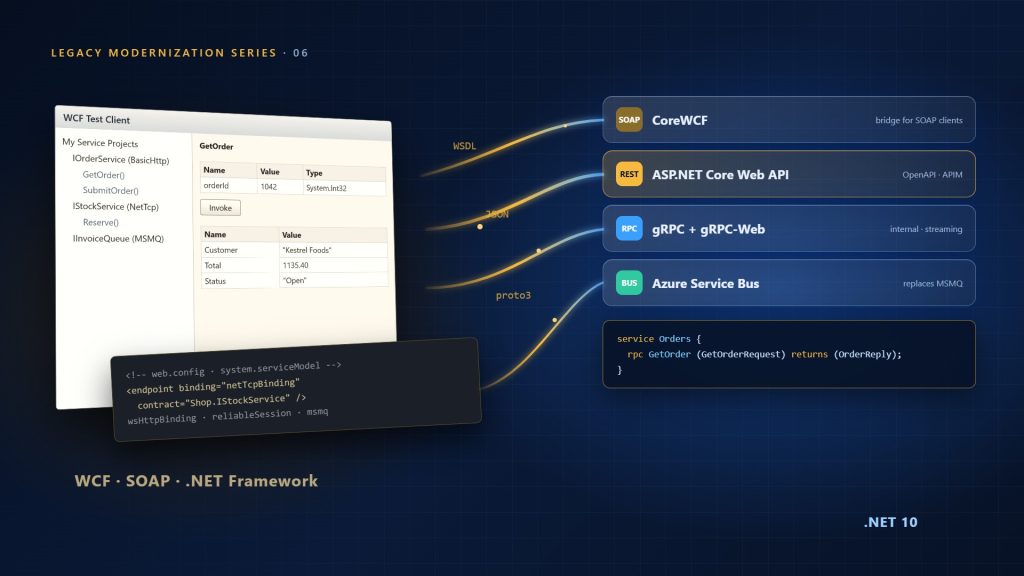
A WCF to gRPC migration, or a move to ASP.NET Core Web API, replaces Windows Communication Foundation services hosted on .NET Framework with modern endpoints on .NET 10. WCF server hosting is not part of modern .NET, so every service needs one of three paths: keep the SOAP contract on CoreWCF, redesign as HTTP/JSON with ASP.NET Core Web API, or redesign as gRPC for fast, contract-first service-to-service calls. The right choice depends on who calls the service, not on what the service does.
Technically reviewed by Harshita Pipaliya.
This is the sixth article in our Legacy Modernization Series. It follows our guides to MVC 5 and VB.NET upgrades, where WCF is usually the last blocker standing.
Executive summary
- WCF server is not in .NET 10. Microsoft’s porting guidance says “WCF server can be used in .NET 6+ by using the CoreWCF NuGet packages” (Microsoft Learn). WCF client libraries for modern .NET are maintained separately (dotnet/wcf on GitHub).
- CoreWCF is supported, with conditions. At CoreWCF 1.0 (April 2022), Microsoft said “Microsoft Product Support will be available for CoreWCF customers”, with support depending on the .NET platform it runs on, and also recommended considering “more modern alternatives to SOAP such as gRPC” (.NET Blog).
- Tooling: Microsoft’s GitHub Copilot app modernization includes an “Upgrading WCF to CoreWCF” skill for server-side services (Microsoft Learn).
- Target platform: .NET 10 LTS, supported to November 14, 2028 (.NET support policy).
- Our recommendation: use CoreWCF where external or unchangeable clients depend on SOAP; use ASP.NET Core Web API for browser, partner and general integration traffic; use gRPC for internal, high-volume service-to-service calls. Many estates use all three, with CoreWCF as a bridge rather than an end state.
WCF in 2026: what is supported
| Item | Status |
|---|---|
| WCF services on .NET Framework 4.8.1 | Supported as part of .NET Framework; no new features |
| WCF server on .NET 10 | Not included; use CoreWCF NuGet packages |
| CoreWCF | Open-source port of the WCF service side; Microsoft Product Support available (2022 announcement) |
| WCF client on .NET 10 | System.ServiceModel.* client packages from the dotnet/wcf project |
| gRPC on ASP.NET Core | First-class, contract-first RPC framework (Microsoft Learn) |
| ASP.NET Core Web API | First-class HTTP/JSON APIs with OpenAPI |
What Microsoft has and hasn’t said. Microsoft points to CoreWCF for WCF server on modern .NET and has suggested gRPC as a modern alternative to SOAP. We did not find a current Microsoft page that names one official replacement for every WCF service, or a current CoreWCF binding support matrix for .NET 10. Check CoreWCF’s release notes for the features you use.
Why WCF services are hard to retire
- Clients you don’t control. Partners, desktop apps and other teams generated proxies from your WSDL years ago.
- WS-* features. Message security, reliable sessions, transactions and federation are hard to reproduce elsewhere.
- Non-HTTP transports.
NetTcpBinding, named pipes and MSMQ are common in internal systems. - Duplex and callbacks. Server-to-client callbacks have no direct REST equivalent.
- Configuration in
web.config/app.config. Bindings, behaviors and endpoints define behaviour that is invisible in code.
Three target options
| Target | What changes for callers | Best for | Watch out for |
|---|---|---|---|
| CoreWCF | Nothing, if bindings and features are supported | External SOAP clients, quick unblocking of a .NET 10 upgrade | Partial WS-* coverage; keeps SOAP as technical debt |
| ASP.NET Core Web API | New HTTP/JSON contract (OpenAPI) | Browser, mobile, partner and low-code integrations | Contract redesign; versioning |
| gRPC | New Protobuf contract and generated clients | Internal service-to-service, streaming, high throughput | Browser clients need gRPC-Web; HTTP/2 infrastructure |
Decision guide: CoreWCF vs Web API vs gRPC
| If the service… | Choose | Why |
|---|---|---|
| Has external SOAP clients you cannot change | CoreWCF now; Web API alongside later | Keeps the WSDL contract stable |
| Is called by browsers, mobile apps, Power Platform or partners | ASP.NET Core Web API | Widest client support, OpenAPI tooling |
Is internal .NET-to-.NET over NetTcpBinding | gRPC | Closest replacement for fast binary RPC |
| Uses duplex callbacks or streaming | gRPC streaming or SignalR | Built-in bidirectional streaming |
| Uses MSMQ for queued calls | Azure Service Bus or another broker; CoreWCF MSMQ as a bridge | Moves to supported messaging |
| Relies on distributed transactions | Redesign (outbox, sagas) | Avoid coupling services through transactions |
| Is rarely used | Retire it | Check logs before migrating anything |
This guide is our recommendation from delivery experience. For a broader API style comparison, see REST vs GraphQL vs gRPC for enterprise applications.
Binding and feature mapping
| WCF | CoreWCF | Web API | gRPC |
|---|---|---|---|
BasicHttpBinding | Supported | Replace with HTTP/JSON | Replace with Protobuf over HTTP/2 |
WSHttpBinding | Supported, some WS-* features not | Replace; use OAuth 2.0 / mTLS | Replace; use TLS + tokens |
NetTcpBinding | Supported, some WS-* features not | Not applicable | Natural replacement |
WebHttpBinding (REST-style WCF) | Supported | Natural replacement | Possible |
| Named pipes | CoreWCF package available | Not applicable | gRPC over named pipes or Unix sockets |
| MSMQ | CoreWCF package available | Not applicable | Use a message broker |
[ServiceContract] / [OperationContract] | Kept | Controllers or minimal API endpoints | service / rpc in .proto |
[DataContract] | Kept | DTO records (System.Text.Json) | message in .proto |
FaultException<T> | Kept | ProblemDetails (RFC 9457) | RpcException with status codes |
| Duplex callback contracts | Check support | SignalR or webhooks | Server or bidirectional streaming |
CoreWCF binding notes are from the CoreWCF 1.0 announcement and the CoreWCF repository’s package list; confirm details for your version.
Code translation patterns
The examples below are illustrative and simplified.
WCF service contract on .NET Framework:
[ServiceContract]
public interface IOrderService
{
    [OperationContract]
    [FaultContract(typeof(OrderFault))]
    OrderDto GetOrder(int orderId);
}

[DataContract]
public class OrderDto
{
    [DataMember] public int Id { get; set; }
    [DataMember] public string Customer { get; set; }
    [DataMember] public decimal Total { get; set; }
}
Option 1: CoreWCF on .NET 10 (same contract, new host):
var builder = WebApplication.CreateBuilder(args);
builder.Services.AddServiceModelServices().AddServiceModelMetadata();
builder.Services.AddSingleton<IServiceBehavior, UseRequestHeadersForMetadataAddressBehavior>();

var app = builder.Build();
app.UseServiceModel(sb =>
{
    sb.AddService<OrderService>();
    sb.AddServiceEndpoint<OrderService, IOrderService>(
        new BasicHttpBinding(BasicHttpSecurityMode.Transport), "/OrderService.svc");
});
app.Run();
Option 2: ASP.NET Core Web API (minimal API):
app.MapGet("/api/orders/{id:int}", async (int id, IOrderRepository repo) =>
    await repo.FindAsync(id) is { } order
        ? Results.Ok(order)
        : Results.Problem(statusCode: 404, title: "Order not found"))
   .RequireAuthorization("orders.read")
   .WithName("GetOrder");
Option 3: gRPC (orders.proto plus service):
syntax = "proto3";
option csharp_namespace = "Shop.Orders";

service Orders {
  rpc GetOrder (GetOrderRequest) returns (OrderReply);
}
message GetOrderRequest { int32 order_id = 1; }
message OrderReply {
  int32 id = 1;
  string customer = 2;
  string total = 3; // decimal as string, or a custom money message
}
public sealed class OrdersService(IOrderRepository repo) : Orders.OrdersBase
{
    public override async Task<OrderReply> GetOrder(GetOrderRequest request, ServerCallContext context)
    {
        var order = await repo.FindAsync(request.OrderId)
            ?? throw new RpcException(new Status(StatusCode.NotFound, "Order not found"));
        return new OrderReply { Id = order.Id, Customer = order.Customer, Total = order.Total.ToString("F2") };
    }
}
// Program.cs: builder.Services.AddGrpc();  app.MapGrpcService<OrdersService>();
Note on decimals: Protobuf has no decimal type. Agree a representation (string or units-and-nanos message) before migrating financial services.
Recommended target architecture
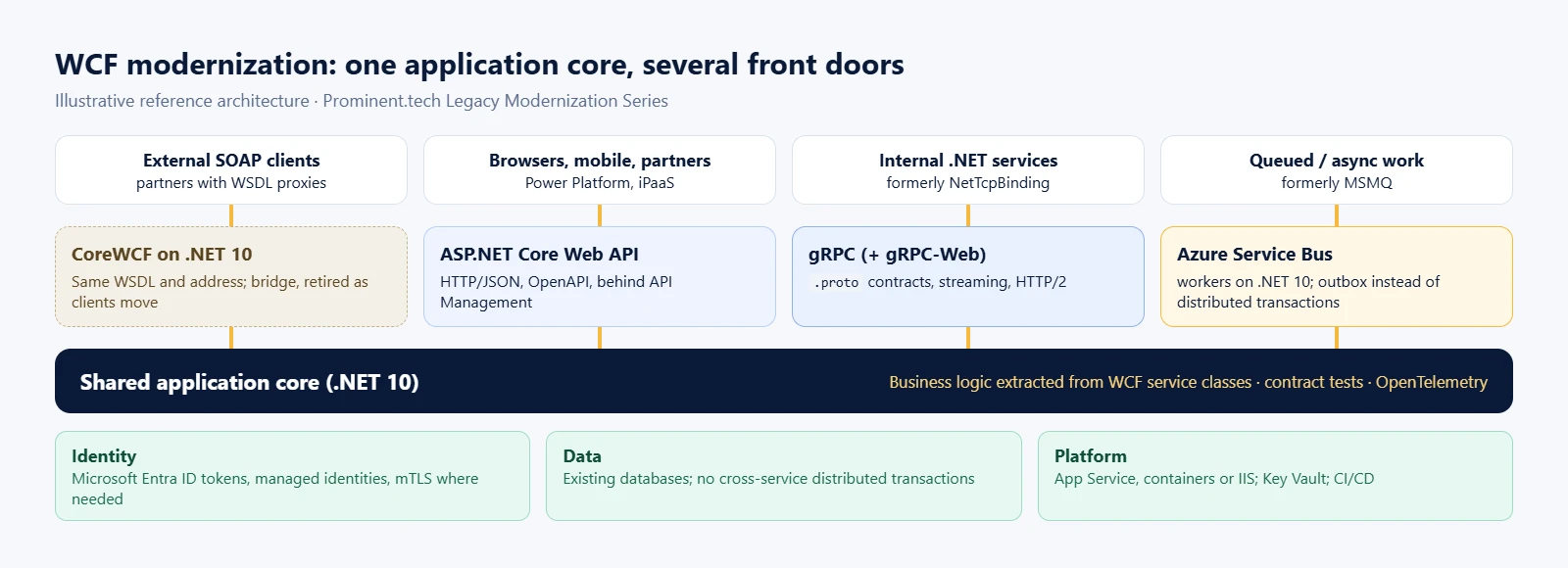
- One application core. Move business logic out of WCF service classes into plain C# services, shared by every endpoint type.
- Multiple front doors. CoreWCF for legacy SOAP clients, Web API for HTTP/JSON consumers, gRPC for internal callers. Retire CoreWCF endpoints as clients move.
- Gateway: Azure API Management or a similar gateway for external APIs: keys, throttling, versioning and analytics.
- Messaging: Azure Service Bus for queued and long-running work previously handled by MSMQ.
- Observability: OpenTelemetry traces across HTTP, gRPC and messaging.
Untangling WCF from a .NET 10 upgrade? Talk to our integration team about a service-by-service plan.
Step-by-step migration roadmap
- Inventory (1 to 3 weeks): list every service, endpoint, binding, behavior and client from config files and logs. Record call volumes and which clients you control.
- Extract the core: move logic out of service classes into testable services; add contract tests that record current SOAP responses.
- Unblock the platform: move services you cannot redesign yet to CoreWCF on .NET 10 (the Copilot “WCF to CoreWCF” skill can help), keeping WSDL and addresses stable.
- Add modern endpoints: expose Web API or gRPC endpoints on the same core; publish OpenAPI or
.protocontracts. - Migrate clients: move internal clients first, then partners with a deprecation timeline.
- Retire: remove SOAP endpoints when traffic reaches zero, then remove CoreWCF.
For API integration work, see our API and system integration services.
Security and identity
- Transport security everywhere: TLS 1.2 or later; mTLS for service-to-service where appropriate.
- Tokens instead of WS-Security: OAuth 2.0 / OpenID Connect with Microsoft Entra ID; managed identities between Azure services.
- Windows authentication: available in ASP.NET Core with Negotiate, and in CoreWCF for internal services during transition.
- Message-level security and WS-Federation: confirm CoreWCF support for your exact configuration; plan a token-based replacement.
- Input validation: SOAP schemas validated input implicitly; add explicit validation for JSON and Protobuf contracts.
Testing, deployment and support
Testing
- Contract tests: replay recorded SOAP requests against CoreWCF and compare responses byte-for-byte where clients are strict.
- Consumer-driven contract tests for new Web API and gRPC endpoints.
- Load tests for gRPC and HTTP/2 through your actual load balancers and proxies.
Deployment
- Check HTTP/2 support end to end for gRPC (load balancers, proxies, App Service configuration); use gRPC-Web for browser callers (Microsoft Learn).
- Keep old and new endpoints live in parallel with per-client routing and monitoring.
Support: plan the next .NET LTS upgrade before November 2028 and track CoreWCF releases, including security advisories.
Cost, effort and timeline
The ranges below are indicative planning assumptions, not benchmarks or quotes.
| Estate profile | Typical scope | Indicative cost (USD) | Indicative duration |
|---|---|---|---|
| Small | Up to 10 services, HTTP bindings, internal clients | $15,000 to $60,000 | 1 to 3 months |
| Medium | 10 to 50 services, NetTcp, partner clients, Windows auth | $60,000 to $250,000 | 3 to 9 months |
| Large | 50+ services, WS-* security, MSMQ, duplex, transactions | $250,000 to $1M+ | 9 to 18+ months |
Cost drivers: number of external clients, WS-* features, transports, duplex contracts and test coverage. See legacy application modernization cost and ROI.
FAQs
Is WCF supported on .NET 10?
WCF server is not included in .NET 10. Microsoft points to the CoreWCF NuGet packages for hosting WCF services on modern .NET. WCF client libraries are available separately for calling existing services.
Is CoreWCF supported by Microsoft?
When CoreWCF 1.0 shipped in 2022, Microsoft said Product Support would be available for CoreWCF customers, with support depending on the underlying .NET version. Check the current CoreWCF releases for your version and features.
Should we migrate WCF to gRPC or REST?
Use gRPC for internal, high-volume .NET-to-.NET calls and streaming. Use REST (ASP.NET Core Web API) for browsers, partners, mobile and low-code consumers. Use CoreWCF only where SOAP clients cannot change yet.
Can browsers call gRPC services?
Not directly over standard gRPC. ASP.NET Core supports gRPC-Web for browser clients, or you can expose a Web API alongside gRPC.
What replaces NetTcpBinding?
gRPC is the closest replacement for fast binary RPC between services. CoreWCF also supports NetTcp as a transitional option.
What about MSMQ-based WCF services?
Move queued work to a supported broker such as Azure Service Bus. CoreWCF has an MSMQ package that can serve as a bridge while you migrate.
Can GitHub Copilot migrate WCF services?
Microsoft’s Copilot app modernization includes a skill for upgrading server-side WCF services to CoreWCF. Redesigning to Web API or gRPC remains an architectural task.
Conclusion
A WCF to gRPC or Web API migration is really a set of decisions about who calls each service. Keep SOAP on CoreWCF only where clients can’t change, give everyone else a modern HTTP/JSON or gRPC contract over a shared application core, and retire SOAP endpoints as traffic drains. That clears the last big blocker from most .NET 10 upgrades.
Previous in this series: ASP.NET MVC 5 to ASP.NET Core MVC. Next: SharePoint 2013/2016 to SharePoint Online.
Related services: API & System Integration · Legacy Software Modernization · .NET Development · Microsoft Azure · Hire .NET Core Developers
Sources
- Microsoft Learn, .NET Framework technologies unavailable on .NET
- .NET Blog, CoreWCF 1.0 has been released (April 2022)
- CoreWCF project on GitHub, CoreWCF
- GitHub (dotnet organization), WCF client libraries for .NET (dotnet/wcf)
- Microsoft Learn, GitHub Copilot app modernization: scenarios and skills
- Microsoft Learn, gRPC on .NET
- Microsoft Learn, gRPC-Web in ASP.NET Core gRPC apps
- Microsoft, .NET and .NET Core Support Policy
Plan your WCF modernization
Prominent.tech helps teams move WCF services to CoreWCF, ASP.NET Core Web APIs and gRPC on .NET 10, contract by contract, with clients, security and cutover planned up front. Talk to our integration team or explore our API and system integration services.