
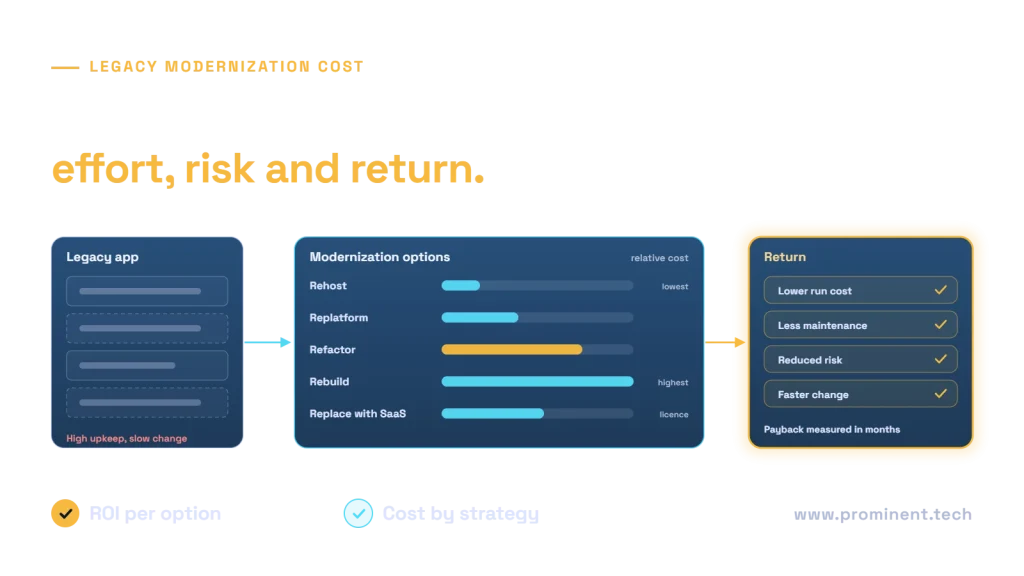
Legacy modernization cost for a typical mid-market business application ranges from about US$20,000 to US$80,000 to rehost it on cloud infrastructure, US$40,000 to US$150,000 to replatform it onto managed services, US$150,000 to US$600,000 to refactor or re-architect it, and US$250,000 to over US$1 million to rebuild it. Replacing it with a SaaS product shifts the cost to licences, configuration and data migration. The right figure depends on code size and quality, test coverage, integrations, data migration and how much downtime the business can accept. These are indicative planning ranges; a short assessment of the actual codebase turns them into a reliable estimate and an ROI case.
Key takeaways
- Estimate legacy modernization cost per application and per strategy. One portfolio usually needs several strategies.
- Code quality and test coverage drive refactoring cost more than lines of code alone.
- Data migration, integrations and cutover planning are commonly under-estimated.
- Build the ROI case from today’s run cost, maintenance effort, incident cost and the value of faster change.
- Modernize in phases, starting with the parts that cost the most to run or change most often.
Legacy modernization cost by strategy
Cloud providers describe modernization options as a set of strategies, often called the “Rs”. The AWS migration strategies guide and the Microsoft Cloud Adoption Framework both use this approach. Each strategy has a very different cost profile.
| Strategy | What changes | Indicative cost per application (USD) | Typical timeline |
|---|---|---|---|
| Retain or retire | Keep as is, or switch off and archive the data | Minimal; archiving $5,000 – $30,000 | Weeks |
| Rehost | Move to cloud virtual machines with no code change | $20,000 – $80,000 | 4 – 10 weeks |
| Replatform | Move to managed services, such as a managed database or app service, with small code changes | $40,000 – $150,000 | 2 – 4 months |
| Refactor or re-architect | Upgrade the framework, restructure code, split into services where useful | $150,000 – $600,000 | 4 – 12 months |
| Rebuild | Write a new application with the same or improved functionality | $250,000 – $1,000,000+ | 6 – 18 months |
| Replace | Adopt a SaaS or packaged product and migrate data | Licences plus $50,000 – $300,000 implementation | 3 – 9 months |
The ranges assume a typical mid-market line-of-business application with a database and a handful of integrations, delivered by a blended onshore and offshore team. Very large systems, mainframes and heavily regulated workloads sit above them.
What drives legacy modernization effort
- Size and complexity. Lines of code, number of modules and business rules, and how tangled they are.
- Technology age. Older frameworks, such as .NET Framework Web Forms or classic ASP, need more rework. See how to modernize a legacy ASP.NET Web Forms application.
- Test coverage. Without automated tests, every change must be verified manually, which can double refactoring effort.
- Integrations. Each connected system adds analysis, rework and testing.
- Data migration. Volume, quality, schema changes and reconciliation. See SQL Server to Azure SQL migration.
- Documentation and knowledge. If the people who built the system have left, discovery takes longer.
- Downtime tolerance. Near-zero downtime needs parallel running and careful cutover, which adds cost.
- Compliance. Audits, validation and security reviews in regulated sectors.
How to estimate modernization effort
- Inventory the application. Modules, code size, frameworks, dependencies, integrations, data stores and users.
- Analyse the code. Static analysis tools measure complexity, duplicated code and outdated dependencies. Upgrade assistants for the target platform show how much changes automatically.
- Choose a strategy per component. Not every part needs the same treatment. Stable, rarely changed modules may simply be rehosted.
- Estimate with ranges. Give each component a best, likely and worst case, and add them up.
- Add the hidden work. Test automation, data migration, cutover, training and hypercare after go-live.
- Add contingency. Typically 15 to 25 percent, depending on how much is unknown.
AI coding assistants can now speed up parts of a refactor, such as upgrading APIs and writing tests, under human review. We describe a practical workflow in OpenAI Codex for legacy .NET modernization.
Pricing modernization risk
The cheapest option on paper can be the most expensive in practice if it fails. Assess each strategy for these risks and include their mitigation in the price:
| Risk | Most exposed strategies | Mitigation to budget for |
|---|---|---|
| Hidden business rules lost | Rebuild, replace | Rule extraction, characterization tests, user acceptance testing |
| Data loss or mismatch | All except retain | Trial migrations, automated reconciliation |
| Extended downtime | Rehost, replatform | Rehearsed cutover, rollback plan |
| Scope creep | Rebuild | Fixed functional baseline, phased delivery |
| Cloud cost surprises | Rehost | Right-sizing and FinOps from day one |
Calculating legacy modernization ROI
A credible business case compares the cost of modernizing with the cost of doing nothing over three to five years.
Annual benefit = run cost saved + maintenance effort saved + incident and downtime cost avoided + value of faster delivery
Payback period = total modernization cost ÷ annual benefit
Illustrative, fictional example for a replatformed order-management application:
| Line | Assumption | Annual value (USD) |
|---|---|---|
| Infrastructure and licences saved | Old servers and database licences retired | $38,000 |
| Maintenance effort saved | 0.5 fewer full-time engineers on upkeep | $45,000 |
| Incidents avoided | Fewer outages from unsupported components | $15,000 |
| Annual benefit | $98,000 | |
| Modernization cost | Replatform including data migration and testing | $130,000 one-time |
| Payback | $130,000 ÷ $98,000 | About 16 months |
Faster delivery of new features is often the largest benefit but the hardest to quantify. Estimate it from the backlog that the legacy system blocks today. Keep new cloud costs in check with practices from our Azure cost optimization guide.
How to reduce legacy modernization cost
- Modernize incrementally. Replace parts of the system step by step instead of a big-bang rewrite. See strangler fig and other migration patterns.
- Write tests first. Characterization tests capture current behaviour and make every later change cheaper and safer.
- Retire what nobody uses. Usage data often shows modules that can be removed rather than modernized.
- Use managed services. Replatforming onto managed databases and app hosting reduces long-term operations effort.
- Use automation and AI assistance under review. Upgrade tools and AI coding assistants reduce repetitive work.
Common questions
How much does legacy application modernization cost?
Indicatively, US$20,000 to US$80,000 to rehost, US$40,000 to US$150,000 to replatform, US$150,000 to US$600,000 to refactor and US$250,000 to over US$1 million to rebuild a typical mid-market application.
Is it cheaper to rebuild or refactor?
Refactoring is usually cheaper and lower risk because it preserves working business logic. Rebuilding makes sense when the code is unmaintainable or the business process itself is changing.
How long does legacy modernization take?
From a few weeks for a rehost to 6 to 18 months for a rebuild. Phased approaches deliver value earlier.
How do we justify modernization to the board?
Compare the three to five year cost of doing nothing, including run costs, maintenance, incidents and blocked change, with the modernization cost and show the payback period.
Can AI reduce modernization cost?
AI coding assistants can speed up code upgrades, documentation and test writing, but every change still needs engineering review and testing.
Get a modernization estimate you can rely on
Share access to the codebase or a description of the application, its integrations and its users. Our legacy software modernization team will assess it, recommend a strategy per component and give you a phased estimate with an ROI case.