
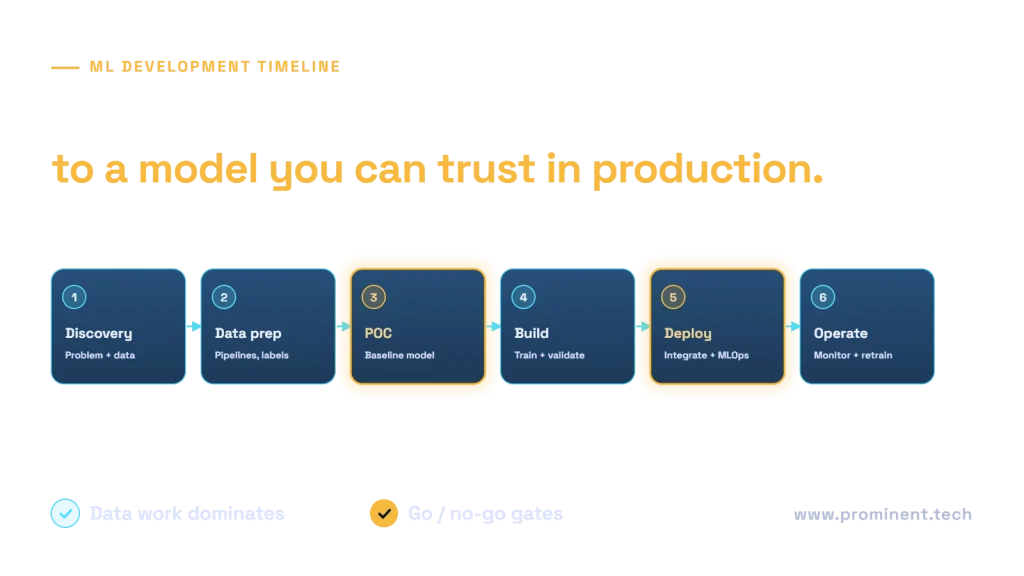
A typical machine learning project takes roughly four to nine months from idea to a production model, in six phases: discovery and data assessment (2 to 4 weeks), data preparation (3 to 8 weeks), proof of concept (3 to 6 weeks), model development and validation (4 to 10 weeks), deployment and MLOps (3 to 8 weeks), then ongoing monitoring and retraining. These are indicative ranges; data availability, labelling, integration complexity and regulatory validation drive most of the variation. Data work, not model training, usually takes the most time, and phases often overlap.
Key takeaways
- Data access, quality and labelling usually take longer than modelling.
- A proof of concept on real data is the key go/no-go point.
- Production deployment and MLOps are a significant phase, not a final step.
- Regulated use cases need extra time for validation and approval.
- Plan for operation and retraining from the start; the timeline does not end at launch.
The machine learning development timeline
| Phase | Indicative duration | Main output |
|---|---|---|
| 1. Discovery and data assessment | 2 to 4 weeks | Problem definition, success metric, data review |
| 2. Data preparation | 3 to 8 weeks | Pipelines, cleaned and labelled data, features |
| 3. Proof of concept | 3 to 6 weeks | Baseline model on real data, go/no-go |
| 4. Model development and validation | 4 to 10 weeks | Validated model, documentation |
| 5. Deployment and MLOps | 3 to 8 weeks | Model in production, monitoring, CI/CD |
| 6. Operation and improvement | Ongoing | Drift monitoring, retraining, new versions |
Phases overlap in practice, so the total is shorter than the sum. These ranges are indicative, based on typical projects, and not a quote. For the broader AI timeline including generative AI, see AI development timeline: POC to production.
Phase by phase
1. Discovery and data assessment
Define the decision the model supports, the success metric and the baseline you must beat. Identify data sources, owners and access constraints. See ML consulting vs development for when this needs a separate engagement.
2. Data preparation
Build pipelines, clean data, create labels and engineer features. This is frequently the longest phase, especially when labels must be created by experts. See the AI-ready data playbook.
3. Proof of concept
Train simple and stronger models on real data and compare them with the baseline. The result is a decision: proceed, change scope, or stop.
4. Model development and validation
Improve the model, test it on held-out and recent data, check fairness and robustness, and document it. In regulated settings, independent validation adds time; see ML governance and model risk management.
5. Deployment and MLOps
Package the model as a service or batch job, integrate it with business systems, and set up CI/CD, monitoring and rollback. See MLOps vs DevOps and Google’s guidance on MLOps automation pipelines.
6. Operation and improvement
Monitor input drift and performance, retrain on new data, and release improved versions through the same pipeline.
What makes the timeline longer or shorter
| Shorter when | Longer when |
|---|---|
| Data is accessible and well documented | Data is spread across systems with access approvals |
| Labels already exist | Labels need expert annotation |
| Clear metric and baseline | Success is undefined or disputed |
| Batch predictions are enough | Real-time inference with tight latency |
| Existing MLOps platform | Platform built from scratch |
| Low-risk use case | Regulated decisions needing validation |
Milestones and go/no-go gates
An illustrative timeline
The following example is illustrative and fictional. A distributor wants to forecast weekly demand per product and warehouse. Sales and inventory data are available but need cleaning; no real-time requirement exists. Discovery takes 3 weeks, data preparation 6 weeks, the proof of concept 4 weeks (overlapping with data work), development and validation 6 weeks, and deployment with monitoring 5 weeks: about 5 to 6 months to the first production forecasts. Related reading: AI demand forecasting. For budgets, see machine learning development cost.
Common questions
How long does it take to develop a machine learning model?
Typically four to nine months from idea to production, depending mainly on data readiness, integration and validation needs. A proof of concept alone often takes three to six weeks.
Which ML phase takes the longest?
Usually data preparation: accessing, cleaning and labelling data.
Can we speed up ML development?
Yes: prepare data access early, agree the metric upfront, use existing MLOps tooling, start with batch predictions and run phases in parallel where possible.
When should we stop an ML project?
If the proof of concept cannot beat the baseline enough to justify the cost, or the data needed is not obtainable, stop or change scope.
Is the project finished after deployment?
No. Models need monitoring and retraining as data and conditions change, so plan for ongoing operation.
Plan your ML project timeline
Our machine learning development and project management teams plan realistic timelines with clear gates and deliver models to production.