
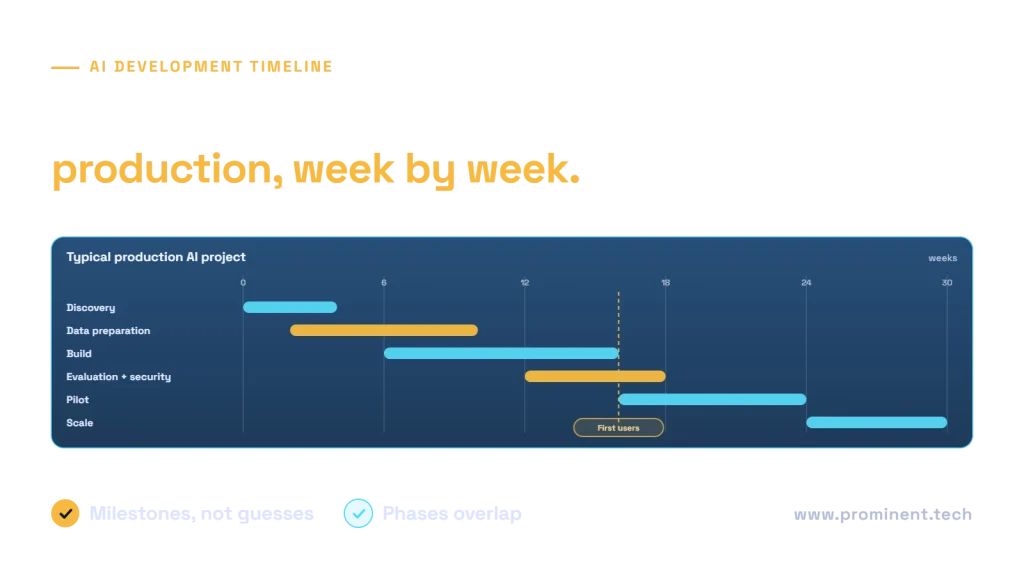
A typical AI development timeline is 4 to 8 weeks for a proof of concept, 8 to 16 weeks for a minimum viable product used by a pilot group, and 4 to 7 months for a production rollout with integrations, security reviews and monitoring. Shared AI platforms or regulated use cases often take 6 to 12 months. In most projects the AI model itself is not what takes the time: data access, integration, evaluation and approvals are. Planning those early, and running phases in parallel where possible, is the most reliable way to shorten the schedule.
Key takeaways
- Separate three goals with different timelines: proving feasibility, proving value with real users, and running reliably in production.
- Data access and security approvals are the most common causes of delay. Start them in week one.
- Build a test set early. Evaluation that starts late pushes the go-live date back.
- Plan milestones with clear exit criteria rather than fixed dates for “done”.
- A pilot with real users before full rollout saves time overall by catching problems while they are cheap to fix.
AI development timeline by project type
| Project type | Goal | Typical duration | What “done” means |
|---|---|---|---|
| Proof of concept (PoC) | Show the idea is technically feasible on real data | 4 – 8 weeks | Meets agreed accuracy on a test set; risks known |
| Minimum viable product (MVP) | Prove value with a pilot group of users | 8 – 16 weeks | Pilot users complete real tasks; benefits measured |
| Production rollout | Run reliably for all intended users | 4 – 7 months | Integrated, secured, monitored and supported |
| AI platform or regulated use case | Shared capability or high-assurance deployment | 6 – 12 months | Governance, audit and multiple use cases supported |
Durations assume a dedicated delivery team, a clear sponsor and reasonable access to data and systems. AI agents that take actions usually sit at the upper end, as we explain in AI agent development cost.
Phase-by-phase AI development timeline
Discovery (weeks 0 to 4)
Confirm the use case, the measurable outcome, the users, the data sources, the systems and the risks. Produce an architecture, a test plan and an estimate for the next phase. Start access requests and security conversations now.
Data preparation (weeks 2 to 10)
Gain access, clean and structure the data, and build the retrieval or training pipelines. This overlaps with discovery and build. Projects with messy or scattered data spend the longest here; see our AI-ready data playbook.
Build (weeks 6 to 16)
Develop the AI logic, integrations, user interface and supporting services in short iterations, demonstrating progress to users every one or two weeks.
Evaluation and security (weeks 12 to 18)
Run the test set, red-team the solution against risks such as prompt injection, complete security reviews and fix what they find. Starting the test set in discovery keeps this phase short. The OWASP Top 10 for LLM Applications is a useful checklist.
Pilot (weeks 16 to 24)
Release to a limited group, measure outcomes against the baseline and collect feedback. Adjust prompts, workflows and interfaces before wider rollout.
Scale (week 24 onward)
Roll out to all intended users, with monitoring, support and a process for ongoing improvement.
What delays AI projects most often
- Data access approvals. Requests for production data or service accounts can take weeks in larger organisations.
- Security and privacy reviews. Threat models, data protection impact assessments and vendor assessments run on the reviewers’ schedules.
- Unclear success criteria. If nobody agrees what “good enough” means, evaluation never finishes.
- Subject-matter expert availability. Experts are needed to label examples and review outputs, but they also have day jobs.
- Integration surprises. Missing APIs or undocumented legacy behaviour. See adding AI to legacy systems.
- Procurement. Contracts for model providers or cloud services.
AI project milestones and exit criteria
| Milestone | Exit criteria |
|---|---|
| Discovery complete | Use case, success measures, architecture, test plan and estimate agreed; access requests submitted |
| Data ready | Sources accessible, cleaned and indexed; test set of real cases collected |
| Proof of concept passed | Agreed accuracy reached on the test set; main risks understood |
| Security approved | Threat model, red-team findings fixed, data protection review signed off |
| Pilot complete | Measured benefit against baseline; user feedback addressed |
| Production live | Monitoring, support, rollback and ownership in place |
Managing the project against exit criteria rather than fixed dates keeps everyone focused on what the next phase really needs. Our project management team runs AI projects this way, using the risk structure of the NIST AI Risk Management Framework for governance checkpoints.
How to shorten the AI development timeline without cutting corners
- Start approvals in week one. Data access, security and procurement run in parallel with discovery.
- Use managed services. Hosted models, managed search and existing identity services remove infrastructure work.
- Narrow the first release. One task and one user group. Add scope after the pilot proves value.
- Build the test set early. It speeds up every later decision.
- Reuse components. A shared AI layer for authentication, logging and retrieval shortens each later project.
- Use AI-assisted engineering under review. Coding assistants can speed up integration and test code. See our AI-assisted development lifecycle.
Common questions
How long does AI development take?
Typically 4 to 8 weeks for a proof of concept, 8 to 16 weeks for a pilot-ready MVP and 4 to 7 months for a production rollout. Platforms and regulated use cases often take 6 to 12 months.
What takes the longest in an AI project?
Usually data access and preparation, integration with existing systems, evaluation and security approvals, rather than building the AI model itself.
Can an AI project be delivered in a few weeks?
A proof of concept can, if data access is quick and the scope is narrow. Production use with real users needs integration, testing and approvals that take longer.
How do we keep an AI project on schedule?
Agree success measures early, start approvals in week one, build a test set during discovery and manage the project against milestone exit criteria.
Should we skip the pilot to save time?
Rarely. A pilot with real users catches workflow and quality problems while they are cheap to fix, which usually saves time overall.
Plan a realistic AI delivery schedule
Share your use case, the systems involved and your target date. Our AI/ML development services team will build a phased plan with milestones, exit criteria and the approvals to start now.