
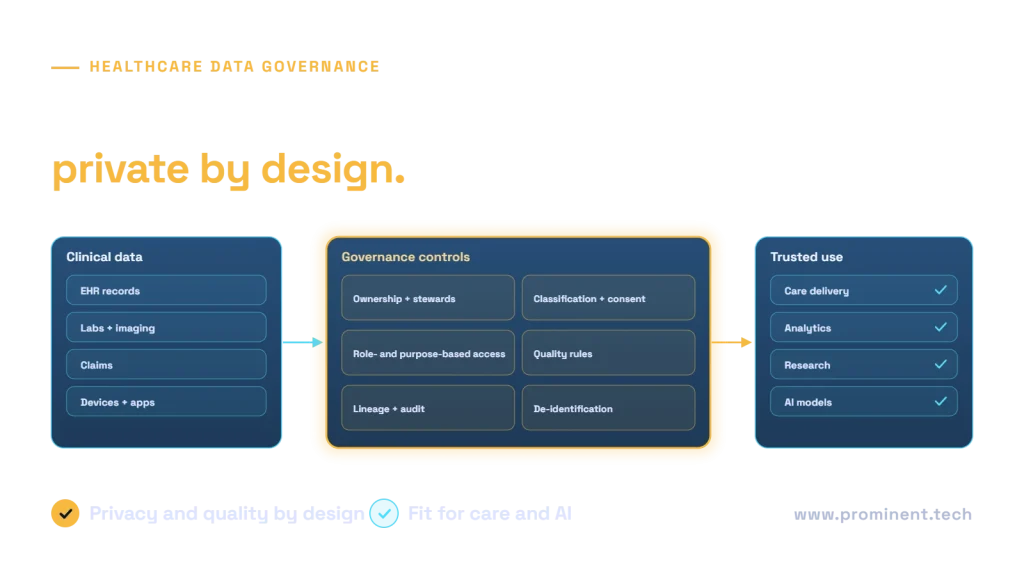
Healthcare data governance is the set of roles, policies, processes and controls that keep clinical and administrative data accurate, private, secure and usable across care delivery, operations, research and AI. It goes further than general data governance because health data is highly sensitive and regulated, because poor quality can affect patient safety, and because data must flow between many systems and organisations. A practical programme assigns clear ownership, classifies data and consent, enforces role- and purpose-based access, measures quality at the source, tracks lineage and audit, and governs de-identified data for secondary use.
Key takeaways
- Health data needs governance for privacy, patient safety and interoperability at the same time.
- Assign business data owners and stewards for each domain, such as patient, encounter, medication and claims.
- Control access by role and purpose, and record consent where it applies.
- Measure data quality where data is created, not only in reports.
- Govern secondary use, including analytics and AI, through de-identification and approval processes.
Why healthcare data governance is different
- Regulation. In the US, the HIPAA Privacy Rule limits use and disclosure of PHI; in Europe and the UK, health data is special category data under GDPR Article 9.
- Patient safety. A wrong allergy, duplicate patient record or mis-mapped lab value can lead to harm, not just a bad report.
- Interoperability. Data must move between EHRs, labs, payers and apps using standards such as HL7 FHIR and data sets like USCDI.
- Many purposes. The same data supports direct care, billing, quality reporting, research and AI, each with different rules.
A healthcare data governance framework
| Component | What good looks like |
|---|---|
| Ownership and stewardship | Named owners and stewards for each data domain with clear decision rights |
| Catalogue and classification | Inventory of data assets labelled for PHI, special category and sensitivity |
| Consent and purpose | Recorded consent or legal basis, with permitted purposes per data set |
| Access control | Role- and purpose-based access, break-glass procedures, regular reviews |
| Data quality | Defined rules and measures at source systems, with stewardship workflows |
| Patient identity | Master patient index and matching rules to prevent duplicates and overlays |
| Lineage and audit | Traceability from source to report or model, with access logs |
| Retention and disposal | Schedules aligned to legal and clinical requirements |
| Secondary use | De-identification standards and an approval process for analytics, research and AI |
Platforms such as Microsoft Purview help with cataloguing, classification and lineage. See our guide to Fabric governance with Purview.
Roles and operating model
- Data governance council: clinical, operational, privacy, security and IT leaders who set policy and resolve conflicts.
- Data owners: senior business leaders accountable for a domain, such as the chief nursing officer for nursing documentation.
- Data stewards: people who define rules, monitor quality and fix issues day to day.
- Privacy and security officers: ensure compliance and approve sensitive uses.
- Data engineering: implement controls, pipelines, catalogue and monitoring.
Clinical data quality
Measure completeness, accuracy, timeliness, consistency and validity for the data elements that matter most, such as patient identifiers, problem lists, medications, allergies and results. Fix issues at the source workflow where possible, because downstream corrections do not reach the clinical record. Automated checks in pipelines catch problems early; see data quality frameworks compared and data pipeline observability.
Secondary use, research and AI
Analytics, research and AI often use data beyond direct care. Govern this with de-identification where possible, minimum necessary access where identifiable data is required, a review and approval process, and documentation of which data trained or feeds each model. Our guides to HIPAA-compliant AI applications and AI-ready data cover the technical controls.
A phased healthcare data governance roadmap
Start with the domains that matter most for safety and your priority use cases, show measurable improvement, then extend. A broader data strategy helps align governance with business goals.
Common questions
What is healthcare data governance?
The roles, policies, processes and controls that keep health data accurate, private, secure and usable for care, operations, research and AI.
How is it different from general data governance?
Health data is more sensitive and regulated, quality issues can affect patient safety, and data must be shared across organisations using healthcare standards.
Who should own healthcare data governance?
A council of clinical, operational, privacy, security and IT leaders, with named owners and stewards for each data domain.
How do we govern data used for AI?
Use de-identified data where possible, approve identifiable uses case by case, document data sources for each model and monitor model outputs and access.
Where should a healthcare organisation start?
With a small number of critical domains, such as patient identity and medications, clear ownership and measurable quality rules, then expand.
Build governance your clinicians and regulators can trust
Share your data landscape and priorities. Our healthcare and data engineering teams will help design the framework, implement controls and measure quality where it matters most.