
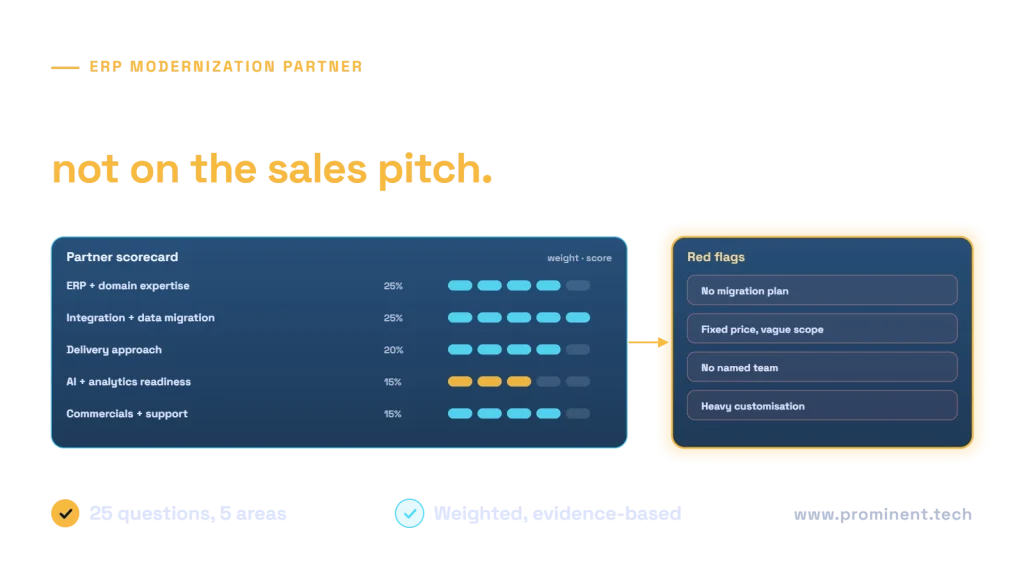
Choose an ERP modernization partner by scoring each candidate on evidence across five areas: ERP and industry expertise, integration and data migration capability, delivery approach, readiness for analytics and AI, and commercial terms and support. The 25-question scorecard below gives each area five questions, a weight and a 1 to 5 score, so you compare partners on the same basis rather than on presentations. Ask for evidence such as similar projects, named team members, sample migration plans and references you can call, and treat vague answers on data migration, scope or support as red flags.
Key takeaways
- ERP modernization succeeds or fails on data migration, integration and change management, not just the ERP product.
- Weight the scorecard to your priorities and score with evidence, not impressions.
- Meet the delivery team you will actually get, not only the sales team.
- Prefer partners who minimise customisation and plan for upgrades.
- Check that the target design supports analytics and AI from the start.
An ERP modernization partner selection process
Before inviting partners, document your goals, scope, current systems, integrations and data volumes. A clearer brief produces comparable proposals. A short business analysis engagement can prepare it.
The 25-question ERP modernization partner scorecard
1. ERP and industry expertise (suggested weight 25%)
- How many implementations or modernizations of this ERP have you delivered for organisations of our size and industry?
- Which industry processes, such as manufacturing, distribution or services, do you know in depth?
- How do you decide between standard functionality and customisation?
- How do you keep customisations compatible with future updates?
- Can we speak to two clients with similar scope?
2. Integration and data migration (suggested weight 25%)
- How will you integrate with our CRM, e-commerce, warehouse and finance systems? See integrating Salesforce, Dynamics 365 and ERP systems.
- What is your data migration approach, including cleansing, mapping, trial loads and reconciliation?
- Which integration patterns and tools do you use? See integration architectures.
- How do you handle historical data we do not migrate?
- Can you show a sample migration plan and cutover runbook?
3. Delivery approach (suggested weight 20%)
- Which methodology do you use, and how do you manage scope changes?
- Who exactly will be on our team, and how much of their time will they give?
- How do you handle testing, including user acceptance testing?
- What is your approach to training and change management?
- How do you report progress, risks and budget?
Microsoft’s Success by Design guidance is a useful reference for what good delivery looks like on Dynamics 365 projects.
4. Analytics and AI readiness (suggested weight 15%)
- How will ERP data feed our analytics platform? See ERP, MES, IoT and Fabric integration.
- Which AI capabilities, built-in or custom, do you recommend for our processes?
- How do you expose ERP data and actions through APIs for future AI agents?
- How do you ensure data quality and master data governance after go-live?
- Can you show an example of AI or analytics delivered on this ERP?
5. Commercials and support (suggested weight 15%)
- What exactly is included in the price, and what assumptions sit behind it?
- How are change requests priced?
- What support model, response times and costs apply after go-live?
- Who owns the code, configuration and documentation?
- How do you handle knowledge transfer to our team?
How to score and weight partners
| Score | Meaning |
|---|---|
| 5 | Strong evidence: relevant references, named team, detailed plans |
| 4 | Good evidence with minor gaps |
| 3 | Adequate answer, limited evidence |
| 2 | Vague answer, no evidence |
| 1 | Not addressed or concerning answer |
Average the five questions in each area, multiply by the area weight and add up the areas. Adjust the weights to your situation: integration-heavy estates might weight that area higher. Have several evaluators score independently, then discuss differences.
Red flags when choosing an ERP modernization partner
- No concrete data migration or cutover plan.
- A fixed price with a vague scope and many exclusions.
- Reluctance to name the delivery team or provide references.
- Recommending heavy customisation before understanding standard features.
- No plan for training, adoption or post-go-live support.
Modernization also carries a cost of doing nothing; see the cost of delaying modernization.
Contract terms that protect you
- Clear scope, assumptions and acceptance criteria per phase.
- Named key personnel with replacement approval rights.
- Milestone-based payments tied to accepted deliverables.
- Ownership of configuration, code and documentation.
- Defined support terms, service levels and exit assistance.
Common questions
How do we choose an ERP modernization partner?
Score candidates on ERP and industry expertise, integration and data migration, delivery approach, analytics and AI readiness, and commercials and support, using evidence and references rather than presentations.
What questions should we ask an ERP partner?
Ask about similar projects, the named team, data migration and cutover plans, integration approach, customisation policy, support terms and code ownership. The scorecard above lists 25.
Should we choose the cheapest proposal?
Not on price alone. Compare scope, assumptions and evidence; a low price with vague scope often leads to change requests and delays.
How long does partner selection take?
Typically four to eight weeks from brief to contract, including demonstrations, reference calls and scoring.
Can one partner handle ERP, integration and AI?
Some can. Otherwise, choose an ERP partner and an integration or AI partner who can show they work together effectively.
Get independent support for your ERP modernization
Our API and system integration and legacy modernization teams can help prepare your brief, evaluate partners or deliver the integration, data migration and AI work around your ERP.