
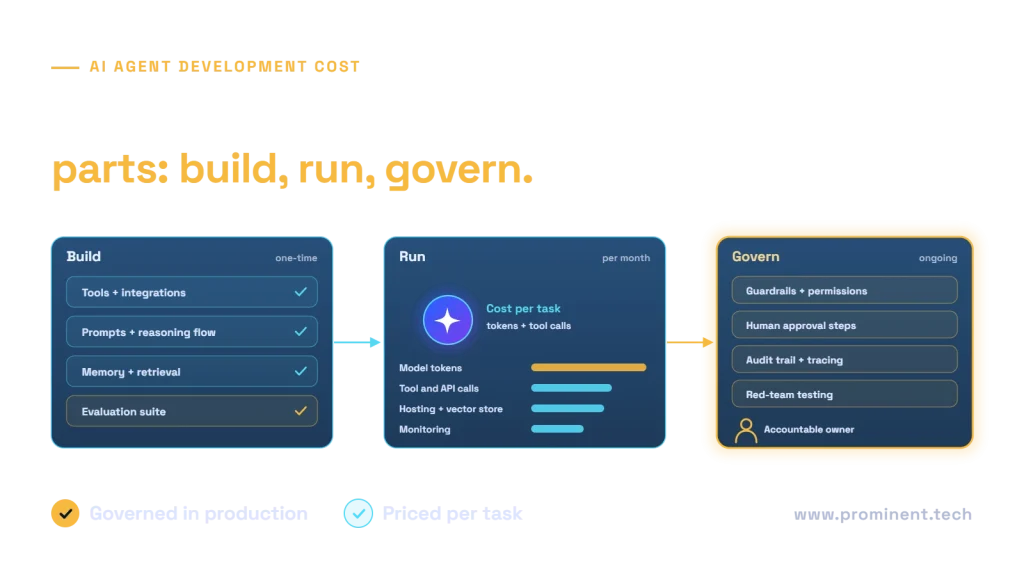
In 2027, AI agent development cost typically falls into three bands: US$30,000 to US$70,000 for a single-purpose agent with read-only tools, US$70,000 to US$180,000 for a workflow agent that takes actions across several systems with human approvals, and US$180,000 to US$500,000 or more for a multi-agent system or shared agent platform. Running an agent then costs roughly US$1,000 to US$25,000 a month, driven mostly by model tokens and tool calls per task. Governance (guardrails, approvals, audit and testing) adds 10 to 20 percent to the build and continues for as long as the agent runs. These are indicative planning figures, not a quote.
Key takeaways
- Estimate an AI agent in three parts: the one-time build, the monthly run cost and the ongoing cost of governing it.
- The number of tools an agent can call, and whether those tools can change data, is the biggest build cost driver.
- Run cost is best measured as cost per completed task, not cost per month.
- Agents that act on business systems need approvals, permissions and audit trails. Budget for them from day one.
- Start with a narrow agent and a measurable task. Expand its tools only when evaluation shows it is reliable.
AI agent development cost by complexity
An AI agent is software that uses a language model to decide which steps to take and which tools to call to complete a goal. That autonomy is what makes agents useful, and also what makes them more expensive than a simple chatbot. If you are still deciding whether you need an agent at all, read agentic AI vs generative AI first.
| Agent type | What it does | Indicative build cost (USD) | Typical timeline |
|---|---|---|---|
| Single-purpose agent | Answers or researches using one or two read-only tools, such as search and a knowledge base | $30,000 – $70,000 | 6 – 10 weeks |
| Workflow agent | Completes a business process across several systems, creates or updates records, and asks a person to approve risky steps | $70,000 – $180,000 | 3 – 5 months |
| Multi-agent system or platform | Several specialised agents coordinated by a supervisor, shared tools, memory and an evaluation pipeline | $180,000 – $500,000+ | 6 – 12 months |
These bands assume a blended onshore and offshore delivery team, a managed model API and existing systems with usable APIs. Systems without APIs, strict data residency or regulated decisions can move a project into a higher band.
What drives AI agent development cost
Number and type of tools
Each tool an agent can call needs an interface, input validation, error handling, permissions and tests. Read-only tools are cheaper than tools that create, update or delete data, because write actions need approvals and rollback plans. Protocols such as the Model Context Protocol make tool connections more reusable. See MCP vs function calling vs REST APIs for the trade-offs.
Reasoning flow and orchestration
A single agent following a clear process is far cheaper than several agents handing work to each other. Multi-agent designs add coordination logic, shared state and more failure modes to test. Our guide to multi-agent orchestration patterns explains when the extra cost is justified.
Memory and retrieval
Agents that remember context across sessions, or search large document collections, need memory stores and retrieval pipelines. This adds data engineering effort and ongoing storage cost. See AI agent memory architecture.
Evaluation
Agents must be tested on realistic tasks, including edge cases and adversarial inputs, before they are trusted. Building a task-level test suite and running it on every change is a significant but essential part of the build.
Run cost: pricing an AI agent per task
A chatbot answers one question with one model call. An agent may plan, call several tools, read the results and call the model again before it finishes. That makes the cost of each completed task the most useful number to track.
A simple way to estimate it:
Cost per task = (model calls per task × average tokens per call × price per token) + tool and API costs per task + a share of hosting and monitoring
Token prices vary by model and change often, so take current figures from the provider, for example Azure OpenAI pricing or Anthropic API pricing. Then multiply cost per task by expected monthly volume. Tracing each run, as described in AI agent observability, lets you see which steps consume the most tokens.
| Run cost line | What drives it | Indicative monthly range (USD) |
|---|---|---|
| Model tokens | Tasks per month, steps per task, prompt size, model tier | $300 – $15,000 |
| Tool and API calls | Paid third-party APIs, search queries, compute per call | $100 – $3,000 |
| Hosting and vector storage | Agent runtime, queues, memory and retrieval services | $300 – $4,000 |
| Monitoring and tracing | Trace volume and retention | $100 – $1,500 |
| Human review time | Share of tasks routed to a person for approval | Measured in staff hours |
Governance cost: the part most agent estimates miss
An agent that can act on business systems needs the same controls you would apply to a new employee with system access, plus some that are specific to AI. These are not optional extras; they are what make an agent safe to deploy.
- Least-privilege permissions. The agent should hold only the access its task needs. See AI agent security threats.
- Guardrails. Input and output checks that block unsafe requests and responses. See LLM guardrails explained.
- Human approval steps. Risky actions, such as payments or customer communications, wait for a person. See human-in-the-loop AI agents.
- Audit trails and tracing. Every decision and tool call is recorded so it can be reviewed.
- Red-team testing. Deliberate attempts to make the agent misbehave, based on lists such as the OWASP Top 10 for LLM Applications.
Plan for governance to add 10 to 20 percent to the initial build, plus ongoing effort to review traces, update guardrails and re-test after changes. The NIST AI Risk Management Framework helps decide how much control a given use case needs.
A worked AI agent cost estimate
This is an illustrative, fictional example of a workflow agent that triages incoming supplier invoices, checks them against purchase orders and drafts approvals for a finance officer.
| Line | Assumption | Amount (USD) |
|---|---|---|
| Build | Four tools (email, ERP read, ERP draft, document extraction), approval step, evaluation suite | $120,000 |
| Governance at build | 15% for permissions, guardrails, audit and red-team testing | $18,000 |
| Run | 3,000 invoices a month at an assumed $0.40 all-in cost per task, plus $1,500 hosting and monitoring | $32,400 a year |
| Ongoing governance and support | Trace reviews, guardrail updates, model upgrades | $20,000 a year |
| First-year total | $190,400 |
Compare the total with the measured benefit, such as processing minutes saved per invoice and the reduction in late-payment penalties, during a limited pilot before scaling.
How to control AI agent development cost
- Start narrow. One task, few tools, read-only first. Add write actions after the agent proves reliable.
- Prefer a single agent. Use multiple agents only when one agent cannot handle the task reliably.
- Route by difficulty. Send routine steps to smaller, cheaper models and reserve the most capable models for hard reasoning. See LLM inference cost optimization.
- Cap steps and budgets. Limit how many steps and tokens a single task can use, so a confused agent cannot run up costs.
- Choose frameworks carefully. A mature framework saves build time. Compare options in LangChain vs LangGraph vs AutoGen.
- Measure cost per task from the pilot onward. It is the number that tells you whether scaling will pay.
Common questions
How much does it cost to build an AI agent in 2027?
Indicatively, US$30,000 to US$70,000 for a single-purpose agent, US$70,000 to US$180,000 for a workflow agent across several systems, and US$180,000 to US$500,000 or more for a multi-agent system or platform, plus monthly running and governance costs.
Why do AI agents cost more than chatbots?
Agents call tools, take actions and make several model calls per task. Each tool needs integration, permissions and testing, and actions on business systems need approvals and audit trails.
What is the biggest ongoing cost of an AI agent?
Usually model tokens, which scale with the number of tasks and the steps per task. Human review time can also be significant if many tasks need approval.
How can we predict monthly agent costs?
Measure cost per completed task during a pilot, then multiply by expected volume. Set step and token limits per task and budget alerts per month.
Do we need multiple agents?
Not usually at the start. A single agent with well-designed tools handles most business workflows. Multi-agent systems add cost and should be justified by evaluation results.
Get a realistic estimate for your AI agent
Share the task you want automated, the systems involved and the decisions that need human approval. Our generative AI development team will scope the build, estimate cost per task and propose a pilot with clear success measures.