
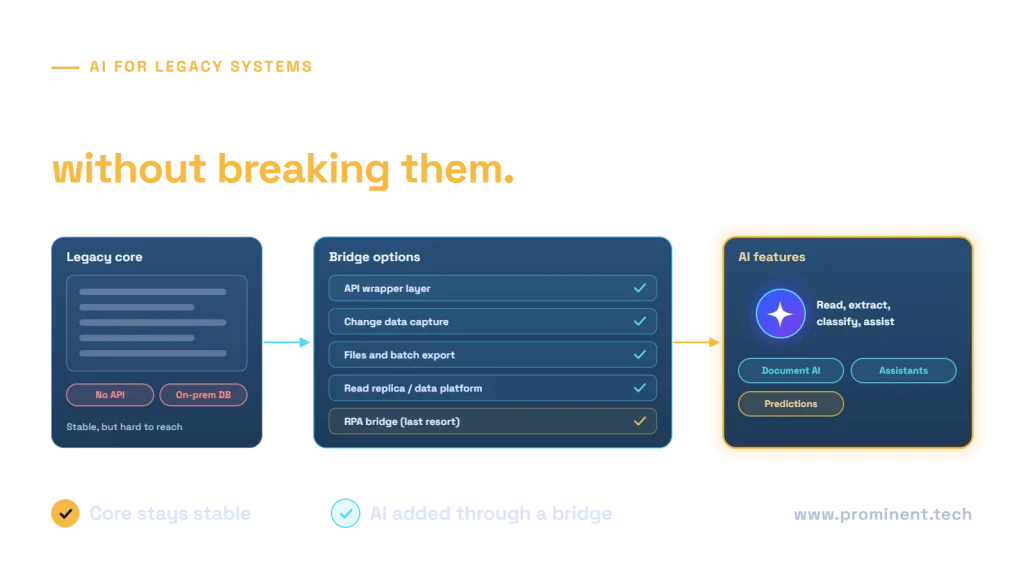
AI integration for legacy systems usually costs more than adding AI to a modern application, because the first job is building a safe bridge to systems that have no APIs, run on-premises or store data in old formats. Indicatively, that bridge costs US$20,000 to US$80,000 for an API wrapper, US$40,000 to US$150,000 for change data capture into a modern data platform, and US$10,000 to US$40,000 for file or batch exports, before the AI feature itself, which typically adds US$25,000 to US$150,000. The good news is that the bridge is reusable: once it exists, each further AI use case costs far less. This guide compares the architecture options, their cost drivers and how to build the ROI case.
Key takeaways
- Do not connect AI directly to a legacy database or user interface. Build a controlled bridge first.
- Choose the bridge by what the AI must do: read data, extract from documents, or write back into the legacy system.
- Read-only AI use cases on replicated data are the cheapest and safest place to start.
- Robotic process automation (RPA) is a last resort for systems with no other access route.
- Compare “AI on legacy now” with “modernize first, then AI” on total cost over three years.
Why legacy systems make AI integration harder
Modern AI services expect data through APIs, events or a data platform. Many legacy systems offer none of these. Common constraints include:
- No API, or only a limited, undocumented one.
- On-premises databases that cannot be exposed directly to cloud services.
- Data stored in old formats, codes or fixed-width files with business meaning only the original developers knew.
- Fragile systems where extra load or unexpected writes risk outages.
- Strict change-control processes, especially in finance, manufacturing and the public sector.
The aim is to add AI value without destabilising the system the business runs on. That means a deliberate integration layer between the legacy core and the AI features.
Architecture options for AI integration with legacy systems
| Bridge | How it works | Best for | Watch out for |
|---|---|---|---|
| API wrapper layer | A new service exposes selected legacy functions and data through modern APIs, translating formats on the way | Assistants and agents that need current data or must write back | Load on the legacy system; needs careful error handling |
| Change data capture (CDC) | Database changes stream into a modern data platform in near real time | Analytics, predictions and assistants over fresh data, without touching the legacy app | Database log access and licensing |
| Files and batch export | Scheduled exports land in cloud storage for AI processing | Overnight enrichment, reporting and document processing | Data is only as fresh as the last export |
| Read replica or data platform | A copy of the data is maintained for AI and analytics workloads | Heavy read workloads that would slow the live system | Keeping copies secure and consistent |
| RPA bridge | Software robots operate the legacy user interface | Systems with no database or API access at all | Brittle when screens change; slow; use as a last resort |
The API wrapper is an example of the anti-corruption layer pattern: it shields modern services from legacy data models. Change data capture tools such as Debezium or platform features such as Microsoft Fabric mirroring keep a modern copy of the data current.
Many legacy processes also depend on paper or PDF documents. Document AI services, such as Azure AI Document Intelligence, can extract fields that are then validated and passed into the legacy system through the bridge.
Cost drivers and indicative ranges
The main cost drivers for AI integration with legacy systems are:
- Access route. A documented database or existing service is far cheaper to bridge than a closed system that needs reverse engineering or RPA.
- Read versus write. Writing AI results back into the legacy system needs validation, transactions and rollback, which can double integration effort.
- Data meaning. Decoding legacy codes and formats into business terms takes analysis time with people who know the system.
- Freshness. Near-real-time data via CDC costs more than nightly exports.
- Change control and testing. Regulated or fragile systems need more extensive regression testing.
For the cost of the AI feature itself, see custom AI integration cost.
AI on legacy now, or modernize first?
Bridging lets you deliver AI value in weeks while the legacy system keeps running. Modernizing first gives a cleaner foundation but delays AI benefits by months. A practical rule:
- Bridge now when the legacy system is stable, will stay for several years and the AI use case is mainly read-only.
- Modernize first when the system is already scheduled for replacement, cannot be accessed safely, or every AI use case would need extensive write-back.
- Do both by building the bridge as the first step of an incremental modernization, so the same APIs later front new services.
Our guide to legacy modernization cost helps compare the options.
Building the ROI case
Because the bridge is reusable, assess ROI across the first two or three AI use cases, not just the first:
Three-year ROI = (benefits of AI use cases − bridge cost − AI feature costs − running costs) ÷ total cost
Illustrative, fictional example: a manufacturer with an on-premises ERP builds a CDC bridge for US$90,000. The first use case, an assistant that answers order-status questions for customer service, costs US$60,000. A second, predicting late deliveries, costs US$45,000 because it reuses the bridge. If together they save the equivalent of three customer-service roles and reduce expediting costs, the payback can fall within the second year. Measure the actual benefits during each pilot before committing to the next.
A practical first AI project on a legacy system
- Pick a read-only use case with clear value, such as answering questions over orders or summarising case history.
- Map the data it needs and the meaning of legacy fields with someone who knows the system.
- Build the lightest suitable bridge: batch export or CDC for read-only cases; an API wrapper if write-back is essential.
- Add the AI feature on the modern side, with permission checks and logging.
- Measure against today’s baseline, then reuse the bridge for the next use case.
Our API and system integration and legacy software modernization teams often deliver this as one combined engagement.
Common questions
Can AI work with legacy systems that have no API?
Yes. Options include building an API wrapper, capturing database changes into a modern platform, scheduled file exports or, as a last resort, RPA that operates the existing screens.
How much does AI integration for legacy systems cost?
Indicatively, US$10,000 to US$150,000 for the bridge depending on the approach, plus US$25,000 to US$150,000 for the AI feature itself. The bridge is reusable for later use cases.
Is it safe to let AI write data into a legacy system?
Only through a controlled layer that validates every change, uses transactions and requires human approval for high-impact updates. Start with read-only use cases.
Should we use RPA to connect AI to legacy software?
Only when there is no database, file or API route. RPA breaks when screens change and is slower and harder to maintain than other bridges.
Do we need to move the legacy system to the cloud first?
No. A secure bridge can make on-premises data available to cloud AI services under your data protection rules, while the core system stays where it is.
Bring AI to your legacy systems safely
Tell us which system holds the data and what you want AI to do with it. We will recommend the lightest safe bridge, estimate the cost and plan a first use case that proves value quickly through our enterprise AI integration service.