
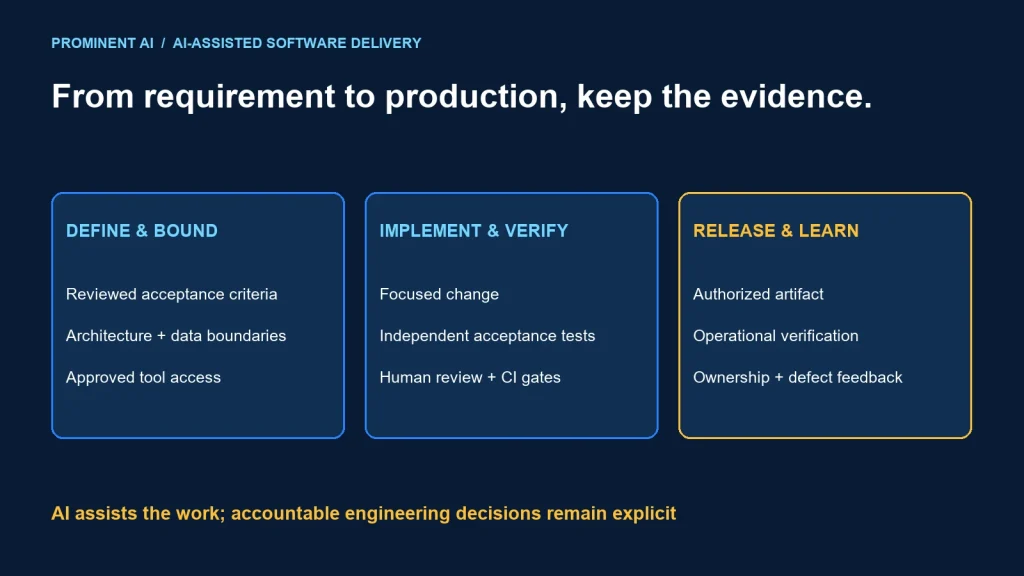
An AI-assisted SDLC uses AI to help produce requirements, designs, code, tests and operational artifacts while keeping accountable owners and independent verification at each stage. Introduce it as a change to the engineering process, not as permission for an agent to move from a vague request directly into production.
Key takeaways
- Specify the outcome and acceptance criteria before delegating implementation.
- Keep architecture, data access and release authority explicit.
- Verify generated code and generated tests independently.
- Measure accepted outcomes, defects and review effort.
- Use a narrow pilot before expanding tools, repositories or autonomy.
A practical AI-assisted lifecycle
Business need → reviewed acceptance criteria
                         ↓
Architecture + threat/data boundary review
                         ↓
Bounded implementation task + approved tool access
                         ↓
Focused change + evidence of checks actually run
                         ↓
Independent tests + human review + CI gates
                         ↓
Authorized release + operational verification
                         ↓
Feedback, defects and measured process improvement
The NIST Secure Software Development Framework describes secure development practices across organizational preparation, software protection, production and vulnerability response. AI assistance should fit into those engineering responsibilities. The workflow below is an original implementation playbook, not a certification or a claim that following it establishes compliance.
For a fictional customer-portal enhancement, AI could help draft edge cases, implement a focused API change and suggest tests. The product owner still decides what the customer needs, the engineer owns the design, and the release owner controls deployment.
Choose assistance levels by task risk. A documentation correction and an authorization change should not receive identical execution privileges or review depth merely because the same assistant can edit both.
Who owns what?
| Role | Accountable decision | AI can assist with |
|---|---|---|
| Product/process owner | Purpose, scope and acceptance | Drafts, questions and scenario enumeration |
| Technical lead | Architecture and integration boundaries | Alternatives, dependency mapping and design critique |
| Implementing engineer | Correctness and explanation of the change | Focused implementation, refactoring and test drafts |
| Independent reviewer/tester | Acceptance evidence and unresolved risk | Additional cases, code review suggestions and failure analysis |
| Release/operations owner | Deployment, recovery and service ownership | Runbook drafts, diagnostic summaries and release notes |
AI-generated approval language is not the approval itself. Record the accountable human or established approval mechanism. Do not let an assistant invent a stakeholder sign-off or mark a test passed without evidence.
Separate tool permissions from task instructions. A prompt can say “do not access production,” but infrastructure should also restrict production access. Keep repository protections, credentials and network boundaries effective independently of the agent’s interpretation.
Introduce assistance stage by stage
1. Requirements and acceptance criteria
Use AI to identify ambiguous terms, missing actors and error cases. Have the owner resolve them. Turn “improve onboarding” into observable outcomes such as who can submit a request, which fields are required and what happens when a dependency fails.
Preserve assumptions in a decision log. An assistant should ask or flag a material gap rather than silently decide retention, access or financial behavior.
2. Architecture and task boundaries
Define interfaces, data classification and change scope. Identify the files or modules likely involved and the contracts that must remain compatible. Use AI to explore alternatives, then review the reasoning against real constraints.
For a modular system, preserve ownership boundaries. The modular monolith guide shows why an apparently convenient cross-module dependency can undermine the intended design.
3. Implementation
Provide a bounded task, fixture data and build instructions. Require a focused diff and an account of tests actually run. Review new dependencies and generated files. Prefer small changes that a reviewer can understand.
If the tool cannot run a required check, record the limitation. “Not run” is useful evidence; an unsupported claim that everything passed is not.
4. Verification and review
Use independent acceptance cases, relevant static checks and runtime tests. Review generated tests for meaningful assertions and realistic failure coverage. A test that repeats the same incorrect assumption as the implementation does not provide independence.
Ask reviewers to inspect changed contracts, authorization, data handling and recovery behavior. AI review suggestions can help direct attention but do not establish correctness by themselves.
5. Release and feedback
Promote the reviewed artifact through the existing controlled release path. Keep production secrets out of the agent workspace. Verify the user-visible path and operational signals after deployment, then record any correction and learning.
An acceptance checklist for AI-assisted changes
| Gate | Required evidence | Blocker example |
|---|---|---|
| Intent | Approved behavior and boundary conditions | Missing decision on who may access the record |
| Design | Reviewed interfaces and data flows | Unapproved external service receives confidential data |
| Implementation | Focused diff and dependency review | Unnecessary framework replacement |
| Verification | Independent checks and truthful results | Tests disabled or expected values weakened |
| Release | Authorized artifact and recovery readiness | Untested package substituted after approval |
| Operations | Named owner and useful diagnostics | No way to identify or recover a failed business operation |
Use the following review record for a pilot. It is a human-readable template, not a CI schema.
Change reference:
Business owner and acceptance scenarios:
Repository commit and approved scope:
Tool / model / execution configuration:
Data and credential boundary:
Design decisions and assumptions:
Checks run with results:
Checks not run and reason:
Independent review findings:
Release artifact and approval reference:
Recovery procedure and operations owner:
Post-release verification result:
Require additional review for high-consequence changes. Examples include authorization, tenant isolation, destructive data operations and business transactions. The review depth should follow the change’s effect rather than the number of lines modified.
A measured adoption plan
- Select a small, representative repository set with clear owners.
- Define permitted tools, data and execution access.
- Choose task classes and a baseline for comparison.
- Run assisted work with the same acceptance standards.
- Record review time, defects, rework and operational exceptions.
- Expand only when the evidence supports the next task class or access level.
Keep incomplete and failed tasks in the measurement. Counting only successful demonstrations exaggerates the benefit. Do not use generated-code volume as a proxy for delivered value.
Compare total effort: implementation, prompting, review, CI and correction. A team may gain speed on one task class while spending more effort on another. Use that information to choose where assistance belongs.
The coding-assistant comparison provides a proposed task pack and governance score sheet. No team productivity benchmark or claimed percentage improvement was produced for this playbook.
Keep ownership after the code is merged
Generated code becomes maintained application code. Assign normal ownership, documentation and support responsibilities. Do not let the use of an assistant become a reason nobody can explain the component.
Retain useful provenance without recording sensitive prompts or source data unnecessarily. A support engineer needs to know the release, design decision and relevant tests; they do not automatically need every model interaction.
When a defect escapes, inspect the process rather than only rewriting the prompt. Was the requirement wrong, the acceptance test missing, the tool overprivileged or the review rushed? Correct the control that allowed the failure and add a meaningful regression case.
Re-evaluate tools after model, product or policy changes. A once-validated configuration can change its behavior or available features. Keep a small recurring task pack to detect important differences.
Common questions
How do teams introduce AI tools across the SDLC safely?
Start with bounded tasks, approved data and tool access, accountable owners and independent acceptance gates. Expand through measured pilots.
Can AI write both implementation and tests?
It can assist with both, but review the tests and retain independent acceptance cases so the same mistake does not define code and expected behavior.
Who owns AI-generated code?
The engineering organization must assign normal implementation, review and operational ownership. Tool assistance does not remove those responsibilities.
What should be measured?
Accepted outcomes, total effort, review corrections, defects and operational exceptions. Generated lines alone do not describe value.
Should coding agents deploy directly to production?
Use the organization’s controlled release process with appropriate authorization, evidence and recovery. Do not grant production access merely to make an implementation task convenient.
Introduce AI assistance through a reviewable engineering process
Bring the current delivery workflow, recurring task classes and review constraints. Discuss AI-assisted engineering adoption with clear acceptance gates and ownership.