
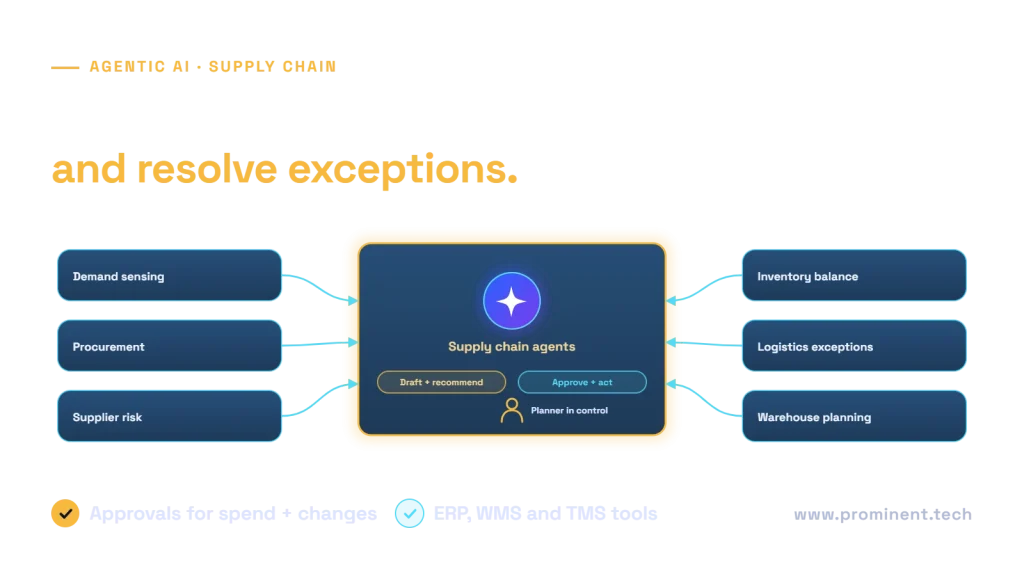
Agentic AI in supply chain uses AI agents that can gather data across ERP, warehouse (WMS) and transport (TMS) systems, reason about the situation and take or propose actions: sensing demand shifts, drafting purchase orders and supplier comparisons, monitoring supplier risk, rebalancing inventory, resolving shipment exceptions and supporting warehouse planning. The value comes from handling the many small exceptions that planners and buyers currently chase by hand. The risk comes from autonomous actions that commit spend or change commitments, so successful implementations start with agents that recommend and draft, keep people approving spend and customer-impacting changes, and expand autonomy only where results are proven.
Key takeaways
- Agents are most useful for exception handling, where data is scattered and decisions are repetitive.
- Connect agents to ERP, WMS and TMS through governed tools, not direct database access.
- Keep humans approving purchases, supplier changes and customer commitments.
- Good master data and timely events matter more than the choice of model.
- Start with one exception type, measure resolution time and expand.
Agentic AI use cases in supply chain
| Area | What the agent does | Typical approval |
|---|---|---|
| Demand sensing | Spots demand shifts from orders, promotions and external signals; proposes forecast adjustments | Planner accepts changes |
| Procurement | Drafts purchase orders, compares supplier quotes and terms | Buyer approves spend |
| Supplier risk | Monitors delivery performance, news and capacity signals; flags risks | Category manager reviews |
| Inventory balancing | Proposes transfers between locations to avoid stock-outs | Automatic within limits |
| Logistics exceptions | Detects late shipments, proposes reroutes and drafts customer updates | Coordinator approves |
| Warehouse planning | Suggests labour plans and slotting based on forecast volumes | Supervisor approves |
The ASCM SCOR model is a useful map of supply chain processes when deciding where agents fit. For forecasting foundations, see AI demand forecasting.
Architecture for supply chain agents
Agents read from a data platform for history and forecasts, receive events for real-time changes, and act through governed tools that wrap ERP, WMS and TMS APIs. See AI integration across ERP, CRM and supply chain and the Model Context Protocol. For scale, see multi-agent systems at scale.
Example: a logistics exception agent
Autonomy and approvals
- Start at “recommend and draft”: the agent prepares, a person decides.
- Allow automatic actions only within limits, such as transfers under a value threshold.
- Require approval for spend, supplier changes and customer commitments.
- Log every recommendation and action with its reasons.
Approval design is covered in human-in-the-loop AI agents, and the full lifecycle in the agent development lifecycle.
Data foundations
- Consistent item, location and supplier master data across systems.
- Timely events for orders, shipments, receipts and stock changes.
- Historical data for forecasting and performance baselines.
- Clear ownership for each data domain.
Measuring results
- Time to resolve exceptions and share resolved without manual chasing.
- Forecast accuracy and stock-out rates.
- On-time-in-full delivery.
- Planner and buyer hours saved.
- Recommendation acceptance rate.
For budgets, see AI agent development cost.
Common questions
What is agentic AI in supply chain?
AI agents that gather data across supply chain systems, reason about situations such as delays or demand changes, and recommend or take actions within defined limits.
Should supply chain agents act autonomously?
Only within tight limits at first. Spend, supplier and customer-impacting decisions should be approved by people until results justify more autonomy.
Which systems do supply chain agents need?
Typically ERP, warehouse management, transport management and a data platform, accessed through governed APIs and events.
Where should we start?
With one frequent exception type, such as late shipments or stock imbalances, where the data exists and resolution time can be measured.
How is agentic AI different from forecasting software?
Forecasting predicts; agents use predictions and live data to recommend or take actions across systems, such as reordering or rerouting.
Put AI agents to work in your supply chain
Share your systems and the exceptions your team chases most. Our AI agent development and integration teams will design a pilot agent with clear approvals and measurable results.