
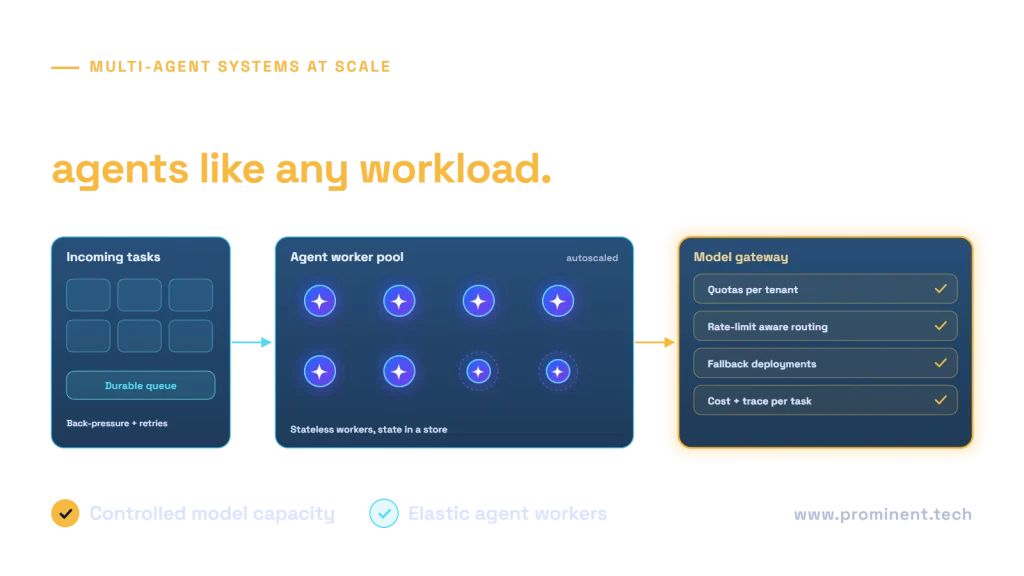
Running multi-agent systems at scale is mainly an infrastructure problem: tasks must be queued and processed by stateless, autoscaled agent workers, state must live in durable stores, every model call must pass through a gateway that manages quotas, rate limits, fallbacks and cost per tenant, and every run must be traced end to end. Applying proven cloud patterns, such as queue-based load leveling, durable orchestration, idempotent tools and back-pressure, turns a promising multi-agent prototype into a dependable production service. This guide covers the patterns, a reference architecture and the operational metrics that matter.
Key takeaways
- Decouple task intake from processing with a durable queue, so traffic spikes do not overwhelm agents or model quotas.
- Keep agent workers stateless and store conversation, plan and tool results externally, so workers can scale and recover freely.
- Model capacity is the scarcest resource. Manage it centrally with quotas, priorities and fallback deployments.
- Make every tool call idempotent, because retries are inevitable at scale.
- Trace each task across agents, tools and model calls, and track cost and success per task and per tenant.
What changes when multi-agent systems scale
Designing how agents collaborate, such as a supervisor delegating to specialists, is covered in our guide to multi-agent orchestration patterns. This article focuses on what happens when that design meets real volume:
- Bursty demand. Thousands of tasks can arrive at once, each fanning out into many model and tool calls.
- Long-running work. Tasks may take minutes and must survive worker restarts and deployments.
- Hard limits. Model deployments have tokens-per-minute and requests-per-minute quotas. See the Azure OpenAI quotas and limits as an example.
- Partial failure. One agent or tool failing should not lose the whole task or repeat side effects.
- Shared cost. Many teams or customers share the same model capacity and budget.
Reference architecture for multi-agent systems at scale
Tasks enter through an API, are validated and placed on a durable queue. An orchestrator, often a durable workflow engine, tracks each task’s state and dispatches steps to a pool of stateless agent workers. Workers call models only through a model gateway and call business systems only through governed tools. State, memory and results live in managed stores. Telemetry flows to a central observability platform.
Seven infrastructure patterns for multi-agent systems
| Pattern | Problem it solves | How to apply it |
|---|---|---|
| Queue-based load leveling | Spikes overwhelm workers and quotas | Buffer tasks in a durable queue; workers pull at a sustainable rate (pattern) |
| Durable orchestration | Long tasks lost on restart | Persist task state and checkpoints in a workflow engine; resume after failure |
| Stateless workers | Workers cannot scale or recover | Load state from a store at each step; any worker can continue any task |
| Event-driven autoscaling | Over- or under-provisioned workers | Scale on queue depth and age, for example with KEDA |
| Idempotent tools | Retries duplicate side effects | Use idempotency keys for every write action |
| Back-pressure and rate limiting | Model or API limits exceeded | Token-bucket limits per tenant and per deployment; retry with backoff |
| Bulkheads per tenant | One customer’s load affects others | Separate queues, quotas or worker pools for priority tenants |
Related guides: idempotency in distributed systems, API rate limiting and backoff and the saga pattern for multi-step actions that need compensation.
Managing model capacity and cost
A model gateway is the control point for the most constrained and expensive resource. It should:
- Allocate token quotas per tenant, team or workload, with priorities for interactive over batch tasks.
- Route requests across several model deployments or regions, and fall back when one is throttled.
- Choose the smallest suitable model per step. See LLM inference cost optimization.
- Cache repeated requests where results can be safely reused.
- Record tokens, latency and cost per call, tagged with task and tenant.
Cloud gateways such as Azure API Management’s AI gateway capabilities provide token limits, load balancing and metrics out of the box.
Operating metrics for multi-agent systems
| Metric | Why it matters |
|---|---|
| Task success rate | The real measure of whether agents are doing their job |
| Cost per completed task | Tells you whether scaling will pay; break down by agent and tenant |
| Queue depth and oldest task age | Early warning of capacity problems |
| Throttled model calls | Shows when quotas or routing need adjusting |
| Steps and tokens per task | Detects agents looping or over-reasoning |
| Tool error rate | Highlights failing integrations |
| Human escalation rate | Shows where agents need improvement or more autonomy |
Instrument with standard telemetry, such as the OpenTelemetry semantic conventions for generative AI, so traces link a task to every agent step, tool call and model call. See AI agent observability.
Hosting choices for agent workers
Container platforms suit most agent workloads: they scale on queue depth, run long tasks and isolate dependencies. Serverless durable workflows suit spiky, step-based tasks with modest compute. Kubernetes gives the most control for large, multi-tenant platforms at the cost of more operations effort. Compare the options in AKS vs Container Apps vs App Service and Azure Functions vs Logic Apps vs Durable Functions. For multi-tenant isolation, see multi-tenant SaaS architecture.
Common questions
How do you scale a multi-agent system?
Queue incoming tasks, run agents as stateless autoscaled workers with state in durable stores, and manage model capacity centrally through a gateway with quotas, routing and fallbacks.
What limits multi-agent systems at scale?
Usually model quotas and cost, followed by tool and API rate limits. Compute for the agent workers themselves is rarely the bottleneck.
Should each agent run as its own microservice?
Not necessarily. Many systems run several agent roles in one worker pool and separate them only where scaling, security or ownership needs differ.
How do we stop retries from duplicating actions?
Give every write action an idempotency key and make tools check it, so a retried step does not repeat a payment, email or record update.
How do we keep costs fair across customers or teams?
Tag every model call with tenant and task, enforce quotas per tenant in the gateway and report cost per task for each tenant.
Scale your agents with confidence
If your multi-agent prototype works and now needs to handle real volume, our cloud and DevOps and cloud AI integration teams can design the queues, gateway, scaling and observability for production.