
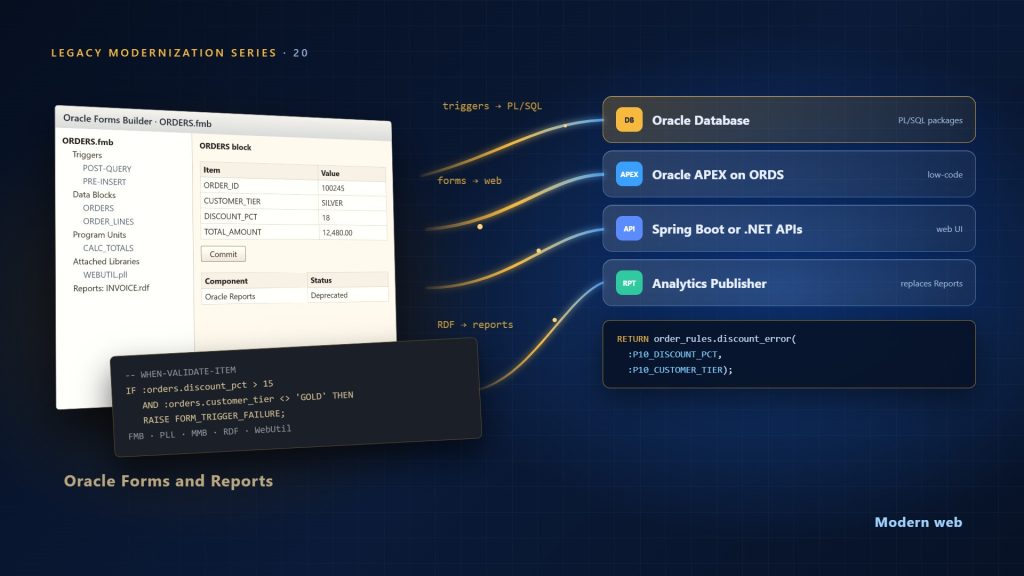
An Oracle Forms migration moves screens and reports built with Oracle Forms and Oracle Reports onto a modern web stack, usually Oracle APEX, Java with Spring Boot, or .NET, while keeping the PL/SQL business logic and the Oracle Database that already run the business. Oracle still supports Forms and Reports, and released version 14.1.2 in December 2024. Oracle has also deprecated Oracle Reports and plans no new features for it, and Premier Support for Fusion Middleware 12c ends in December 2026. This guide sets out the options, the architecture and a phased plan.
Technically reviewed by Harshita Pipaliya.
This is the twentieth article in our Legacy Modernization Series. It follows Visual FoxPro to .NET and SQL Server. For Java targets, see also our Struts to Spring Boot guide and Java 8 to Java 25 guide.
Executive summary
- Still supported, on a clock: Oracle released Forms and Reports 14.1.2 on 19 December 2024, and upgrades to it are supported only from 12.2.1.4 or 12.2.1.19 (Oracle blog). Oracle states Premier Support for Fusion Middleware 12c ends in December 2026 and Extended Support in December 2027 (Oracle docs).
- Reports is deprecated: Oracle Reports is included in 14.1.2 but deprecated since 12.2.1.3. Oracle plans only critical bug fixes and recommends Oracle Analytics Publisher, formerly BI Publisher (Oracle docs).
- Forms has a roadmap: Oracle’s June 2026 statement of direction plans 14.1.2 support through 2030 (Premier) and 2033 (Extended), and intends to include Forms and Reports in a next release targeted for 2027. It is a statement of intent, not a commitment.
- The value is in the PL/SQL: most Forms applications hold business rules in PL/SQL triggers and program units. Moving those rules into database packages makes them reusable by any front end.
- Our recommendation: upgrade to 14.1.2 now if you are on 12c, so you are supported during the migration. Then move logic into PL/SQL packages or services and rebuild screens in Oracle APEX (for PL/SQL-centric teams) or Spring Boot or .NET with a web UI (for teams standardizing off Oracle tools), module by module. Replace Reports in parallel.
Oracle Forms and Reports support status
| Item | Status | Date |
|---|---|---|
| Forms and Reports 14.1.2 | Released (JDK 17.0.12+ or 21.0.4+) | 19 December 2024 |
| Upgrade path to 14.1.2 | Only from 12.2.1.4 or 12.2.1.19 | – |
| Fusion Middleware 12c Premier Support | Ends | December 2026 |
| Fusion Middleware 12c Extended Support | Ends | December 2027 |
| Fusion Middleware 14.1.2 support (planned) | Premier through 2030, Extended through 2033 | Statement of direction, June 2026 |
| Oracle Reports | Deprecated since 12.2.1.3; critical fixes only | – |
| Embedded Java applet in a browser | No longer recommended | – |
| Oracle APEX (current) | Release 26.1 | July 2026 |
Sources: Oracle release announcement, Oracle end-of-support page, Oracle Fusion Middleware statement of direction (June 2026), Forms 14.1.2 deprecated features, APEX 26.1 release notes. Confirm the exact dates for your licences in Oracle’s Lifetime Support Policy.
What this means: Forms is not end of life, but 12c is close to the end of Premier Support, and Reports has no future features. Staying on Forms is a valid short-term choice; staying on 12c or on Reports for the long term is not.
Why organizations move off Oracle Forms
- User experience: applet-style screens and the Forms Standalone Launcher feel dated, and do not suit mobile or browser-only users.
- Skills: Forms developers are scarce and often near retirement.
- Reports: deprecated, so every report needs a new home anyway.
- Platform: WebLogic, JDK and middleware upgrades every few years for one tool.
- Integration: logic inside form triggers cannot be called by APIs, portals or other systems.
- Licensing: Forms and Reports run on Fusion Middleware licences. Review your entitlement before committing to any option.
Migration options compared
| Option | Best for | Keeps | Watch-outs |
|---|---|---|---|
| Upgrade to Forms 14.1.2 | Buying time; stable apps | Everything | UI and skills issues remain; Reports still deprecated |
| Oracle APEX | PL/SQL teams staying on Oracle Database | PL/SQL, database, Oracle skills | New UI model; licence tied to Oracle Database |
| Java (Spring Boot) + web UI | Java shops, cloud-neutral targets | Database, logic as packages or services | Larger rebuild; front-end skills needed |
| .NET + Blazor or React | Microsoft-standard organizations | Database, logic as packages or services | Larger rebuild; Oracle data access in .NET |
| Packaged software (ERP, SaaS) | Commodity processes | Data only | Process change; custom rules lost or rebuilt |
Many estates mix options: APEX for internal data-entry screens, and Java or .NET services where other systems need APIs.
Oracle Forms to web concept mapping
| Oracle Forms | Modern web | Notes |
|---|---|---|
| Form module (FMB) | APEX page, or web component plus API | One form often becomes several pages |
| Data block on a table | APEX interactive grid or form region; REST endpoint plus grid | |
Triggers (WHEN-VALIDATE-ITEM, PRE-INSERT, POST-QUERY) | Validations, processes, service methods | Move rules into PL/SQL packages first |
| Program units and libraries (PLL) | PL/SQL packages in the database | Reusable by any UI |
| List of values (LOV), record groups | APEX LOVs; lookup endpoints | |
| Master-detail relations | Master-detail pages; nested resources | |
| Menus (MMB) | Application navigation | |
| Alerts and messages | Inline validation and notifications | |
CALL_FORM, OPEN_FORM | Page links with parameters | |
| WebUtil client file and OLE access | Browser upload and download; server jobs | Desktop integration needs redesign |
| Oracle Reports (RDF) | Analytics Publisher, APEX reports or a reporting service | See below |
Replacing Oracle Reports
| Report type | Typical target |
|---|---|
| Pixel-perfect documents (invoices, statements, letters) | Oracle Analytics Publisher (Oracle’s recommendation), or a document generation service |
| Operational lists and filters | APEX interactive reports, or grids in the new UI |
| Analytical and management reports | A BI tool (Oracle Analytics, Power BI or similar) |
| Batch print and distribution | Scheduled jobs producing PDF and email |
Reuse the report SQL where you can, and compare old and new outputs for the same parameters before switching.
Code patterns: before and after
The examples below are illustrative and simplified.
1. Oracle Forms trigger (before): a validation rule inside the form.
-- WHEN-VALIDATE-ITEM on ORDERS.DISCOUNT_PCT
IF :orders.discount_pct > 15
   AND :orders.customer_tier <> 'GOLD' THEN
   MESSAGE('Discount above 15% needs a GOLD customer');
   RAISE FORM_TRIGGER_FAILURE;
END IF;
2. The rule moved into a PL/SQL package (after): callable by APEX, Java or .NET.
CREATE OR REPLACE PACKAGE order_rules AS
  FUNCTION discount_error(p_discount_pct NUMBER, p_tier VARCHAR2)
    RETURN VARCHAR2;
END order_rules;
/
CREATE OR REPLACE PACKAGE BODY order_rules AS
  FUNCTION discount_error(p_discount_pct NUMBER, p_tier VARCHAR2)
    RETURN VARCHAR2 IS
  BEGIN
    IF p_discount_pct > 15 AND p_tier <> 'GOLD' THEN
      RETURN 'Discount above 15% needs a GOLD customer';
    END IF;
    RETURN NULL;
  END;
END order_rules;
/
3. APEX validation using the package: a “Function Body (returning Error Text)” validation.
RETURN order_rules.discount_error(:P10_DISCOUNT_PCT, :P10_CUSTOMER_TIER);
4. The same rule behind a Spring Boot API:
@Service
public class OrderRules {
    private final JdbcTemplate jdbc;
    public OrderRules(JdbcTemplate jdbc) { this.jdbc = jdbc; }

    public Optional<String> discountError(BigDecimal pct, String tier) {
        return Optional.ofNullable(jdbc.queryForObject(
            "select order_rules.discount_error(?, ?) from dual",
            String.class, pct, tier));
    }
}
5. A report query reused for the new report:
SELECT c.customer_name, SUM(o.total_amount) AS total
FROM   orders o JOIN customers c ON c.customer_id = o.customer_id
WHERE  o.order_date BETWEEN :p_from AND :p_to
GROUP  BY c.customer_name
ORDER  BY total DESC;
Recommended target architecture
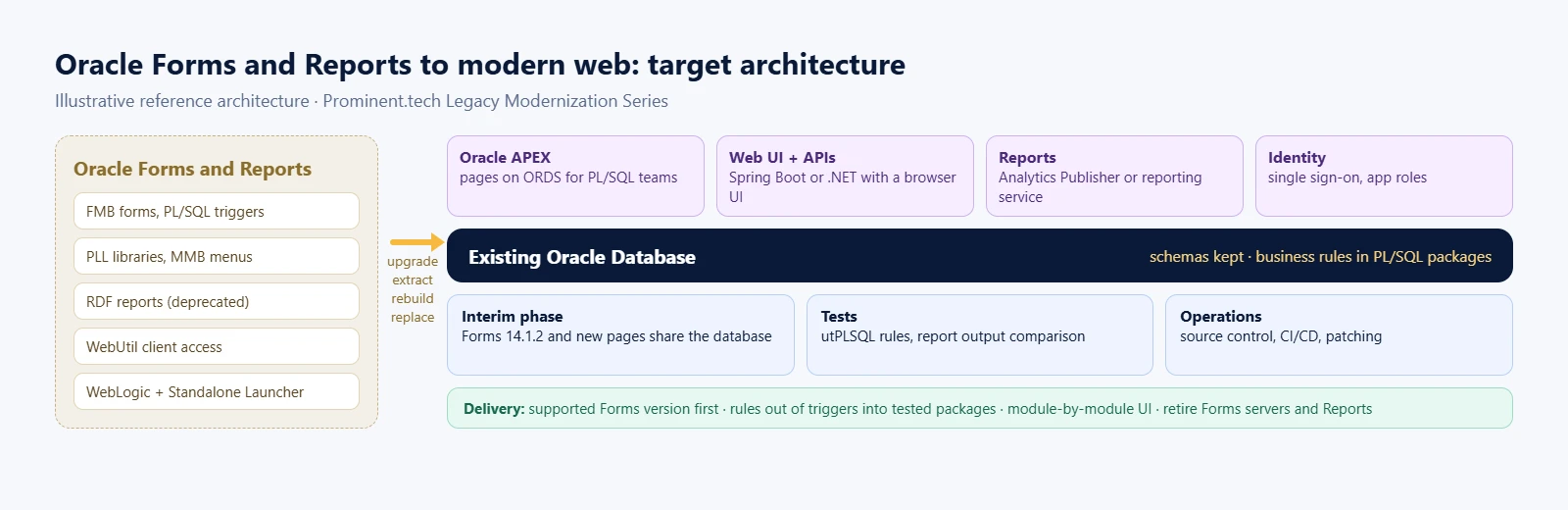
- Data: the existing Oracle Database, with schemas, constraints and PL/SQL packages kept.
- Business logic: rules moved from form triggers into PL/SQL packages, and into Spring Boot or .NET services where APIs are needed.
- User interface: Oracle APEX on Oracle REST Data Services (ORDS), or a browser UI over REST APIs; chosen per module.
- Reporting: Oracle Analytics Publisher for documents, APEX or BI tools for lists and analytics.
- Operations: single sign-on, source control for PL/SQL and APEX exports, CI/CD and automated tests.
Running Oracle Forms on 12c? Talk to our modernization team about an upgrade-then-migrate plan before Premier Support ends.
Oracle Forms migration steps
- Inventory: count forms, blocks, triggers, program units, libraries, menus and reports; note WebUtil use and calls to other forms.
- Upgrade if needed: move 12c environments to 14.1.2 so the estate is supported during the migration.
- Classify forms as simple CRUD, master-detail, complex transactional, or rarely used (retire candidates).
- Choose the target per module: APEX, Java or .NET, or packaged software.
- Extract logic: move trigger code and program units into PL/SQL packages with unit tests.
- Rebuild screens module by module, starting with simple CRUD forms and lookups.
- Replace reports in parallel, starting with the most used and the most business-critical.
- Retire Forms and Reports servers, WebLogic domains and client launchers once the last module moves.
Security considerations
- Identity: replace database logins typed into Forms with single sign-on and application roles.
- Least privilege: the web tier connects through a dedicated schema or proxy user with only the grants it needs.
- Injection: use bind variables in all SQL, including dynamic SQL moved out of Forms.
- Client access: remove WebUtil file and OLE access to the user’s machine; use controlled upload and download.
- Patching: keep ORDS, APEX, WebLogic, the JDK and the database on supported, patched versions.
Testing, deployment and support
Testing
- Turn every rule moved into a PL/SQL package into a unit test (for example with utPLSQL).
- Compare old and new report outputs for the same parameters.
- Run user acceptance on real workflows, especially keyboard-heavy data entry.
Deployment
- Run old forms and new pages against the same database during the transition, with links between them.
- Keep PL/SQL and APEX applications in source control and deploy through pipelines.
Support
- Track Oracle support dates for Fusion Middleware, APEX and ORDS.
- Plan regular APEX and ORDS upgrades, which Oracle releases more often than Forms.
Cost, effort and timeline
The ranges below are indicative planning assumptions, not benchmarks or quotes.
| Application profile | Typical scope | Indicative cost (USD) | Indicative duration |
|---|---|---|---|
| Small | Up to 50 forms, under 50 reports | $60,000 to $200,000 | 3 to 6 months |
| Medium | 50 to 300 forms, 50 to 300 reports, libraries, WebUtil | $200,000 to $900,000 | 6 to 15 months |
| Large | 300+ forms, 300+ reports, several applications and integrations | $900,000 to $3M+ | 15 to 36 months |
An upgrade to 14.1.2 alone usually costs a fraction of these ranges. A move to APEX is usually cheaper than a full Java or .NET rebuild, because the PL/SQL stays. Cost drivers: form and report counts, trigger complexity, WebUtil, integrations and test coverage. See legacy application modernization cost and ROI.
FAQs
Is Oracle Forms end of life?
No. Oracle released Forms and Reports 14.1.2 in December 2024 and plans support for 14.1.2 through 2030 (Premier) and 2033 (Extended). Fusion Middleware 12c Premier Support ends in December 2026.
Is Oracle Reports still supported?
It is included in 14.1.2 but deprecated. Oracle plans only critical bug fixes and recommends Oracle Analytics Publisher.
What is the best replacement for Oracle Forms?
Oracle APEX suits teams with strong PL/SQL skills that stay on Oracle Database. Java with Spring Boot or .NET suits organizations standardizing on those platforms or needing APIs. Many use both.
Can Oracle Forms be converted automatically?
Partly. Commercial tools and AI assistants can analyse Forms modules and draft APEX, Java or .NET code. Generated output needs review and testing, and the UI usually needs redesign.
Should we upgrade to Forms 14.1.2 first?
If you are on 12c and the migration will take more than a few months, yes. It keeps you supported while you migrate.
Can Forms and the new application run side by side?
Yes. Both can use the same Oracle Database, so you can move module by module.
How long does an Oracle Forms migration take?
Small applications can move in three to six months. Large estates with hundreds of forms and reports often take more than a year, in phases.
Conclusion
Oracle Forms is still supported, but 12c is near the end of Premier Support and Oracle Reports is deprecated. Upgrade to 14.1.2 to stay supported, move business rules out of form triggers into PL/SQL packages, choose APEX, Java or .NET per module, and replace reports in parallel.
Previous in this series: Visual FoxPro to .NET and SQL Server. Next: Lotus Notes and Domino to Power Platform or Modern Web Applications.
Related services: Legacy Software Modernization · Web Application Development · .NET Development · Microsoft Azure
Sources
- Oracle, Oracle FMW Forms and Reports 14.1.2 has been released
- Oracle, Oracle Fusion Middleware: End of Premier and Extended Support
- Oracle, Oracle Fusion Middleware statement of direction (June 2026)
- Oracle, Forms and Reports 14.1.2 deprecated and desupported features
- Oracle, About Oracle Reports (14.1.2)
- Oracle, Upgrading Oracle Forms (14.1.2)
- Oracle, Oracle APEX 26.1 release notes
Plan your Oracle Forms migration
Prominent.tech helps teams plan Oracle Forms and Reports modernization, from an upgrade to 14.1.2 to moving PL/SQL business rules into tested packages and rebuilding screens in Oracle APEX, Java or .NET module by module. Talk to our modernization team or explore our legacy software modernization services.