
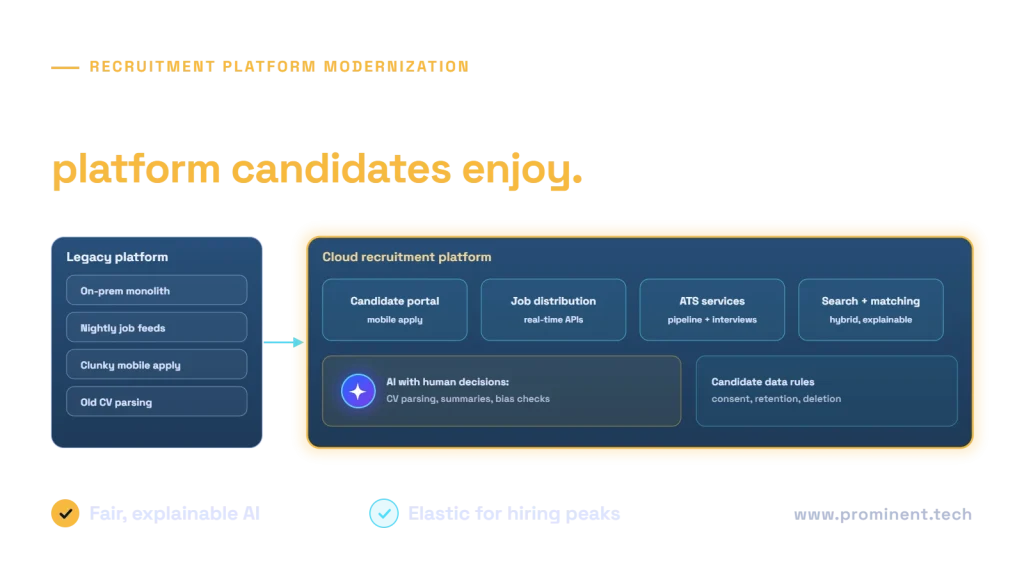
Modernizing a legacy recruitment platform in the cloud replaces an on-premises monolith, nightly job feeds and dated application forms with a scalable platform: a mobile-friendly candidate portal, real-time job distribution APIs, modular applicant tracking services, hybrid search and matching, document AI for CV parsing and a data platform for hiring analytics. Because recruitment handles personal data and increasingly uses AI in decisions about people, the design must also build in candidate consent and retention rules, human decision-making, bias monitoring and explainability. A phased migration keeps hiring running while each capability moves.
Key takeaways
- Candidate experience, especially mobile applications, is often the biggest driver for modernization.
- Real-time integrations with job boards and HR systems replace fragile batch feeds.
- Use AI to assist recruiters, not to make hiring decisions automatically.
- Recruitment AI is treated as high-risk in some jurisdictions; plan for transparency and oversight.
- Migrate in phases, starting with the candidate-facing layer and integrations.
Common problems with legacy recruitment platforms
| Problem | Impact |
|---|---|
| Long, desktop-only application forms | Candidates abandon applications |
| Nightly batch job feeds | Stale or closed jobs remain advertised |
| On-premises monolith | Slow to change; struggles with hiring peaks |
| Keyword-only search | Good candidates missed in the database |
| Outdated CV parsing | Manual re-keying by recruiters |
| Weak data retention controls | Privacy risk from keeping candidate data too long |
Target cloud architecture for a recruitment platform
Search is central to recruiter productivity. Hybrid search that combines keywords with semantic matching finds relevant candidates even when CVs use different terms; see hybrid vs vector vs keyword search. Integrations with the HR system and onboarding workflows close the loop after an offer; see low-code HR automation.
Responsible AI in recruitment
- Assist, do not decide. AI can parse CVs, summarise applications and suggest matches; recruiters make the decisions.
- Explain suggestions. Show why a candidate was suggested, based on job-relevant criteria.
- Monitor bias. Test outcomes across groups and remove features that act as proxies for protected characteristics.
- Be transparent. Tell candidates how AI is used and how to request human review.
- Follow regulation. The EU AI Act lists AI used in recruitment among high-risk uses, and the UK ICO publishes guidance on AI and data protection.
Candidate data and privacy
- Collect only what is needed for the role and stage of the process.
- Record consent for talent pools and future opportunities.
- Apply retention periods and automatic deletion for unsuccessful candidates, in line with guidance such as the ICO’s recruitment and selection guidance.
- Support access and deletion requests efficiently; see GDPR-compliant cloud architecture.
- Protect identity documents and right-to-work checks with stricter access.
A phased modernization roadmap
Each phase uses incremental migration so hiring never stops; see zero-downtime cloud migration and modernization timelines by system age.
Common questions
Why modernize a recruitment platform?
To improve candidate experience, integrate with job boards and HR systems in real time, scale for hiring peaks, use modern search and AI, and manage candidate data properly.
Can AI make hiring decisions?
It should support recruiters, not replace their decisions. Recruitment AI often carries legal obligations for transparency, fairness and human oversight.
How long does recruitment platform modernization take?
Typically 6 to 18 months in phases, depending on the age of the platform, integrations and data volumes.
How long should candidate data be kept?
Only as long as necessary for the purpose, usually a defined period after the role is filled unless the candidate consents to a talent pool. Follow your local guidance.
Should we buy an ATS instead?
If your process is standard, a packaged ATS may fit. Custom or hybrid platforms suit recruitment businesses whose platform is their product or differentiator.
Modernize your recruitment platform
Share your current platform, integrations and hiring volumes. Our legacy modernization and cloud teams will design the target platform and a phased plan that keeps hiring running.