
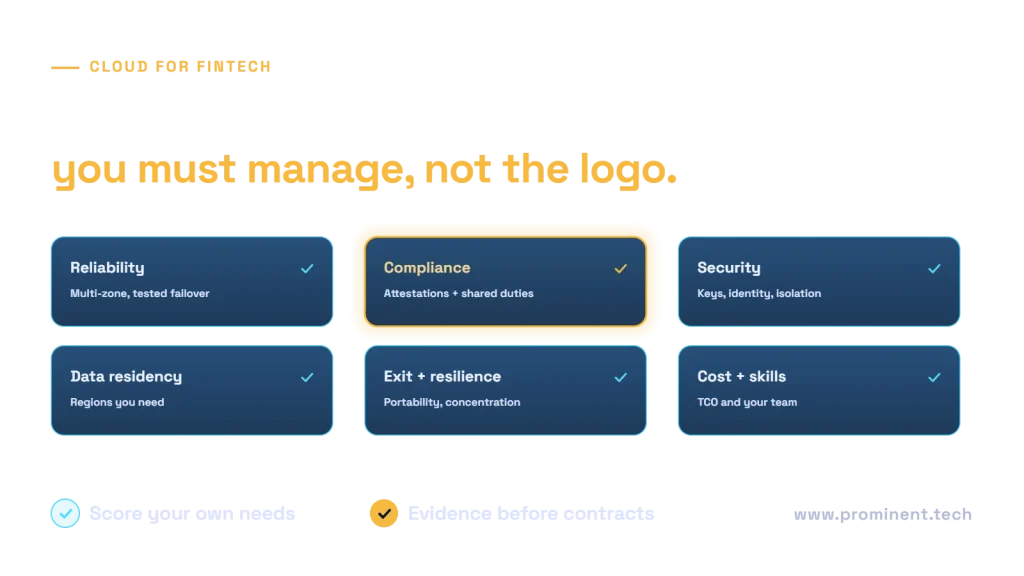
To choose a cloud provider for FinTech, evaluate AWS, Microsoft Azure and Google Cloud against your own requirements: reliability for transaction processing, the compliance attestations and regulatory support you need (such as PCI DSS, SOC 2 and ISO 27001 reports), security and key management, data residency in your markets, operational resilience and exit planning, and total cost given your team’s skills. All three major providers can support regulated financial workloads; the right choice usually depends on your existing technology, regulators’ expectations in your markets, specific managed services and your team, rather than on any provider being universally better. Remember that compliance is shared: the provider’s certifications cover their infrastructure, not your application.
Key takeaways
- Start from your regulatory, reliability and data requirements, then compare providers.
- Provider attestations cover their side of the shared responsibility model only.
- Design for multi-zone resilience and test failover; plan for provider outages.
- Financial regulators increasingly expect documented exit and concentration risk plans.
- Team skills and existing estate often decide total cost more than list prices.
Selection criteria for a FinTech cloud provider
| Criterion | Questions to ask |
|---|---|
| Reliability | Are there enough availability zones and regions where you operate? What are the service level agreements for the services you would use? |
| Compliance evidence | Which attestations are available for the specific services you need (PCI DSS, SOC 1/2, ISO 27001)? Can you get the reports? |
| Security | Customer-managed keys and hardware security modules, identity integration, network isolation, confidential computing options |
| Data residency | Regions in your markets, controls on where data and backups are stored and processed |
| Financial services support | Regulatory documentation, contract terms for regulated firms, audit and access rights |
| Managed services | Databases, messaging, analytics and AI services that fit your architecture |
| Exit and portability | How hard would it be to move? Which services create lock-in? |
| Cost and skills | Total cost of ownership including support, licensing and your team’s experience |
Each provider publishes compliance information: AWS compliance programs, Azure compliance documentation and Google Cloud compliance. Check the scope for the exact services and regions you plan to use.
Shared responsibility for compliance
A provider’s PCI DSS or SOC 2 attestation covers its infrastructure and services. You remain responsible for how you configure them, your application code, identity and access, data protection and your own compliance assessments. The PCI Security Standards Council publishes the standard and guidance on cloud environments.
Reference architecture for FinTech workloads
- A governed landing zone with separate accounts or subscriptions for production, non-production and cardholder data; see the Azure landing zone checklist.
- Multi-zone deployment for transaction services, with tested failover and backups in a second region.
- Idempotent APIs and reliable messaging for payments; see idempotency in distributed systems.
- Customer-managed keys, centralized logging and security monitoring.
Resilience, exit and regulation
Financial regulators expect firms to manage the risks of relying on third-party technology providers. In the EU, the Digital Operational Resilience Act (DORA) sets requirements for ICT risk management and third-party arrangements, and other regulators have similar expectations. In practice this means documented exit strategies, resilience testing, incident reporting and contracts with the right audit rights. Multi-cloud is one option, but it adds cost and complexity; portable design and a credible exit plan are often enough. See cloud portability across AWS, Azure and Google Cloud and GDPR-compliant cloud architecture. This article is technical guidance, not legal or regulatory advice.
A selection process
For a head-to-head comparison of two providers, see Azure vs AWS for enterprise applications. For moving existing systems, see the zero-downtime cloud migration playbook.
Common questions
Which cloud provider is best for FinTech?
There is no universal best. AWS, Azure and Google Cloud all support regulated financial workloads; choose based on your requirements, markets, existing technology and team.
Does a PCI DSS compliant cloud make my app compliant?
No. The provider’s attestation covers its part; your configuration, application and processes still need their own assessment.
Should a FinTech use multi-cloud?
Only if a clear requirement justifies the extra cost and complexity. Many firms use one primary provider with portable design and a documented exit plan.
What does DORA mean for cloud choice?
For EU financial entities, it requires ICT third-party risk management, resilience testing and exit strategies, which affect contracts and architecture with any provider.
How long does a cloud provider evaluation take?
Typically several weeks, including requirements, scoring, a proof of concept for critical services and contract review.
Get an independent cloud recommendation for your FinTech
Our cloud and DevOps team helps financial services companies assess requirements, compare providers and design compliant, resilient architectures.