
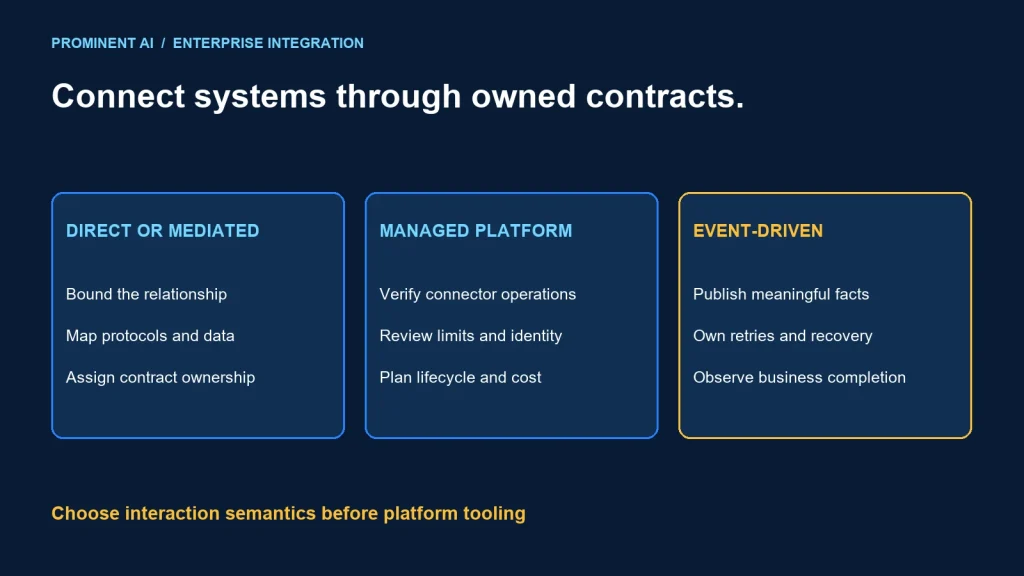
Choose enterprise integration architecture from the interaction contract, system constraints and operating ownership. Point-to-point links suit bounded direct integrations; an ESB can centralize mediation; iPaaS provides managed integration tooling; event-driven designs decouple producers and consumers through asynchronous contracts. These options can coexist and are not four mutually exclusive product categories.
Key takeaways
- Separate business interaction patterns from platform hosting choices.
- Centralizing integration can improve consistency while creating a shared change and failure boundary.
- Managed connectors still need permissions, capacity and lifecycle management.
- Asynchronous delivery requires duplicate handling, recovery and visible business status.
Point-to-point vs ESB vs iPaaS vs event-driven
A point-to-point integration connects a source and destination directly through an agreed interface. It can be synchronous or asynchronous. The term describes the relationship rather than guaranteeing a particular transport or level of maintainability.
IBM’s ESB explanation describes centralized mediation such as routing, transformation and protocol adaptation. Its iPaaS overview describes cloud-based integration tools and connectors. These describe different dimensions: a managed platform can implement several integration patterns.
Microsoft’s event-driven architecture guidance separates producers, channels and consumers. Decide whether the workload needs notification, work distribution or retained streaming history rather than treating every broker as equivalent.
| Approach | Primary value | Responsibility to retain |
|---|---|---|
| Point-to-point | Direct, bounded relationship | Contract, credentials, failures and support for each connection |
| ESB | Shared mediation and integration conventions | Runtime isolation, change governance and platform capacity |
| iPaaS | Managed workflow and connector capabilities | Connector limits, identity, deployment and commercial terms |
| Event-driven | Asynchronous producer/consumer separation | Event semantics, delivery behavior, replay and reconciliation |
Choose a business contract first: immediate answer, queued work, notification of a completed fact, or a durable history to process. The platform shortlist follows from that requirement.
Two integration architecture diagrams
Request and mediation path
Source application → authorized API operation
├─ Direct adapter → target system
└─ Shared mediation runtime → mapping/routing → target system

Contract owners define timeout, result meaning and safe retry behavior.
An iPaaS or other runtime may host the mediation workflow.
A central runtime can hide protocol differences from callers, but it should not become the unowned location of every business rule. Decide which system is authoritative for customer, order or invoice state.
Asynchronous event or work path
Producer → durable publication boundary → channel
├─ Consumer A → owned state/action
└─ Consumer B → owned state/action

Each consumer: validate → deduplicate as required → process
→ record progress → retry or quarantine → reconcile
End-to-end status remains visible to business operations.
Use fan-out only when each subscriber should receive its own copy. Competing workers processing a queue represent a different contract. Retained streaming history introduces its own position and replay responsibilities.
Coupling and integration ownership
Count dependencies by how changes propagate. A direct API with a stable contract may be less coupled than a central model that every team must change for each release. Conversely, duplicated transformations and credentials across many direct links can be expensive to maintain.
For an ESB or iPaaS, define ownership of shared runtime configuration separately from ownership of individual workflows. Platform administrators should not automatically become the product owner for every business process.
Version interface contracts and mappings. A source field renamed in a SaaS product can break a workflow even if no local code changed. Monitor vendor deprecations and test connector upgrades against representative data.
Establish one authoritative owner for each business record and transition. Integration copies should have a documented purpose and freshness expectation. Avoid bidirectional synchronization without conflict resolution and clear field-level ownership.
Document support handoffs. When an order is stuck, the operator needs to distinguish source acceptance, transport delivery, target processing and business rejection. A green connector run may not prove the intended business outcome.
Throughput, latency and recovery
Model peak arrival rate, payload distribution, target capacity and the acceptable age of work. A queue can absorb a burst but cannot make a slow destination process indefinitely faster than its sustainable rate.
Evaluate connectors for batching, pagination, throttling, concurrency and timeout behavior. Verify the exact product, connector and plan rather than assuming all managed connectors have the same limits.
Design retries from failure semantics. A timed-out request may already have committed a write. Use operation identity and a target-supported duplicate-handling strategy where business actions must not repeat. Blind retries can multiply incidents.
For asynchronous workflows, define retry limits, quarantine or dead-letter handling and replay authority. Reprocessing should be an owned operation with context about what has already happened. Do not move failed messages back repeatedly without investigating the cause.
Track business completion and reconciliation alongside technical delivery. A customer creation workflow can deliver successfully but fail a target business validation. Those are different outcomes and need different support actions.
Protect credentials, payloads and logs. Apply least privilege to each connector and control access to workflow history. Integration platforms can accumulate broad visibility across systems, making access review important to their operating model.
A selection matrix for enterprise systems
| Workload | Candidate approach | Decision evidence |
|---|---|---|
| One stable application-to-API exchange | Point-to-point with clear ownership | Contract stability, safe failure handling and support path |
| Several legacy protocols need reusable mediation | ESB or suitable integration runtime | Adapter coverage, isolation and change governance |
| Common SaaS workflow with supported connectors | iPaaS evaluation | Exact operations, permissions, limits and total cost |
| Several consumers react to a business fact | Event-driven publication | Event meaning, subscriber independence and recovery |
| Burst work for a rate-limited target | Queued processing with bounded concurrency | Queue-age objective, target capacity and duplicate handling |
| Immediate transactional answer required | Explicit synchronous contract where feasible | Latency, timeout and partial-failure semantics |
A hybrid can fit an enterprise: a managed connector retrieves approved source data, a mediation workflow validates it, and a durable channel feeds independent consumers. Keep responsibilities explicit instead of assuming the product diagram defines them.
Compare total operating cost: runtime or subscription charges, connector licensing, transfer, monitoring, support and workflow engineering. Include the cost of exceptions and connector gaps rather than evaluating only a demonstration happy path.
A bounded integration pilot
For a fictional CRM-to-order-platform integration, begin with one approved customer update. Define the authoritative fields, acceptable delay and handling of a rejected record. Test valid updates, missing identifiers, duplicates, throttling, credential failure and target unavailability.
If downstream reporting also needs the update, determine whether it should subscribe independently to a meaningful event or consume a separate projection. Do not make the CRM caller coordinate every downstream system unless that orchestration is intentional.
- Inventory source, destination, contracts and data ownership.
- Specify result meaning, latency and recovery objectives.
- Shortlist patterns and platforms that support required operations.
- Build the smallest representative workflow.
- Exercise failure, retry and reconciliation cases.
- Measure throughput, completion age and operating effort.
- Review permissions, lifecycle and commercial assumptions.
- Approve the design with named business and platform owners.
This is a proposed evaluation scenario, not a claim of a completed client integration or measured throughput. For existing workflows, migrate through controlled routing and reconciliation rather than replacing every connection at once.
Use the API interface comparison for contract choices and the queue and topic guide for messaging responsibilities.
Common questions
Which enterprise integration architecture is right for your systems?
Choose from interaction semantics, legacy interfaces, workload, ownership and recovery needs. Direct, mediated, managed and event-driven approaches can coexist.
Is iPaaS the same as event-driven architecture?
No. iPaaS describes managed integration capabilities, while event-driven describes an interaction style. A platform may implement that style or other workflows.
Are point-to-point integrations always bad?
No. A bounded stable relationship can be appropriate. Problems grow when contracts, credentials and transformations multiply without ownership.
Does a queue solve a slow destination?
It can buffer bursts, but sustainable processing still depends on destination capacity. Define backlog age and recovery behavior.
Does connector success prove business completion?
Not always. Verify the target’s business outcome and reconciliation status in addition to technical delivery.
Choose integration boundaries your teams can operate
Bring your system inventory, interfaces and failure scenarios. Request an API integration architecture review to compare patterns, ownership and a practical delivery plan.