
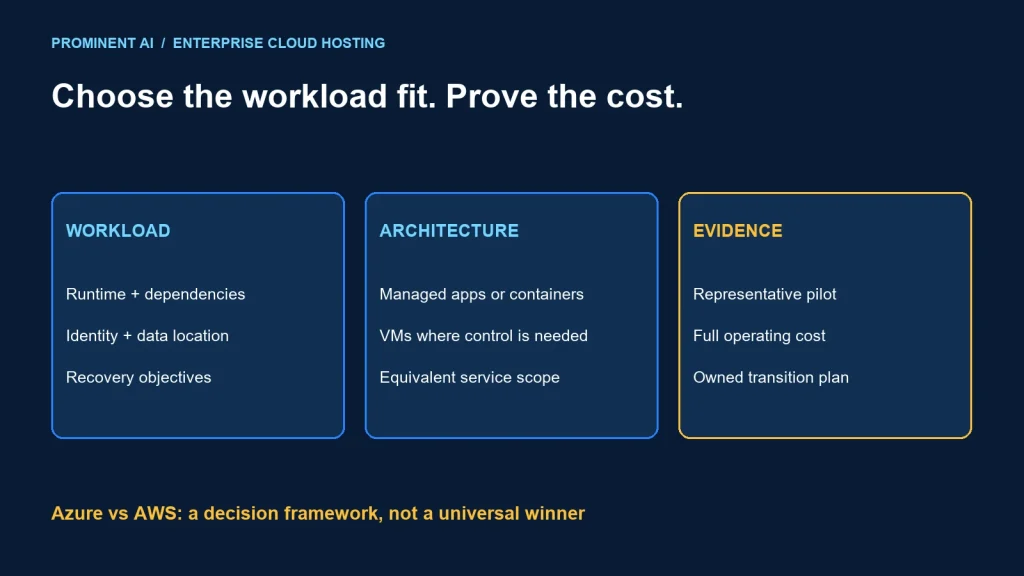
Choose Azure or AWS for enterprise hosting by matching the application’s runtime, data, identity, recovery and operating requirements to a complete service design. A .NET workload does not automatically require Azure, and an existing AWS estate does not automatically make every new workload cheaper there. Compare viable architectures using the same service objectives and cost boundary.
Key takeaways
- Compare managed hosting, containers and virtual machines separately.
- Region, service tier and architecture matter more than broad feature counts.
- Include data movement, resilience, security operations and engineering effort in TCO.
- A bounded pilot should prove deployment, integration, recovery and cost assumptions.
Azure vs AWS enterprise hosting starts with a workload contract
Write down expected users, request patterns, background jobs, data volumes and dependencies. Specify latency targets and recovery objectives for the complete application. Distinguish current measurements from forecasts.
Inventory runtime and operating-system requirements. An application that depends on a particular Windows component, local filesystem behavior or enterprise network integration has a different migration path from a stateless containerized API. The language alone does not describe those constraints.
Identify where important data and users already reside. Moving compute while leaving a chatty database on another network can change latency, transfer cost and availability. Include the full request path rather than benchmarking one isolated server.
Record mandatory organizational boundaries: approved regions, access reviews, audit evidence, procurement terms and support ownership. Treat these as requirements to verify, not blanket claims that one cloud is inherently compliant.
Compare hosting candidates by operating model
Microsoft’s compute selection guide distinguishes App Service, Functions, Container Apps, AKS and virtual machines by application needs and management responsibilities. AWS’s compute overview includes EC2, Elastic Beanstalk, ECS, EKS, Fargate and Lambda. These are candidate families, not interchangeable products.
| Workload shape | Azure candidates | AWS candidates | Evaluate carefully |
|---|---|---|---|
| Web application or API | App Service; Container Apps for suitable container designs | Elastic Beanstalk; ECS with a suitable compute and ingress design | Runtime support, networking, deployment and operational ownership |
| Kubernetes platform | AKS | EKS | Cluster lifecycle, add-ons, networking and team capability |
| Container workloads without managing worker VMs directly | Container Apps where requirements fit | ECS with Fargate where requirements fit | Execution model, limits, scaling and integration behavior |
| Event-triggered functions | Azure Functions | AWS Lambda | Triggers, execution constraints, concurrency and dependency behavior |
| OS-dependent application | Azure Virtual Machines | Amazon EC2 | Licensing, patching, availability and recovery responsibilities |
Verify current availability, supported runtimes, quotas and networking features for the exact region and tier. This table intentionally avoids declaring feature parity. Two managed services can solve similar business problems through substantially different deployment and security models.
Choose Kubernetes only when its control and ecosystem justify the platform workload. Container packaging by itself does not establish a need for a cluster. Conversely, a managed application service is unsuitable if a required dependency or operating control cannot be supported.
A decision matrix that separates constraints from preferences
| Dimension | Question | Evidence required |
|---|---|---|
| Application compatibility | Does the full dependency set run correctly? | Representative deployment and functional tests |
| Identity and access | Can users and workloads obtain only intended access? | Federation, service identity and denied-access tests |
| Data proximity | Where do critical reads and writes occur? | End-to-end latency and transfer estimates |
| Resilience | Can the design meet approved recovery objectives? | Restore and failover rehearsal |
| Operations | Who handles incidents, upgrades and capacity? | Runbook, skills inventory and support coverage |
| Economics | What does equivalent service delivery cost? | Reviewed bill of materials and sensitivity model |
| Exit and change | How are data and workloads moved later? | Export, dependency and migration design |
Eliminate candidates that fail mandatory requirements before assigning preference scores. Otherwise a low price can compensate numerically for a missing capability that the business actually cannot accept.
For remaining candidates, agree weights with application owners, security, operations and finance. Record why a score was assigned and its confidence. An untested assumption should not carry the same authority as a measured pilot result.
How do you choose Azure or AWS for a .NET workload?
First separate modern cross-platform .NET from applications that depend on Windows-specific components or older .NET Framework behavior. Inspect actual libraries, authentication, file handling and background processes. A successful compilation is not a complete hosting compatibility test.
Then evaluate the existing estate. If deployment, identity, monitoring and data operations already work well in one cloud, that established capability has economic value. Include the effort of extending it as well as the cost of introducing another operating model.
For a new stateless .NET API, shortlist managed application or container options that meet requirements. Run the same business journeys, dependency calls and failure tests. For an OS-dependent application, a VM-based migration may be a practical intermediate stage while modernization is planned.
Review Windows and database licensing with the organization’s licensing owner. Benefits, eligibility and portability depend on actual agreements and service choices. Do not put an assumed discount into the business case before it has been confirmed.
A reasonable outcome may be to retain the application in its current cloud and improve architecture there. Migration needs a business benefit large enough to cover transition cost and risk.
A workload cost model with transparent assumptions
Use a shared monthly boundary: compute, data services, storage, networking, security and observability, backup, support and operations. Add one-time migration and change effort separately. Include production, test environments and recovery capacity.
Monthly recurring TCO = compute + data + storage + network
 security/observability + backup/recovery + support + operating effort

Evaluation-period cost = months × recurring TCO + one-time transition cost
Fictional planning example: the following values are arbitrary currency units, not Azure or AWS prices, benchmarks or a customer quote. Both candidates are assumed to meet the same workload contract; that assumption must be tested.
| Monthly area | Candidate A | Candidate B |
|---|---|---|
| Compute | 900 | 820 |
| Data services | 600 | 620 |
| Network | 120 | 200 |
| Security and observability | 180 | 190 |
| Backup and recovery | 100 | 110 |
| Support | 100 | 100 |
| Operating effort | 500 | 400 |
| Recurring total | 2,500 | 2,440 |
If transition cost is 2,000 for A and 5,000 for B, the simplified first-year totals are 32,000 and 34,280 respectively. The lower recurring total alone does not win this example. At a constant 60-unit monthly difference, recovering B’s additional 3,000 transition cost would take 50 months, before considering financing or changing demand.
Replace every input with reviewed estimates. Test sensitivity to peak traffic, data growth, log retention, cross-region transfer and staff effort. Commitments require a separate utilization analysis; unused committed capacity can erase expected savings. Avoid mixing discounted compute on one side with on-demand compute on the other without explaining the difference.
The model excludes taxes, exchange rates, financing and risk valuation. Add them where decision-makers require them. Use the cloud cost review guide for a more detailed cost-control process.
A pilot that can change the decision
- Deploy the same representative workload and data shape in each viable design.
- Exercise identity, integration, scheduled work and critical user journeys.
- Measure end-to-end behavior under normal and peak conditions.
- Rehearse failed deployment, backup restore and dependency failure.
- Capture resource consumption and operating effort for the cost model.
- Record unresolved limits and confirm ownership before approval.
These are proposed tests, not claims of a completed cross-cloud benchmark. Preserve the workload definition and test inputs so results remain comparable. A pilot with a smaller dataset or missing security controls can understate production cost.
For migration, plan data synchronization, cutover, user sessions and a realistic recovery boundary. Define the point after which returning to the old environment requires reconciliation. Validate rollback through the progressive deployment checklist.
Common questions
Is Azure always the best cloud for .NET applications?
No. Evaluate runtime dependencies, data proximity, organizational capabilities and equivalent hosting designs. Existing cloud operations can materially affect the decision.
Is AWS cheaper than Azure for enterprise hosting?
There is no universal winner. Compare the same workload, resilience, service scope and commercial assumptions, including operations and migration effort.
Should every enterprise application use Kubernetes?
No. Use it when the required controls and platform ecosystem justify its operating responsibilities. Managed application or container services may fit simpler requirements.
Does using containers eliminate cloud lock-in?
No. Identity, databases, networking, messaging and deployment controls can remain platform-specific even when application packaging is portable.
What should a cloud comparison pilot prove?
Compatibility, critical journey behavior, integration, recovery and credible cost assumptions for the complete workload.
Choose a hosting design from workload evidence
Bring your dependency inventory, service objectives and existing cloud agreements. Discuss a cloud architecture and cost review to build a workload-specific Azure versus AWS decision and transition plan.