
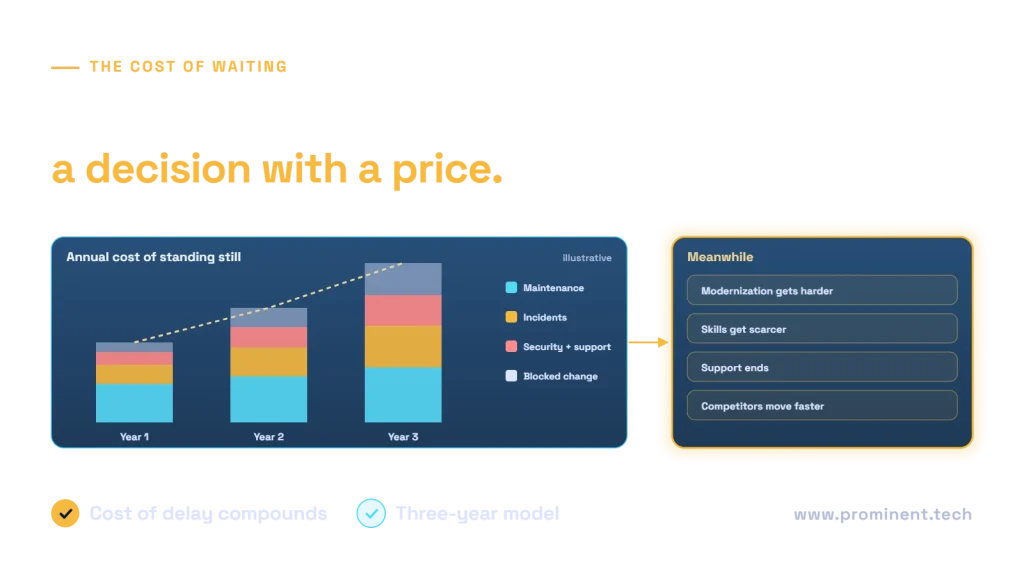
Delaying legacy modernization is not free: every year a business-critical system stays on outdated technology, the organisation typically pays more in maintenance, incidents, security and extended support, and loses value from changes the system cannot deliver, while the eventual modernization itself becomes larger and riskier. A simple three-year model makes this visible by adding the yearly cost of standing still and comparing it with the cost and payback of acting now. In many mid-market cases, the cost of delay over three years equals or exceeds the cost of a phased modernization. This guide shows how to build that model with your own numbers.
Key takeaways
- The cost of delaying modernization has six parts: maintenance, incidents, security and support, infrastructure, talent and blocked change.
- Most of these costs rise each year as technical debt compounds.
- The cost of modernizing also rises with delay as more code, data and workarounds accumulate.
- Compare three-year “do nothing” cost with phased modernization cost and payback.
- Use real numbers from your service desk, finance and backlog, not estimates alone.
The six costs of standing still
| Cost | What it includes | How it usually trends |
|---|---|---|
| Maintenance effort | Engineering time spent keeping the system running, patching and fixing | Rises as code and dependencies age |
| Incidents and downtime | Outages, data fixes, lost orders, overtime and customer impact | Rises as components become fragile |
| Security and extended support | Unsupported software, custom security fixes, extended support fees | Jumps when vendor support ends |
| Infrastructure inefficiency | Over-provisioned servers, old licences, manual operations | Stays high while alternatives get cheaper |
| Talent | Premium rates and long hiring times for legacy skills; key-person risk | Rises as experts retire or leave |
| Blocked change | Features, integrations and AI use cases the system cannot support | Grows with business and market demands |
Ward Cunningham’s technical debt metaphor fits well: the interest on old decisions is paid every year in extra effort and lost opportunity.
Why the cost of delay compounds
Unsupported platforms are a common trigger. When a framework, operating system or database leaves support, as tracked in the Microsoft lifecycle policy, security fixes stop or become paid extras. Attackers actively exploit known vulnerabilities in older software, as the CISA Known Exploited Vulnerabilities catalog shows.
A three-year technical debt model
Illustrative, fictional example for a mid-market company running a legacy order-management system:
| Cost of standing still (USD) | Year 1 | Year 2 | Year 3 | Total |
|---|---|---|---|---|
| Maintenance effort | $60,000 | $72,000 | $86,000 | $218,000 |
| Incidents and downtime | $30,000 | $45,000 | $65,000 | $140,000 |
| Security and extended support | $20,000 | $32,000 | $48,000 | $100,000 |
| Blocked change (estimated value lost) | $15,000 | $30,000 | $50,000 | $95,000 |
| Cost of delay | $125,000 | $179,000 | $249,000 | $553,000 |
Against this, a phased replatform and refactor estimated at US$350,000 over 12 months would remove most of these costs from Year 2 onward. Waiting also makes the modernization itself more expensive: in this example, each year of delay might add 10 to 15 percent to the modernization estimate as more workarounds and data accumulate. For modernization cost ranges by strategy, see legacy application modernization cost.
Where to find the numbers
- Maintenance: time-tracking or sprint data for work on the legacy system.
- Incidents: service desk tickets, outage durations and the revenue or overtime they cost.
- Security and support: vendor support contracts, end-of-support dates and security findings.
- Infrastructure: hosting, hardware and licence invoices.
- Talent: contractor premiums and time to hire for legacy skills.
- Blocked change: the business backlog items the system cannot support, with estimated value.
Be conservative with blocked-change estimates and transparent about assumptions; the model is persuasive because the other lines are factual.
Presenting the cost of delay to leadership
- Lead with the total cost of delay over three years and the trend, not technology details.
- Show the phased modernization plan, its cost and when savings begin.
- Highlight risk events, such as end-of-support dates, with their dates.
- Offer a first phase that delivers value within six months, for example a replatform or an API layer that unlocks AI use cases. See adding AI to legacy systems.
Common questions
What is the cost of delaying modernization?
The combined yearly cost of extra maintenance, incidents, security and extended support, inefficient infrastructure, scarce skills and blocked business change, plus the rising cost of the eventual modernization.
How do we calculate technical debt cost?
Measure the effort and spend attributable to the legacy system each year, add incident and risk costs and the value of blocked changes, and project the trend over three years.
Is it ever right to delay modernization?
Yes, if the system is stable, still supported, rarely changes and will be retired soon. The model helps prove that case too.
What triggers the cost of delay to jump?
End of vendor support, loss of key staff, a major security finding or a business change the system cannot accommodate.
How do we reduce risk if we must delay?
Document the system, add automated tests, isolate it behind APIs, and plan the modernization so it can start quickly when needed.
Quantify your cost of delay
Share your system’s maintenance, incident and support data. Our legacy software modernization team will build the three-year model with you and propose a phased plan that starts paying back early.