
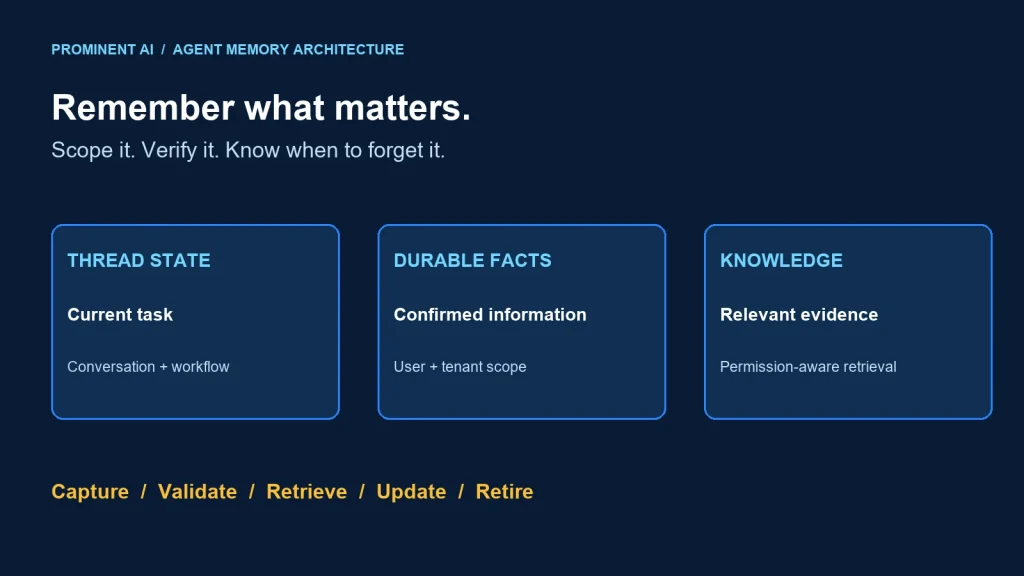
Production AI agent memory should distinguish temporary conversation state, durable user or workflow information and retrievable knowledge. These have different owners, lifetimes and access rules. A useful architecture stores only what the application needs, scopes every read and write to the right user or tenant, and provides a deliberate way to correct or forget information.
Memory does not have to mean copying every conversation into a vector database. For many applications, a small structured workflow record and a controlled knowledge source are better starting points. This guide proposes a memory design for an enterprise service assistant, with a lifecycle model, storage choices and failure tests.
Key decisions
- Keep workflow facts separate from model-generated summaries.
- Use thread state for the current interaction and structured stores for durable business facts.
- Use semantic retrieval when similarity helps find relevant information, not as an authorization mechanism.
- Attach provenance, ownership and expiry to information that persists.
- Design correction and deletion propagation before collecting long-term memory.
Short-term, long-term and semantic memory are different dimensions
“Short-term” and “long-term” describe how information persists. “Semantic” describes how meaning can be represented or searched. A semantic index can contain temporary data or durable documents. A durable memory can be a normal database row with no embeddings at all.
| Memory form | Useful contents | Typical boundary | Common mistake |
|---|---|---|---|
| Current context | Relevant messages and tool results for the next model request | One inference context | Including every past message whether useful or not |
| Thread state | Current task, selected record and workflow progress | One conversation or workflow | Using a predictable thread ID as the only access control |
| Durable profile or application memory | A confirmed preference or explicit long-running task fact | A defined user, tenant or business object | Turning an inferred preference into an authoritative fact |
| Semantic knowledge retrieval | Approved documents or indexed records | Source permissions and retrieval policy | Treating similarity as proof of permission or truth |
| Audit evidence | Decision and execution references | Restricted operational retention | Mixing audit requirements with personalization memory |
Framework terminology varies. For example, LangGraph distinguishes checkpointers for thread state from stores for cross-thread application data. That distinction can inform a design, but storage capability alone does not define who may read a record or how long it should remain.
A reference architecture for scoped memory
In the proposed enterprise assistant, a trusted application session establishes the user and tenant. A memory service receives that context, applies the intended scope and retrieves only relevant items. The prompt builder then combines allowed memory with current instructions and tool results. The model never chooses its own tenant boundary.
- Authenticate the request. Establish trusted user, tenant and workflow identifiers.
- Load structured state. Retrieve the permitted current workflow and explicitly confirmed preferences.
- Retrieve permitted knowledge. Apply source and record permissions before content is given to the model.
- Build a bounded context. Select relevant evidence, preserve source references and exclude expired information.
- Propose updates. Separate a model’s suggested memory from a validated durable update.
- Persist deliberately. Write only permitted fields with provenance, scope and lifecycle metadata.
Keep the memory service separate from the source-of-truth business system. A conversation summary saying “the customer is active” must not override an account record that now says “closed.” When freshness matters, query the authoritative service rather than rely on yesterday’s conversational memory.
A practical memory record
A useful application record could contain the following fields. This is an illustrative data contract, not a prescribed database schema.
{
  "memory_id": "mem-demo-001",
  "tenant_id": "tenant-demo",
  "subject_id": "user-demo",
  "kind": "confirmed_preference",
  "key": "report_format",
  "value": "summary_first",
  "source_ref": "preference-confirmation-demo",
  "status": "active",
  "version": 1,
  "expires_at": null
}
The absence of an expiry in an example does not justify indefinite retention. The application must define the lifecycle for each memory kind. Use server-controlled ownership fields and validate updates against the authenticated subject. Do not accept a model’s proposed tenant_id as proof that the write is authorized.
Design the memory lifecycle, not just the storage layer
Capture
Decide whether the information is needed at all. A temporary shipping address in a support interaction need not become a durable personalization fact. A confirmed output-format preference may be useful across sessions. Define the permitted fields and avoid storing unrelated conversation content by default.
Validate
Check source, scope and meaning. A user saying “my colleague prefers weekly reports” does not mean the current user prefers weekly reports. An agent’s inference should be marked as a suggestion or discarded rather than silently promoted to a confirmed fact.
Retrieve
Load the right scope and then rank for relevance. A broad similarity search followed by a model instruction to “ignore other tenants” is not isolation. The retrieval layer must prevent unauthorized material from entering the model context.
Use
Tell the application which items informed the response. A summary can compress conversation history, but should preserve important commitments and uncertainty. For consequential decisions, rely on original evidence and current business records rather than a compressed narrative alone.
Update and retire
Support versioning, correction, expiry and deletion. Propagate changes to derived indexes and caches. A memory should not reappear after being removed simply because an old summary is processed again as if it were new evidence.
Semantic retrieval: useful relevance, explicit isolation
Semantic retrieval helps find related material when exact words differ. It does not establish factual correctness, current validity or access rights. Use metadata and business authorization alongside any similarity calculation.
In our proposed design, a query carries a trusted tenant scope and allowed source set. The search service returns permitted candidates with source references. The application rejects expired or superseded items, then assembles the limited evidence needed for the task. Where permissions can change, choose an approach that enforces those changes before material reaches the model.
Separate knowledge from instructions
A remembered document or note can contain malicious instructions. Treat it as content to interpret, not a new policy for tool use or data access. It must not authorize a cross-tenant search, change a retention rule or create a new memory-writing capability. For related integration boundaries, see MCP architecture and enterprise security.
Use relevance budgets
Set a practical context budget for the task. More retrieved memory can increase distraction and processing cost without improving the answer. Compare a small set of relevant, current records with a larger noisy set using representative test questions. Report observed results only after running the experiment; there is no universal number of memories that fits every workflow.
Correction and forgetting must reach derived data
When a user corrects a preference or an owner retires a source document, identify every representation that can influence future responses: structured records, embeddings, summaries, caches and pending workflow state. Define which system is authoritative for each item and how changes propagate.
A practical correction path marks the old value as superseded, writes the validated new value and invalidates derived representations. A deletion path removes or makes the memory unavailable according to the application’s documented policy and retention requirements. Backups and restricted audit evidence may follow different processes; do not promise immediate erasure from every system unless that behavior is actually implemented and verified.
Test resurrection explicitly. Restore an old conversation checkpoint or replay a queued extraction job after a correction. The old value should not regain authority merely because it appears in historical text.
Worked example: a returning service assistant user
A fictional specialist returns to an unfinished incident review. The assistant needs the current workflow stage, the selected incident and the specialist’s confirmed preference for a summary-first answer. It does not need every previous ticket they have viewed.
- The application authenticates the specialist and verifies access to the workflow.
- Thread state identifies the unfinished review and its incident reference.
- The business API retrieves the incident’s current status, subject to permission.
- The memory service returns the confirmed presentation preference.
- The prompt builder includes relevant evidence and labels any previous summary as historical.
- If the specialist changes the preference, the application records a validated update rather than treating every sentence as a profile instruction.
If access to the incident was revoked, memory cannot restore it. If the incident was resolved while the specialist was away, the assistant uses the current business record. If the conversation summary is incomplete, the assistant can ask for clarification or load permitted source evidence instead of inventing missing decisions.
Memory architecture acceptance checklist
| Scenario | Expected behavior |
|---|---|
| User switches tenant | Previously loaded tenant information is not reused in the new scope |
| Another user guesses a workflow ID | Access is denied by authorization, regardless of identifier knowledge |
| A preference is corrected | The new confirmed value is used and the old value is superseded |
| Access to a source is revoked | Its content does not enter future model contexts through memory |
| A source document expires | Retrieval excludes it or clearly routes to a permitted current source |
| An old extraction task is replayed | It cannot overwrite a newer correction without validation |
| A stored note contains instructions | It cannot change security policy or grant tool authority |
| A worker restarts | Required durable workflow state survives; temporary state behaves as documented |
Evaluate task completion, incorrect personalization, stale facts, unauthorized retrieval and correction effectiveness. Test with data that includes ambiguous subjects and contradictory versions. Good memory improves continuity without making the system overconfident about what it remembers.
Common questions about AI agent memory
How should production AI agents store and forget information?
Does long-term memory require a vector database?
Is conversation history a reliable source of business truth?
Can a thread ID protect conversation memory?
Should an assistant remember every user message?
Plan memory around the task and its boundaries
Discuss an AI agent integration assessment with Prominent AI Services LLP. Bring the workflow, source-of-truth systems and information that genuinely needs to persist across interactions.
Technical reference reviewed 2 November 2026. The architecture and records are illustrative; no customer data was used.