
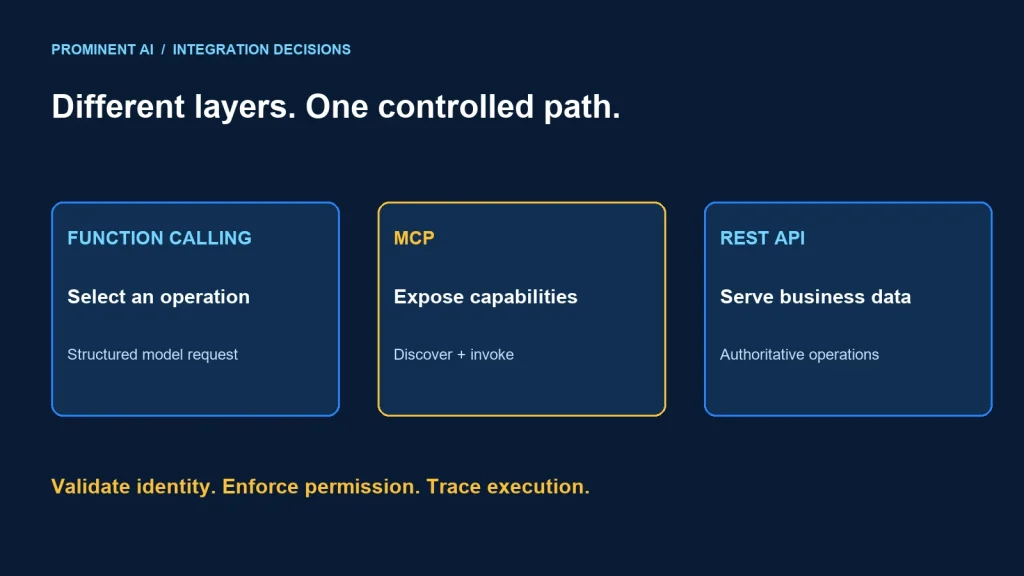
MCP, function calling and REST APIs usually belong at different layers of an AI integration. Function calling lets a model propose a structured operation. MCP supplies a common interface through which compatible applications discover and invoke capabilities. A REST API can remain the business-system interface that actually reads or changes a record. An enterprise application can use all three in the same request path.
The right decision is therefore which responsibilities need each interface, rather than which term should replace the others. This guide compares those responsibilities and works through a fictional customer-service integration, including an illustrative latency model and a decision checklist.
Quick answer: which should you choose?
- Use a direct API integration when a known application needs a small, stable set of business operations and a shared discovery layer would add little value.
- Use function calling when the model should select a defined operation and produce structured arguments, while application code validates and executes it.
- Evaluate MCP when approved capabilities should be exposed consistently to multiple compatible AI hosts or integration clients.
- Use a deterministic workflow when the execution sequence is already known and model discretion is unnecessary.
Three interfaces, three different responsibilities
Function calling: selecting a structured operation
For an application-defined client tool, the model produces a tool name and arguments; the application validates them, executes the operation and returns the result. The structured call is a request to execute, not permission to execute. Some providers also offer server-executed tools, which have a different execution owner. Anthropic’s tool-use documentation illustrates this distinction.
In our proposed design, function calling answers “Which approved lookup is relevant, and what ticket ID was requested?” It does not decide whether the user can access the ticket. That decision remains executable application policy.
MCP: exposing discoverable capabilities
An MCP host uses clients to communicate with servers that expose capabilities such as tools and resources. This gives compatible applications a common protocol interface. The server still needs to implement its own business adapter and enforce the intended access boundary. See the MCP architecture documentation.
In the example, MCP answers “How can an approved host discover and invoke the ticket lookup capability?” It does not determine how a model should reason, how a long-running workflow resumes or whether a refund should be approved.
REST APIs: accessing business resources
A REST-style enterprise API commonly exposes business resources through HTTP endpoints. That API can provide the authoritative ticket state, record permissions and supported update operations. HTTP defines request and response semantics; REST is an architectural style rather than a synonym for every HTTP endpoint. RFC 9110 is the reference for HTTP semantics.
In the proposed integration, the service-desk API answers “What is the permitted current state of this ticket?” It remains useful to non-AI consumers, including portals, mobile applications and ordinary workflows.
MCP vs function calling vs REST APIs: decision matrix
| Question | Function calling | MCP | Business REST API |
|---|---|---|---|
| Primary concern | Structured model-to-tool requests | Common capability discovery and invocation | Supported business resource operations |
| Typical contract | Tool name and argument schema | Protocol capabilities and tool/resource contracts | Endpoints, methods, payloads and errors |
| Execution owner | Your application for client tools; provider for provider-hosted tools | The server and its downstream adapters | The business service |
| Reusable across hosts? | May need provider or host adaptation | Designed for compatible clients; verify actual features | Reusable across many software consumers |
| Replaces authorization? | No | No | No; the API must implement it |
| Replaces workflow durability? | No | No | Not by itself |
| Good initial fit | An assistant choosing among bounded actions | Shared capabilities for several AI applications | Stable integration with an authoritative system |
Worked example: a customer-service ticket lookup
Imagine a company with a service-desk portal and two AI assistants. All need a ticket summary. The service-desk platform already has a supported API and permission model. The company must choose how much integration infrastructure it actually needs.
Option A: one assistant calls an application adapter
The assistant receives a narrow tool definition. The model proposes get_ticket_summary with a ticket ID. Application code validates the request, establishes the trusted caller, checks permission and invokes the service-desk API. This can be a sensible first implementation when there is one consumer and one maintained adapter.
The main advantage is a smaller component set. The trade-off is that another host may need its own integration wiring. Keep the business access logic in a reusable module so adding a second interface does not create a second, inconsistent permission implementation.
Option B: several hosts use a shared MCP capability
Each approved host connects to the reviewed MCP server. That server exposes the same ticket summary contract and delegates to the supported business API. Hosts still need correct identity handling, approved server configuration and a suitable policy for presenting or executing tools.
The potential benefit is shared integration maintenance at the capability boundary. The cost is a service with its own release process, monitoring, identity integration and compatibility testing. Confirm that both hosts support the features you need before presenting the shared adapter as portable.
Option C: an ordinary workflow uses the API directly
A scheduled process that checks overdue tickets and sends predefined reminders may not need a model at all. The sequence is known. An ordinary workflow can read the approved API and apply explicit rules. Adding an AI capability-discovery layer would be justified only by another concrete requirement.
These are illustrative design alternatives, not results from a client deployment. For a concrete permission-boundary example, see building a secure MCP server for enterprise APIs.
Latency and cost: compare equivalent request paths
Do not conclude that one interface is faster from its name. Draw the actual path, then measure discovery, model requests, network hops, permission checks and upstream calls. A local adapter and a cross-region shared service have different deployment costs even if their business function is identical.
For a simple sequential lookup, an illustrative accounting model is:
End-to-end time =
  model/tool-selection time
  + adapter and policy time
  + business API time
  + answer-generation time
  + any discovery or connection work on the critical path
For illustration only, suppose the four main terms are 400 ms, 40 ms, 120 ms and 500 ms. Their sum is 1,060 ms. If a shared remote adapter adds 30 ms of network time, the illustrative total becomes 1,090 ms, before any additional discovery work. These are arithmetic assumptions, not measured MCP or provider benchmarks.
A useful experiment compares the same question, model, API, permissions and deployment region. Record warm and cold behavior separately, and include failed calls and retries. For concurrent workflows, use trace spans on the critical path rather than blindly adding overlapping durations.
What belongs in the cost model?
- Model input and output consumption, including tool descriptions and repeated context.
- Hosting, network transfer and observability for adapters and shared services.
- Business API usage limits or charges where applicable.
- Engineering time for integration duplication, compatibility updates and incident response.
- Review effort for permissions, approvals and security-sensitive changes.
A shared adapter may reduce duplicated development without reducing model consumption. A direct integration may have lower operational overhead while becoming harder to maintain as consumers multiply. Quantify the actual expected consumers and changes instead of assuming reuse always wins.
Security and governance do not disappear at any layer
For all three approaches, identity and authority must survive the entire path. A model-produced argument must not establish the user’s tenant, role or approval status. A shared service should not turn a broad service credential into a universal data-access shortcut.
Use bounded contracts, trusted identity context and server-side record checks. Keep secrets out of model-visible arguments and errors. Treat retrieved text as untrusted content, and make write approval an executable policy bound to a particular proposed change. Review the MCP security guidance when an MCP server or proxy participates in the path.
Governance questions for an architecture review
- Which team owns the source of truth and its business rules?
- Which component validates the caller, and how is authority conveyed downstream?
- Can a capability access another tenant’s record or an arbitrary network destination?
- Can a write occur without the intended approval, or be repeated after a timeout?
- Can operators trace a failed request without exposing sensitive contents?
- Who maintains the tool contract when the model provider, host or business API changes?
A practical selection checklist
Start with the outcome. Write down the exact record to retrieve or operation to perform. If the task is deterministic, consider an ordinary workflow first. If language understanding helps select a bounded operation, add a model interface without giving the model unchecked execution authority.
Count real consumers. One assistant with a stable backend often does not need a shared service immediately. Several approved hosts that need the same maintained capabilities can justify evaluating MCP. Confirm compatibility through a small implementation, not a slide claiming universal interoperability.
Keep boundaries reusable. Place authorization and business access logic below the interface adapter. That lets a direct tool handler and an MCP server share the same reviewed rules rather than drift apart.
Test before expanding. Compare successful requests, denied access, missing records, upstream timeouts and incompatible schema changes. Record latency and operational effort alongside task quality. Choose the simplest design that meets the actual acceptance criteria.
Common questions
When is MCP preferable to function calling?
Does MCP replace REST APIs?
Does function calling automatically execute the model’s request?
Is MCP always slower than a direct integration?
Which option is best for a high-impact write operation?
Choose the integration around your business boundary
Discuss an AI agent integration assessment with Prominent AI Services LLP. Compare the intended consumers, permission model, operational ownership and acceptance criteria before introducing another service.
Technical references reviewed 2 November 2026. Example timings are declared assumptions, not measured performance results.