
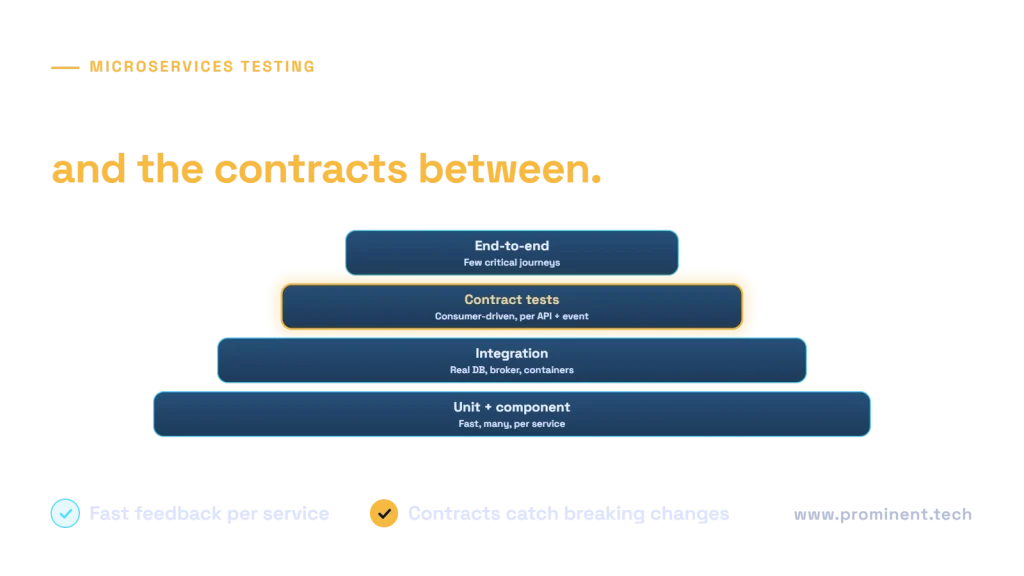
An effective microservices testing strategy combines many fast unit and component tests inside each service, integration tests against real dependencies such as databases and message brokers, consumer-driven contract tests between services, and a small number of end-to-end tests for critical user journeys, all backed by production monitoring. Contract testing is the key difference from monolith testing: it lets each team change and deploy its service independently while proving it has not broken the APIs and events other services depend on. Relying mainly on large end-to-end suites leads to slow, flaky pipelines that block independent releases.
Key takeaways
- Test most behaviour inside each service, where tests are fast and reliable.
- Use containers to run integration tests against real dependencies.
- Contract tests protect APIs and events between independently deployed services.
- Keep end-to-end tests few and focused on business-critical journeys.
- Production monitoring, canary releases and rollback complete the strategy.
Why microservices testing is different
In a monolith, a single build and test run can verify the whole system. With microservices, each service is built and deployed independently, communicates over the network through APIs and events, and often owns its own data. Failures move to the boundaries: a changed field name, a new required parameter, an event published in a different shape, or a timeout. Testing has to focus on those boundaries without requiring every service to be deployed together. For context on the architecture choice itself, see microservices vs monolithic architecture.
The testing layers
| Layer | What it checks | Runs | Typical tools |
|---|---|---|---|
| Unit | Business logic in isolation | Every commit, seconds | xUnit, NUnit, JUnit, Jest |
| Component | One service through its API with dependencies stubbed | Every commit, minutes | In-memory host, WireMock |
| Integration | Service with real database, cache or broker | Every commit or merge | Testcontainers |
| Contract | API and event compatibility between consumer and provider | Every commit on both sides | Pact, schema registries |
| End-to-end | Critical journeys across services | Before release, in staging | Playwright, API test suites |
| Production checks | Real behaviour under real traffic | Continuously | Synthetic monitoring, canaries, tracing |
Tools are examples, not recommendations for every stack.
Contract testing in practice
In consumer-driven contract testing, each consumer records the requests it makes and the responses it relies on. The provider verifies those contracts in its own pipeline. If a provider change would break a consumer, the provider’s build fails before deployment. The Pact documentation explains the approach in detail. For events, schema registries with compatibility rules play a similar role.
- Contracts only cover what consumers actually use, so providers can still evolve.
- Combine contracts with clear API versioning; see API versioning best practices.
- A “can I deploy?” check in the pipeline confirms compatibility with what is running in each environment.
Integration testing and service virtualization
Integration tests run a service against real infrastructure, typically started in containers for each test run, so database queries, migrations and message handling are exercised for real. Testcontainers is a common way to do this. Other services are replaced with stubs or virtualized services, so the test does not depend on their availability.
Test the hard distributed cases deliberately: retries and duplicate messages (see idempotency in distributed systems), timeouts and partial failures in multi-step workflows (see saga pattern vs two-phase commit), and out-of-order events (see event-driven architecture).
End-to-end tests: fewer, better
End-to-end tests are slow, need many services deployed together and fail for reasons unrelated to the change. Keep a small suite covering the journeys that matter most, such as sign-up, checkout or payment, and make them reliable rather than numerous. Martin Fowler’s article on testing strategies in a microservice architecture is a good reference for the balance.
Putting it in the pipeline
Release safely with progressive delivery and quick rollback; see blue-green vs canary deployments and Azure DevOps vs GitHub Actions.
Common questions
What is the best testing strategy for microservices?
Many unit and component tests per service, integration tests with real dependencies in containers, consumer-driven contract tests between services, a few end-to-end tests and production monitoring.
What is contract testing?
A way to verify that a service provider still meets the expectations of its consumers, by checking recorded consumer contracts in the provider’s pipeline.
Do we still need end-to-end tests?
Yes, but only a few, for critical journeys. Most defects should be caught earlier by faster tests.
How do you test asynchronous events?
Use message contracts or schema compatibility checks, integration tests with a real broker in containers, and tests for retries, duplicates and ordering.
How do you test microservices that share data?
Ideally each service owns its data. Where data is shared, add contract or schema checks on the shared structures and test migrations carefully.
Build a microservices test strategy that speeds up releases
Our software development and DevOps teams set up contract, integration and pipeline testing so your teams can deploy services independently with confidence.