
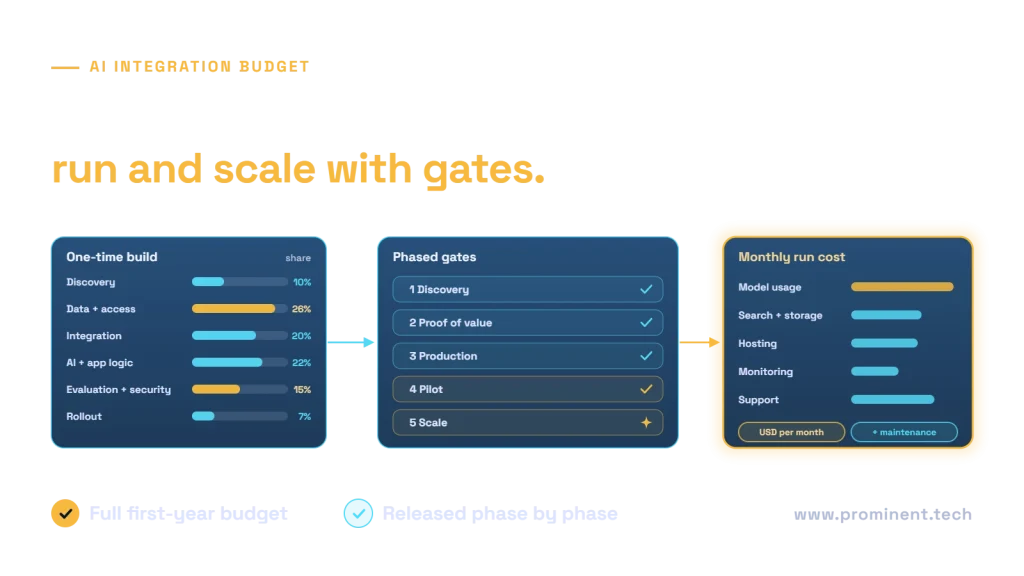
For a mid-market company, a custom AI integration typically costs between US$25,000 and US$60,000 for a single, well-scoped workflow, US$60,000 to US$150,000 for a multi-system production rollout, and US$150,000 to US$400,000 or more for a shared AI platform serving several use cases. Running costs come on top: model usage, search and hosting, monitoring and support usually add US$1,000 to US$15,000 a month, plus about 15 to 20 percent of the build cost each year for maintenance. These are indicative planning ranges, not a quote. The real figure depends on how ready your data is, how many systems the AI must reach and how much risk control the use case needs.
Key takeaways
- Scope drives custom AI integration cost more than the choice of model. The number of systems, data sources and user groups matters most.
- Data preparation and access control typically take 20 to 30 percent of the build budget and are the most common source of overruns.
- Budget for the first year, not just the build: add 12 months of running costs, maintenance and a 10 to 15 percent contingency.
- Release budget in phases with measurable gates, so a weak use case stops early and cheaply.
- Compare vendor quotes on the same scope, assumptions and acceptance criteria, not on the headline number.
Custom AI integration cost: indicative ranges by scope
“Custom AI integration” covers very different projects. Adding a document assistant to an intranet is not the same as embedding AI decisions into an order-to-cash process across a CRM and an ERP. The fairest way to estimate custom AI integration cost is by scope tier. The table below uses typical mid-market projects delivered by a blended onshore and offshore engineering team.
| Scope tier | Typical example | Indicative build cost (USD) | Typical timeline |
|---|---|---|---|
| Focused workflow | An assistant that answers questions from one document library, or summarizes and routes incoming emails, with one system connection | $25,000 – $60,000 | 6 – 10 weeks |
| Multi-system production | AI embedded in a CRM or service desk, reading from two or three systems, with SSO, audit logs and human review | $60,000 – $150,000 | 3 – 5 months |
| Shared AI platform | An AI gateway, shared retrieval layer and evaluation pipeline serving several departments and use cases | $150,000 – $400,000+ | 6 – 12 months |
The ranges are wide on purpose. Two projects that sound the same can differ by a factor of two once the data and integration audit is done. For example, a document assistant over clean, well-permissioned SharePoint content is much cheaper than one over scanned PDFs with inconsistent access rights. Treat these numbers as a way to test whether a proposal is in a sensible band, then get a scoped estimate.
Where a custom AI integration budget actually goes
Many buyers expect the AI model to be the main cost. In practice, model work is usually less than a quarter of the build. Most of the effort goes into connecting the AI to your data and systems safely, and proving that it works.
Discovery and solution design
Discovery confirms the use case, the measurable outcome, the data sources, the systems involved and the risks. A good discovery phase produces an architecture, a test plan and a firm estimate for the next phase. Skipping it is the most expensive way to save money, because scope problems surface later during the build.
Data preparation and access
AI can only be as good as the information it can reach. This work covers cleaning and structuring documents, removing duplicates, mapping fields between systems and, critically, carrying user permissions into the AI layer so that people only see answers drawn from content they are allowed to read. Our guide to data cleaning and preprocessing covers this stage in more depth.
System integration
Integration effort grows with every system the AI reads from or writes to. Modern systems with documented APIs, such as Microsoft 365, Salesforce or Dynamics, are faster to connect. Older systems without APIs may need middleware, database views or an event layer. If you are weighing integration styles, see point-to-point vs ESB vs iPaaS vs event-driven integration.
AI and application logic
This is the part most people picture: prompts, retrieval, tool calls, workflow logic and the user interface. Using a managed model API keeps this phase relatively contained. Fine-tuning or hosting your own models adds cost, and is only worth it when evaluation shows a clear need.
Evaluation, security and testing
A production AI feature needs a test set of real examples with expected outcomes, automated regression checks for every prompt or model change, and security testing against risks such as prompt injection and data leakage. The OWASP Top 10 for LLM Applications is a useful checklist for this stage.
Running costs after launch
The build is a one-time cost. Running costs continue for as long as the integration is in use, and they grow with adoption. Plan for these lines from the start.
| Cost line | What drives it | Indicative monthly range (USD) |
|---|---|---|
| Model usage | Number of requests, prompt and response length, model tier | $200 – $8,000 |
| Search and vector storage | Volume of indexed content, query load, managed service tier | $100 – $2,500 |
| Application hosting | Compute, networking, environments (dev, test, production) | $200 – $2,500 |
| Monitoring and logging | Trace volume, retention period, alerting | $50 – $800 |
| Support and improvement | Prompt tuning, new data sources, incident handling | Usually 15 – 20% of build cost per year |
Model prices change often and differ by provider and region, so check current rates on the official pages, such as Azure OpenAI pricing and OpenAI API pricing, and model your own volumes in the Azure pricing calculator. For techniques that cut model spend, see LLM inference cost optimization and RAG cost optimization.
Hidden cost drivers mid-market teams miss
When AI integration projects overrun, the cause is rarely the model. These are the cost drivers that most often appear late.
- Permission-aware retrieval. If answers must respect existing access rights, the AI layer has to enforce them on every query. This is essential and takes real engineering time.
- Unstructured or low-quality source data. Scanned documents, duplicated versions and missing metadata need cleanup before the AI can use them reliably.
- Systems without APIs. Legacy applications may need an integration layer before AI can read or write data. Our legacy software modernization team often starts here.
- Human review workflows. High-impact decisions need a review step, a queue and an audit trail. That is product work, not just AI work.
- Evaluation data. Someone has to build and maintain a test set of real cases with expected answers. Subject-matter experts’ time is a real cost.
- Compliance and security reviews. Data protection impact assessments, vendor reviews and penetration tests take calendar time and budget, especially in regulated sectors.
- Change management. Training, guidance and support for users decide whether the investment is actually used.
The NIST AI Risk Management Framework is a practical reference for deciding which of these controls your use case needs, and therefore how much of this work to budget.
A first-year budget model for custom AI integration
A credible business case shows the full first-year cost, not only the build quote. Use this simple model:
First-year cost = build + (monthly running cost × 12) + maintenance (15–20% of build) + contingency (10–15% of build)
Here is an illustrative, fictional example for a multi-system service-desk assistant:
| Line | Assumption | Amount (USD) |
|---|---|---|
| Build | Service desk, knowledge base and CRM integration with SSO and review queue | $95,000 |
| Running cost | $2,400 a month for model usage, search, hosting and monitoring | $28,800 |
| Maintenance | 15% of build for prompt tuning, fixes and small changes | $14,250 |
| Contingency | 10% of build for scope discovered during delivery | $9,500 |
| First-year total | $147,550 |
To judge return on investment, compare that total with a measured benefit, such as agent minutes saved per ticket multiplied by ticket volume and loaded cost per minute. Measure the benefit during the pilot rather than assuming it.
How to reduce custom AI integration cost without cutting quality
- Start with one high-value workflow. A narrow first release proves value faster and creates reusable components, such as identity, logging and retrieval, for later use cases.
- Gate the budget. Fund discovery and a proof of value first. Release the production budget only when the proof meets agreed measures.
- Reuse what you have. Existing APIs, an existing identity provider and managed cloud services are cheaper than building new infrastructure.
- Use the smallest model that passes evaluation. Route simple requests to cheaper models and reserve the most capable models for hard cases. See small vs large language models for enterprise AI.
- Prefer retrieval over fine-tuning at first. Retrieval-augmented generation is usually cheaper to build and to keep current. Our comparison of RAG vs fine-tuning vs prompt engineering explains when each fits.
- Automate evaluation early. A regression test set catches quality drops before users do, which saves expensive rework.
How to compare AI integration quotes like for like
Quotes for the same idea can vary several-fold because vendors assume different scopes. Before comparing prices, check that every proposal answers the same questions:
| Question | Why it matters |
|---|---|
| Which systems and data sources are in scope? | Each additional system adds integration and testing effort |
| Does the quote include data cleanup and permissions? | This is the most commonly excluded and most expensive item |
| How will quality be measured before go-live? | Without a test set and acceptance criteria, “done” is undefined |
| Which security and compliance activities are included? | Prompt-injection testing, logging and data protection reviews take time |
| What are the estimated monthly running costs? | A cheap build with expensive running costs can cost more in year one |
| Who owns the code, prompts and evaluation data? | Ownership affects future vendor flexibility and maintenance cost |
| What happens after launch? | Support, monitoring and improvement should be priced, not assumed |
A vendor who cannot answer these questions has not yet understood your project, whatever the price.
Common questions
How much does custom AI integration cost for a mid-market company?
Indicatively, US$25,000 to US$60,000 for one focused workflow, US$60,000 to US$150,000 for a multi-system production rollout, and US$150,000 to US$400,000 or more for a shared AI platform. Monthly running costs and annual maintenance are additional.
What is the biggest driver of AI integration cost?
Scope: the number of systems and data sources the AI must reach, the quality of that data and the level of control the use case needs. Model choice usually matters less than these factors.
Is it cheaper to use an off-the-shelf AI tool?
Often yes, if the tool fits your workflow and data without heavy customization. Custom integration pays off when AI must work inside your own systems, follow your rules or use proprietary data.
How long does a custom AI integration take?
A focused workflow typically takes 6 to 10 weeks, a multi-system rollout 3 to 5 months, and a shared platform 6 to 12 months, including discovery and testing.
How can we keep AI running costs predictable?
Set usage budgets and alerts, route requests to the smallest model that meets the quality bar, cache repeated answers and review cost per transaction every month.
Plan your AI integration budget with confidence
Bring your use case, the systems involved and your target outcome. Our enterprise AI integration and API and system integration teams can turn them into a phased plan with a scoped estimate and clear go or no-go gates.