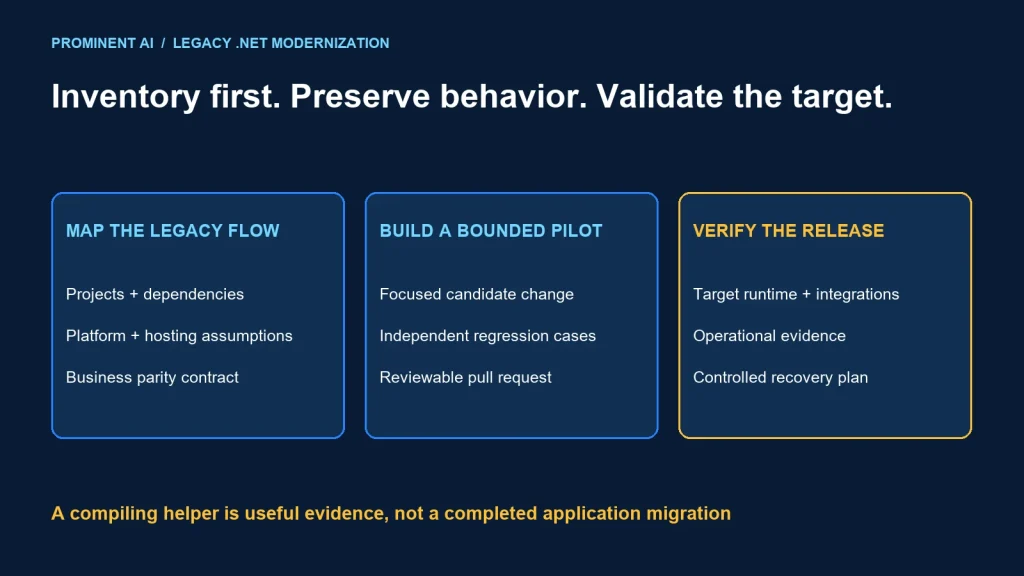
Codex can assist .NET modernization by mapping dependencies, proposing bounded changes and building regression evidence for human review. Start with a representative application flow and a compatibility inventory. Do not treat a target-framework edit or a successful compile as proof that a legacy application has been migrated correctly.
Key takeaways
- Separate framework migration, behavior-preserving refactoring and feature change.
- Inventory Windows-specific and third-party dependencies before choosing the target architecture.
- Build parity tests around important business behavior.
- Keep changes in focused pull requests with explicit limitations.
- Validate deployment, identity and operational behavior in the intended environment.
Inventory the real modernization boundary
Microsoft’s .NET Framework porting overview explains that compatibility depends on the APIs and technologies the application uses. Some dependencies remain Windows-specific or require replacement. Referencing a library successfully does not establish runtime compatibility.
| Area | Evidence to collect | Decision to make |
|---|---|---|
| Projects and targets | Project types, target frameworks and build chain | Migration order and target |
| Packages and binaries | Direct/transitive packages and external assemblies | Compatible version, replacement or isolation |
| Platform APIs | Windows services, registry, UI and other OS assumptions | Stay on Windows or redesign the dependency |
| Hosting and identity | Web/batch entry points, authentication and configuration | Target hosting and access model |
| Data and integrations | Database behavior, external contracts and side effects | Parity, compatibility and recovery requirements |
Ask Codex to produce an inventory with file references and unresolved questions. Review the evidence rather than accepting a generic list of recommended technologies. A legacy application can depend on deployment scripts and scheduled jobs that are not visible in the main project file.
The Windows Compatibility Pack guidance describes support for additional APIs and the need to analyze platform compatibility. Adding the package does not make every Windows-dependent application cross-platform.
Choose one flow and define parity
A fictional support application might begin with a status-label helper, then a read-only request query, before attempting a hosting or identity migration. Pick a flow with clear input/output evidence and manageable external dependencies.
Define what “same behavior” means: response shape, ordering, null handling, culture, error behavior and relevant side effects. Record any intentional behavior change separately. A cleaner implementation that changes a customer-visible rule is not automatically a successful refactor.
OpenAI’s modernization cookbook describes a bounded pilot, explicit design and parity-oriented validation. Adapt that planning pattern to .NET while keeping the framework-specific compatibility work grounded in Microsoft’s guidance. The cookbook is not evidence that every legacy stack can be upgraded automatically.
Legacy flow + dependency inventory
             ↓
Reviewed target and parity contract
             ↓
Bounded Codex task in isolated development workspace
             ↓
Candidate implementation + regression evidence
             ↓
Human PR review + integration/deployment validation
             ↓
Controlled release and operational comparison
A practical Codex development workflow
- Establish the baseline: preserve existing work and record the repository commit, build results and known failures.
- Map the pilot: identify relevant projects, APIs, dependencies and external effects.
- Approve the target: decide framework, platform and compatibility boundaries.
- Write parity cases: define expected outputs independently of the candidate implementation.
- Delegate a focused change: constrain files, dependencies, tool access and permitted behavior changes.
- Verify and review: inspect the diff, actual checks and remaining uncertainty.
- Rehearse deployment: validate the target environment before production promotion.
A proposed task prompt is:
Review the status-label helper and its callers. Propose a small
modernization preserving null, whitespace, casing and unknown-state
behavior. Use the supplied parity fixtures. Do not change APIs,
dependencies or deployment configuration outside the approved scope.
Implement the reviewed change, run the available checks and report
exact results and limitations. Do not claim a full framework migration.
This is a reusable prompt recipe, not a claim that a production repository was ported for the article. Keep repository instructions and build commands current. Review any new dependency or broadened permission separately.
A runnable C# parity example
We compiled and ran a .NET 10 console fixture comparing a legacy-style helper with a switch-expression implementation. Both trim and normalize the supplied state, map READY and BLOCKED, and return Unknown otherwise.
static string LegacyLabel(string? state)
{
    if (state == null) return "Unknown";
    var value = state.Trim().ToUpperInvariant();
    if (value == "READY") return "Ready for review";
    if (value == "BLOCKED") return "Needs attention";
    return "Unknown";
}
static string ModernLabel(string? state) => state?.Trim().ToUpperInvariant() switch
{
    "READY" => "Ready for review",
    "BLOCKED" => "Needs attention",
    _ => "Unknown"
};
var cases = new (string? Input, string Expected)[]
{
    (null,"Unknown"),(" ready ","Ready for review"),("BLOCKED","Needs attention"),
    ("","Unknown"),("unexpected","Unknown"),("Ready","Ready for review")
};
foreach (var test in cases)
    if (LegacyLabel(test.Input) != test.Expected || ModernLabel(test.Input) != test.Expected)
        throw new Exception("Parity fixture failed");
Console.WriteLine("6 parity cases passed on .NET 10; no .NET Framework application ported");
The project uses net10.0, nullable analysis and no external packages. Save the code above as Program.cs in that console project and run dotnet run --project Lab.csproj after placing the helper and expected cases in the console project.
| Input | Expected result in both implementations |
|---|---|
| null | Unknown |
| Whitespace around ready | Ready for review |
| BLOCKED | Needs attention |
| Empty string | Unknown |
| Unexpected state | Unknown |
| Ready with mixed case | Ready for review |
All six cases passed. Both implementations ran on the modern runtime; this does not test an original .NET Framework binary, framework compatibility, hosting, database behavior or a full application migration. It demonstrates a narrow parity gate that can support a larger modernization process.
Real parity cases should include the application’s actual edge conditions. Culture-sensitive parsing, serialization and time handling deserve explicit tests when relevant.
Review pull requests for compatibility and evidence
Keep framework changes and business changes separable where feasible. Review project files, package resolution, configuration and deployment artifacts as well as C# source. A small code diff can rely on a large environmental change.
Check whether the assistant removed code because it appeared unused without tracing reflection, configuration or scheduled entry points. Ask for evidence of callers and runtime use, then validate the proposed removal.
Review generated tests and expected values. Require a clear account of checks that ran, checks that were blocked and compatibility questions still open. Do not convert a model summary into a migration sign-off.
The spec-driven guide provides requirement-to-test traceability, while the code-security checklist covers review of dependencies and access boundaries.
A deployment and recovery checklist
- Target runtime and hosting prerequisites are verified.
- Platform-specific dependencies are tested in the target operating system.
- Identity, secrets and configuration are resolved through approved mechanisms.
- Database and external-system behavior is validated with representative fixtures.
- Public contracts and important user flows pass acceptance checks.
- Telemetry explains failed operations without exposing sensitive data.
- Artifact, release approval and recovery decision owner are recorded.
- Data changes and external effects have their own recovery plan.
Do not assume a source revert restores changed data or reverses an external operation. Rehearse recovery for the actual release. Compare the modernized flow in a controlled environment before expanding the migration boundary.
Common questions
How can Codex assist with legacy .NET upgrades?
It can help inventory dependencies, explain code, propose focused changes and draft regression tests. Engineers must review compatibility, architecture and release evidence.
Is changing the target framework enough?
No. APIs, packages, hosting, platform assumptions and runtime behavior still need validation.
Does the Windows Compatibility Pack make an app cross-platform?
No. Some supported APIs remain Windows-specific. Analyze and test the actual platform dependencies.
What should parity testing cover?
Important inputs, outputs, errors and side effects, including relevant null, culture, serialization and ordering behavior.
Was a full .NET Framework application migrated here?
No. The local example compiled two helper implementations on .NET 10 and passed six parity cases.
Modernize through a bounded pilot and verified behavior
Bring the application inventory, compatibility concerns and a representative flow. Discuss AI-assisted engineering adoption with a practical modernization plan.