
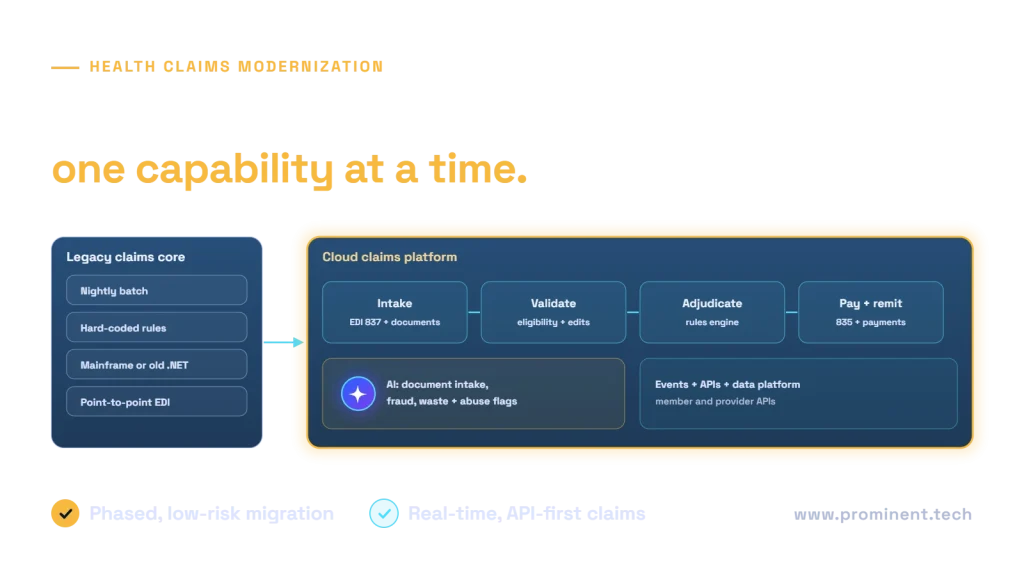
Cloud modernization for health insurance claims systems replaces nightly batch processing, hard-coded rules and point-to-point EDI with an API-first, event-driven claims platform in the cloud: claims intake, validation, adjudication, payment and remittance become separate, scalable services with a configurable rules engine, a data platform for analytics and AI, and the APIs regulators and partners now expect. Because claims systems are business-critical and regulated, modernization works best in phases, starting with intake and data, then moving adjudication capabilities one line of business at a time, with parallel running and reconciliation until each phase is proven.
Key takeaways
- Modernize claims in capabilities, not in one big replacement.
- Start with intake and data: they deliver value quickly and reduce later migration risk.
- Externalise adjudication rules into a configurable engine owned by the business.
- Keep HIPAA transaction standards and interoperability APIs at the centre of the design.
- Run old and new adjudication in parallel and reconcile results before switching each line of business.
Why health insurers modernize claims systems
- Speed. Members and providers expect real-time status, not overnight batches.
- Agility. Benefit and policy changes take months when rules are hard-coded.
- Cost. Legacy infrastructure, licences and scarce skills keep rising. See the cost of delaying modernization.
- Interoperability. Regulations such as the CMS Interoperability and Patient Access rule require standards-based APIs for many US payers.
- AI readiness. Fraud, waste and abuse detection and document automation need modern data access.
Target cloud claims architecture
| Component | Role |
|---|---|
| EDI and API gateway | Receives claims (X12 837), sends remittances (835) and exposes status and member APIs |
| Intake and document AI | Captures paper and attachments, extracts data, routes exceptions |
| Validation services | Eligibility, provider, coding and duplicate checks |
| Rules engine | Configurable benefit, pricing and adjudication rules with versioning |
| Payment and remittance | Payment calculation, finance integration, remittance advice |
| Event backbone | Publishes claim lifecycle events to downstream systems |
| Data platform | History, analytics, reporting and AI features |
A phased claims modernization roadmap
Each phase follows the strangler pattern: new services take over one capability while the legacy core continues to handle the rest. See migration patterns and, for the infrastructure move itself, zero-downtime cloud migration.
Standards and compliance
- HIPAA transaction standards. Claims, eligibility and remittance transactions follow adopted standards and operating rules based on X12.
- Privacy and security. Claims data is PHI; apply HIPAA safeguards, BAAs and audit logging. See HIPAA-compliant applications.
- Interoperability APIs. FHIR-based member and provider APIs where required. See FHIR API integration.
- Auditability. Every adjudication decision traceable to the rule version and data used.
Where AI fits in modern claims
- Document AI for attachments and paper claims.
- Fraud, waste and abuse detection with investigator review.
- Prediction of claims likely to pend or be denied, so issues are fixed earlier.
- Assistants that help staff find policy and benefit rules.
Our guide to AI in insurance claims processing covers these use cases in more depth.
Risks and how to manage them
- Payment errors: parallel adjudication with automated reconciliation before switching each line of business.
- Hidden rules: rule extraction workshops and characterization tests on historical claims.
- Partner disruption: keep EDI endpoints stable and test with trading partners early.
- Data migration: migrate open claims carefully and keep history accessible for appeals.
Common questions
How long does claims system modernization take?
Typically two to four years for a full platform, delivered in phases that each provide value within six to twelve months.
Should we replace the claims system with a packaged product?
Sometimes. Packaged platforms suit standard products; custom or hybrid approaches suit differentiated products or complex integrations. Compare total cost and fit.
Can claims processing run in the public cloud?
Yes, with HIPAA safeguards, BAAs and appropriate controls. Many payers run core workloads in the cloud.
Where should a health insurer start?
Usually with claims intake and a modern data platform, which deliver quick wins and make later adjudication migration safer.
How do we avoid paying claims incorrectly during migration?
Run new and legacy adjudication in parallel, reconcile results automatically and switch lines of business only when differences are explained.
Plan your claims modernization
Share your current claims platform, lines of business and priorities. Our legacy modernization and cloud teams will design the target architecture and a phased roadmap with parallel running and reconciliation built in.