
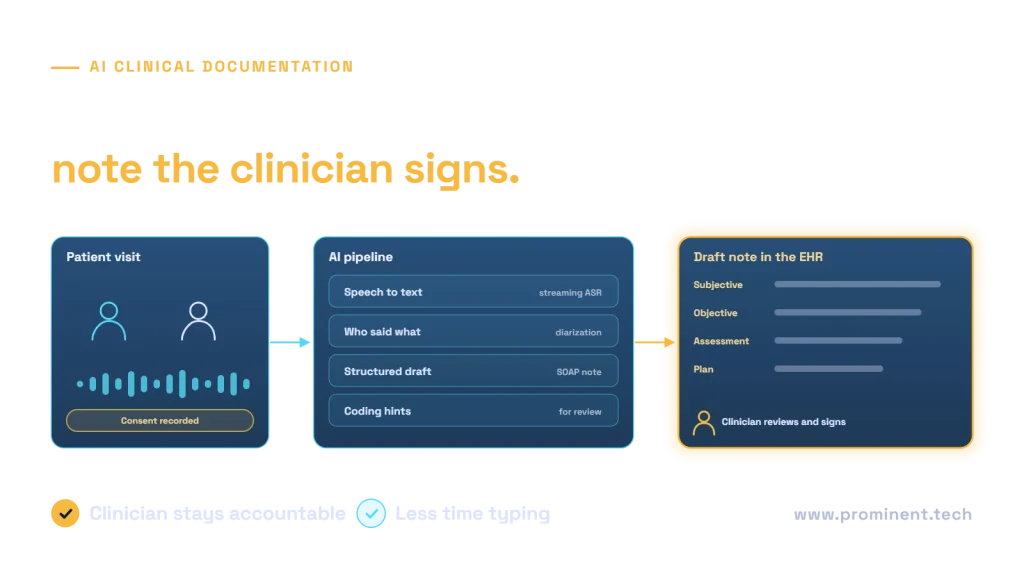
AI for clinical documentation turns the clinician-patient conversation, dictation or chart data into a structured draft note, such as a SOAP note, that the clinician reviews, edits and signs in the EHR. The most common approach today is the ambient scribe: with the patient’s consent, audio is captured, transcribed by speech recognition, separated by speaker, and summarised by a language model into the organisation’s note template, then written to the EHR as a draft. Done well, it reduces after-hours charting; done badly, it introduces omissions or invented details. Clinician review, evaluation on real encounters, privacy safeguards and workflow fit determine which outcome you get.
Key takeaways
- AI clinical documentation produces drafts; the clinician remains the author and signs the note.
- Speech recognition quality, speaker separation and template design drive note quality.
- Evaluate on real encounters across specialties, measuring omissions and unsupported statements.
- Consent, PHI safeguards and BAAs are prerequisites, not add-ons.
- Measure time saved per encounter and clinician satisfaction in a pilot before scaling.
Types of AI clinical documentation
| Type | What it does | Best for |
|---|---|---|
| Ambient scribe | Listens to the visit and drafts the note | Outpatient and emergency encounters |
| Dictation with structuring | Turns clinician dictation into a structured note | Specialists who already dictate |
| Chart summarisation | Summarises prior notes, results and history before a visit | Complex patients, handovers |
| Coding suggestions | Suggests diagnosis and procedure codes from the note | Coding teams, with review |
| Patient message drafts | Drafts replies to patient portal messages | High-volume inbox work |
How an AI ambient scribe works
Audio is captured on a device in the room and streamed securely for transcription. Speech recognition must handle medical vocabulary, accents and background noise; see speech-to-text architecture. Speaker diarization separates clinician from patient so statements are attributed correctly; see speaker diarization explained. A language model then drafts the note in the organisation’s template, and the draft is written to the EHR, for example as a FHIR DocumentReference or through the vendor’s note interface, for the clinician to finalise. Integration patterns are covered in healthcare AI and EHR integration.
Quality risks and how to evaluate them
| Risk | Example | Mitigation |
|---|---|---|
| Omission | A reported symptom missing from the note | Template prompts per section; recall-focused evaluation |
| Unsupported statement | An exam finding that was never mentioned | Grounding to the transcript; flag uncertain content |
| Misattribution | Patient’s statement recorded as the clinician’s | Diarization quality checks |
| Transcription error | Wrong drug name or dose | Medical vocabulary tuning; highlight medications and doses for review |
| Inconsistent style | Notes that do not match specialty norms | Specialty-specific templates |
Evaluate with clinicians on a representative set of real or simulated encounters across specialties, scoring completeness, accuracy and edit effort. Re-run the evaluation whenever models or templates change.
Consent, privacy and safeguards
Inform patients and obtain consent according to your organisation’s policy and local law. Treat audio, transcripts and drafts as PHI, use vendors under BAAs, decide retention periods for audio and transcripts, and confirm that data is not used to train vendor models without authorisation. See HIPAA-compliant AI applications and healthcare data governance.
Workflow and adoption
- Start recording with one tap inside the EHR or on an approved device.
- Deliver the draft within minutes of the visit so it can be reviewed while memory is fresh.
- Let clinicians edit quickly and give feedback that improves templates.
- Offer specialty-specific templates and allow opting out for sensitive visits.
- Train clinicians on what to check, especially medications, doses and plans.
Measuring results
- Documentation time per encounter and after-hours charting time.
- Edit rate and types of edits made to drafts.
- Note completeness and quality audits.
- Clinician satisfaction and burnout survey measures.
- Patient experience feedback.
Voice-driven workflows also extend beyond the clinic; see voice AI agents architecture.
Common questions
What is AI clinical documentation?
The use of speech recognition and language models to draft clinical notes, summaries or codes from conversations, dictation or chart data, which clinicians then review and sign.
Is an AI scribe accurate enough for clinical notes?
It can produce useful drafts, but omissions and unsupported statements occur. Clinician review is essential and accuracy should be evaluated on your own encounters.
Do patients need to consent to ambient recording?
Organisations typically inform patients and obtain consent in line with their policies and applicable law. Provide an easy way to opt out.
How does the note get into the EHR?
Usually as a draft through the EHR vendor’s note interface or a standards-based API, for the clinician to edit and sign.
How much time can AI clinical documentation save?
It varies by specialty and workflow. Measure documentation and after-hours time before and during a pilot rather than relying on general claims.
Bring AI documentation into your clinical workflow
Share your specialties, EHR and documentation pain points. Our healthcare and conversational AI integration teams will design and pilot an AI documentation workflow with clinician review and HIPAA safeguards built in.